Eighth Grade

Eighth-Grade-movie-2018.jpg

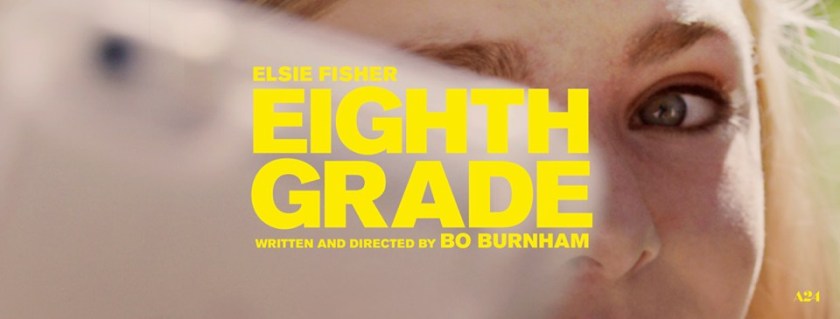
Eighth Grade is a masterpiece. It’s a simple as that. I don’t know what’s in the water that writer director Bo Burnham is drinking but I would like to splash a little on my neck. Actually Burnham is known as a YouTube star though I am unfamiliar with his early work or later TV work. He has a following. And with Eighth Grade, it’s apparent why. While chronicling the life and times of 13 year old Kayla Day (Elise Kate Fisher) you never feel imposed upon. There is never some heavy hammer here. Just like social media itself, like a snake, it slowly envelops its prey and before you know it, you can…not…breathe.

My experience watching Eighth Grade was almost as terrifying as watching A Quiet Place, the awkwardness revealed in the film hits the highest of pitched levels. At times I wanted to cover my eyes. I certainly do not envy kids today or their parents — of which I am one. I think the real triumph of the film is that it can at one hand painfully and accurately represent the struggle of this age and at the same time entertain the audience every step of the way. Having us wonder what on earth will happen next. 

The construct of the paradoxically shy YouTuber is a brilliant intro to Kayla. Meanwhile, her earnest dad (Josh Hamilton) is trying to get through to her, like paddling out against a set of twenty foot waves. And yet you can sympathize with both people. With just wanting to be left alone, with just needing to connect with someone in real life. The social media montages are brilliantly conceived and executed. The audio was screaming as loud as the Tamil language Indian films that get blasted at Marcus Cinema here in Mid-America…we were unsure if this was on purpose but it certainly would make sense if it was. 

I can’t understand why this film is rated R. Kids today eat expletives (Fuck, okay? Fuck.) for breakfast. Frankly, this rating is a form of censorship and I think the MPAA should get off its high horse. The MPAA standards are uneven and need to evolve. Regardless, kids will be watching this film on their iPhones soon enough. I did read that there will be an MPAA approved version that 13 year olds can watch in the theater, which would be great. 

I highly recommend to anyone Eighth Grade. Bring your kids. God forbid it may start an actual conversation.  

BlacKkKlansman

BlacKkKlansman-true-story-Spike-Lee-movie-how-much-is-true-1001111.jpg

BlacKkKlansman, a Spike Lee Joint. Spike Lee has had a profound effect on me and was a true inspiration for my getting involved in filmmaking. And even though BlacKkKlasman is not wholly written by Spike Lee it has every element, including sho nuffs, to make the viewer understand this is the work of the great cinematic auteur, Spike Lee. His strength for me is the mixing of theatricality, graphics and traditional narrative conventions. There is also always something kind of off in a Spike Lee joint. The characters are not all developed, but purposefully caricatured. He paints many of his characters with broad strokes. He concentrates on his leads, their lives, their mistakes and passions. Everyone else is just a satellite to these stars.

One thing you notice immediately in a Spike Lee joint is the intense and beautiful score by constant collaborator Terence Blanchard. Terence Blanchard is a musical genius and has scored every Lee film since 1991’s gem Jungle Fever. Also, you will notice the ensemble cast. Lee uses many of the same actors in his films, sometimes I find this distracting but at the same time I think it’s cool and works. Ultimately, Spike Lee puts his style, his stamp, over just about anything else in his films. This might be an effect of his commercial work but it’s there. In Lee you find strange situations like a woman dancing not long after she is attacked by a police officer. Or strange cuts that don’t make sense, like jump cuts that seem to be simply editing errors. But again, it’s a Spike Lee joint. It’s a living organic work. In Hitchcock it’s the over the top exactitude that’s the style. And his films can be said to suffer for that too—however others love it. It’s what makes Hitchcock, Hitchcock. And the same can be said for Lee.

BlacKkKlansman includes strong performances by John David Washington (yes, the son of that Washington) and Adam Driver but the most emotional part of the film is the document at the end which chronicles the assassination of Heather Heyer by a white nationalist Nazi during a peaceful protest in Charlottesville, Virginia on August 12, 2017. It’s not just a social document for its own sake but it ties together brilliantly the naiveté of the protagonist, Ron Stallworth, in this 1970’s period piece and his assumption that America had moved forward and that its race relation problems were in the rear view mirror. As the first black detective in the Colorado Springs PD he explains to a lieutenant in a back hallway at the police station how America would never again elect a racist president.

As a nation, we shouldn’t take films like BlacKkKlansman for granted. I am glad that it was screened here in my little corner of Wisconsin. Maybe the letters I send the movie chain about screening indie films are working? I don’t know but I am grateful I was able to watch this important film on the big screen and I recommend you do too if you have the chance.

Mission: Impossible — Fallout

mission-impossible-fallout.jpg

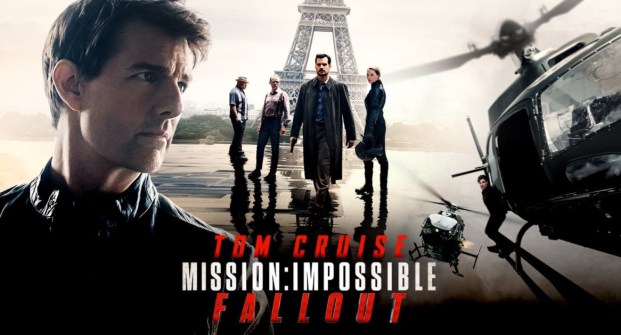
Let’s talk about Mission: Impossible— Fallout. You might say that it’s wrong to criticize this film because the storyline does not have an original bone in its body. But I stand by Ebert who wonders why do audiences go see films where they already know what is going to happen? This film is a Euro-Porn Travel Magazine on Steroids. Please quote me. The chase scenes are not anywhere near as interesting or creative as say Atomic Blonde. But hey, if you have never seen a movie where the bomb has a counter on it and it is going to explode and destroy the Earth then yeah, when the house lights come up, you will give this movie a standing ovation. So without belaboring it, it is an absolutely valid criticism always to demand originality and expect creativity. Deadpool 2 did it, and that’s also sequel. Also, just since I am taking the time to write this. The verbal exposition and the use of dialogue to explain events surpasses a student film with less than zero budget. Dear studio suits, nobody cares that Mission: Impossible movies start with long boring explanations that self destruct in 5 seconds. Maybe the explanations should self-destruct 5 seconds before they start. 

Now here is a part of this review you might like if you are still with me. I actually enjoyed this film. I think the part I enjoyed most was the “action camp” I’ll call it. Unlike Deadpool, this film doesn’t have the cojones (balls, people or ovaries. I don’t know how to say ovaries in Spanish, but you get it) to break the fourth wall. But it could so easily break the fourth wall at almost any moment. I mean the use of Scooby-Doo-like masks is enough to make anyone over the age of I don’t know 11 or 12 just laugh out loud. But when you pile one ludicrous set up or element after another, it becomes enjoyable somehow. Who cares — but in a good way. It’s a suspension of disbelief paradigm shift. It’s also interesting that Tom Cruise, who couldn’t help the human injury masquerading as a movie masquerading as a thinly veiled soon to be opened amusement park ride that was The Mummy actually triumphs in Fallout. Triumphs! He shows amazing acting chops, his stunts are equally amazing and not since Forrest Gump or Run Lola Run has anyone run so convincingly in a movie. I think it would have been easy to kill an entire tub of popcorn (you can buy, take home and reuse a tub of popcorn these days, which I think is just as perverse as the ability to now buy bulletproof backpacks for school, but that’s just my sensibility). In short, (sorry Tom, not trying to be glib, I’m only slightly taller than you after all) Tom Cruise holds this film down, and even the most hackneyed, absurd and thread bare plot twists can not touch his veracity and screen presence. Fallout offers action and Fallout delivers. If you like action and Tom Cruise, Fallout won’t disappoint. If you would rather watch grass grow or paint dry for two hours, I would respect that decision as well. 

Sicario: Day of the Soldado

sicario.day.of.the.soldado.jpg

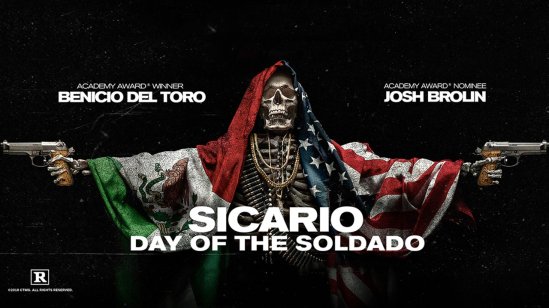
When we sat down to watch Sicario: Day of the Soldado, audible laughter erupted  from our seats as Josh Brolin reappeared. Josh has starred in 3 of the last 4 films we have seen. Including Avengers: Infinity War and Deadpool 2. In LA it’s often said that at any given time there are two million unemployed actors in the city. So I my next question is — How great is Josh Brolin’s Agent?! Brolin himself has either made a deal with the devil or Creative Artists Agency — or I suspect both. I don’t actually know who his agent is but I know that when I lived in LA and drove by the ominous, sleek and cold, CAA building, which is larger than most embassies, I always got a good case of the heebie-jeebies. Not to mention what I always imagined was the amount of espionage, a la The Conversation, the telephoto lenses and wiretapping devices that were set up across the Avenue of the Stars from CAA at The Hyatt Regency Century Plaza to get the upper hand on the latest deal making. …But hey, sure, it’s all just a product of my overly active imagination. 

Meanwhile back at Marcus Cinema in Appleton, Wisconsin, in my red leather  “DreamLounger” reclining La-Z-Boy in theater 14…the lights seemed awfully bright. For some reason, at the start of Sicario, the house lights never dimmed. D even got up and went out there and told the staff…but nada changed. One thing this did was help me realize how dark this film actually is. I mean literally dark. Many scenes have crushed blacks that under these circumstances where wiped out. I’m sure cinematographer Dariusz Wolski’s head would have exploded had he been in attendance. The other thing this lighting snafu brought to my attention is what a tightly wound story Sicario is…well at least until the end, where it goes off the rails, jumps the shark, what have you. But there was no way I was going to get up and complain about the lights and miss any of this. I figured D had taken one for the team already, after all. 

A kudos goes to writer Taylor Sheridan, who also wrote one of my 2016 favorites Hell or High Water. Sicario strongly develops the secondary, or supporting characters. It helps make the drama a lot more meaningful when you know where a character is coming from, metaphorically. 

On the other hand, there is a place where this story logically ends. But then it begins again. Personally, I have a pet peeve regarding epilogues. It shows a lack of confidence in the audience and a certain amount of uncertainty in the artist. An appeasement at best, a setting up of the next film, akin to a commercial, at worst. I’m sure there are plenty of valid financial or political or possibly even creative reasons for epilogues but they always fall flat for me. Most of the time I have to have someone else explain the endings of movies to me — and that’s fine with me.  

One other thing, from someone who has worked on several films in Mexico and heard complaints about this. A border story is like the low lying fruit on the creative tree in terms of storytelling regarding Mexico. Yes, in its obvious, tangible way, it has a built in drama that people can easily relate to on a dramatic level. And well told, a border story like Sicario, can be extremely effective. But there are plenty of other great films coming out of Mexico all the time. Instant classics like Amores Perros and really great more recent films like Güeros.  

Let’s for a moment talk about the insane coolness of Benicio del Toro. This guy has the charisma and presence of a modern day John Wayne. I was sitting in a cafe on Vermont Avenue in Los Feliz one night when he shows up at the door. The only sound you could hear was the wait staff falling over one another to get to the guy. It. Was. Eerie. I just wonder what makes someone like that think he can just get a grilled cheese at 11:45 on a Tuesday night and not throw the equilibrium of the entire universe totally off. But even more than that, he needs Brolin’s agent. 

Uncle Drew

uncle.drew.mondo.jpg

The TBI was off the charts for this film, stretching way past the point where you order your chalupa, at least 15 cars deep. That should have been my first clue that Uncle Drew would surpass my admittedly low expectations. I have been burned many times by films that rely on a star athlete to try and carry a feature. As a basketball film with an African-American cast, wouldn’t Uncle Drew rely on the same disappointing jokes and stereotypes that we have all suffered through a thousand times? And yet, it didn’t. The theme of the film is somewhere between family is right in front of you if you can see it / ego can destroy the greatest talent / you miss 100 percent of the shots you don’t take. 

Is Uncle Drew formulaic? Yes. It is about as formulaic as you can get and yet it’s such an enjoyable ride, you don’t really mind. From an aesthetic point of view, it’s beautifully shot. RED digital cameras have truly come into their own. There was a great mix of glamorous photography along with arching action shots. In terms of the make up, I think the film should be nominated for an Academy Award for prosthetics. It was fantastic to see folks you recognize look straight up geriatric. At the same time, it’s sort of believable that someone who is dedicated to something like say playing the drums, riding a bike or playing basketball could excel at it after not playing for decades. More than muscle memory, the film makes a case for love of the game. 

The acting in the film also raised it above what I expected going in and made it greater than the sum of its parts.  You could see the actors were in tune with their characters. Even in the bloopers, where thankfully the only mom joke in the entire film can be found, the main character, Dax, strongly played by Lil Rel Howery, says he wouldn’t know, he is an orphan. It goes to show how deep the actors prepared and how the characters had many dimensions and motivations to guide their performances.  

As a basketball playing fanatic for many years I appreciated the film on another level as well. Sure, looking back on schoolyard hoops there are the great moments, the bad moments and the moments you tell your therapist about but the point is, as Uncle Drew points out, you don’t stop playing because you get old, you get old because you stop playing. I’m glad these geezers got together to once again throw down the rock.

Book Club

BookClub775x515.jpg

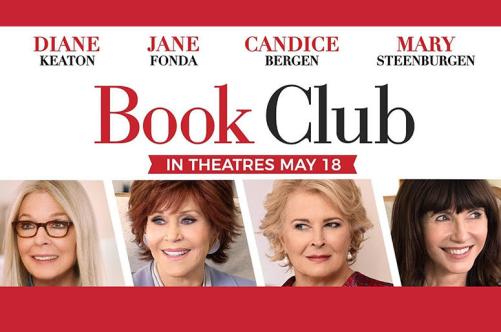
Okay, this movie was really funny. You could hear people laughing all the way up in the rafters of our local Marcus Cinema (for those not in the US Midwest, it’s a nice movie chain with reclining seats at the location L & D frequent — which is one of the reasons we frequent it.) While driving to this film I had a sort of similar feeling as I had before going into Blockers. Is this movie for me? For the L & D? I suggested to D that maybe he should be taking his wife to this. But I have to say, I was way off base. Book Club is actually a great buddy movie. And in attending new release films as much as we have I’ve learned that the great strength in movies is exposing people to other people, places and things they might not have any idea about…and realize how much they are similar and even how much they might like those odd people, places and things. I’ve realized that every movie is for everyone. You may not like it, you may even end up walking out but that movie was made for you to enjoy. (Except Mother!, if you enjoyed that you would enjoy an extended weekend in Palm Springs in June locked in a room with Rex Reed while he was forced, Clockwork Orange style, to watch a marathon session of Melissa McCarthy and Jodie Foster movies.) But yes, for most of the rest of us the real beauty of Cinema is being able to viscerally experience these foreign yet familiar dimensions, places, spaces and human emotions. It’s not something to be ashamed of but rather celebrated!

One thing about Book Club that immediately gets your attention is how easy on the eyes Jane Fonda is. At age 80, she has the sex appeal of a person half her age — let’s face it, even younger. I wanted to run home and try to dig up her Jane Fonda Workout VHS tapes from the 1980s. It’s here I will admit to wearing leg warmers during the winter of 1982… as a fashion statement. I know it doesn’t make it right, but all the kids were doing it. Though perhaps Jane Fonda is best known to youngsters for her bombshell role in the cult classic Barbarella, I had recently watched her 1978 masterpiece Coming Home, for which she won the best actress Oscar. And deservedly so. Her acting range was impeccable. There was even a steamy sex scene which I think fit right into the zeitgeist of the times— the post-Vietnam War reckoning and the cocaine fueled to hell with it attitude of the free love disco generation.  In other words, Jane Fonda carried Book Club with her pinky. 

The rest of the cast was also fantastic, with Mary Steenburgen, Candice Bergen, Diane Keaton reprising Annie Hall, Craig T. Nelson, Don Johnson and Richard Dreyfuss. I would give a special nod to Andy Garcia, whose character Mitchell was an understated and graceful study who was totally believable and likable. Also of note, the entire storyline of Steenburgen slipping Craig T. Nelson a couple of Viagara while out on a date…this is a riot and played particularly well. 

So there is a lot of excellent going on with Book Club. Of course, like A Quiet Place, it’s not realistic (No, I will not let that go.) in that it’s unlikely that these ladies of a certain age would be hooking up with dudes of a certain age 10 years younger. And in this, the film plays more like an adaptation of a romance novel. But honestly, who cares, we are at Book Club to be entertained and entertained we are. We can see how truly amazing Jane Fonda is, so anything else can also be believed. Why not? Why not keep looking for love, falling in love and most importantly believing you deserve happiness, your entire life. It’s a great message to remember and try to live out. 

Deadpool 2

LDandF

I’ve discovered that the worst thing you can do is have high expectations going into a film. But I just couldn’t help it. And I am glad I did. Like the original, this segment of the Deadpool series was outlandish, intense, funny and zany. So if you enjoyed Deadpool, this installment won’t let you down. 

Before I get into the review I want to point out that a stunt person died in a motorcycle crash making the film. In our day and age, this should under no circumstances ever happen. It’s just a movie, people. The film was dedicated to the stunt person, S.J. Harris. I hope that producers, directors and everyone who is involved in filmmaking takes safety precautions on-set seriously. Yes, sometimes there are risks in getting shots, but they shouldn’t be life threatening. 

Also of note, The L & D Report was honored by the presence of a special guest, the filmmaker, author, musician, artist and storyteller, Frank Anderson. We had recently attended a screening of his fantastic film, “The Life of Reilly” about Charles Nelson Reilly.  It was great getting Frank’s angle and insight and just hanging out at the popcorn stand with him. 

I read a good article about movies last week in the New York Times, “Dystopia, Apocalypse, Culture War: 2018 or 1968?  The article posits that in 1968 the status quo in society seemed to be upended and films of the times like Planet of the Apes and 2001: A Space Odyssey, reflected that. So what does Deadpool 2 say about us as a society? I will just mention the existential aspect of the film. Like in Life of Pi, we love to tell ourselves stories about the afterlife. And if there isn’t one? Well that’s not very cinematic, is it? It’s always interesting to experience what creative filmmakers think the afterlife will be like and that holds true here. The story itself is deft at shifting emotional gears. From being self-reflexive, self-deprecating and hilariously absurd to hitting you with the deepest feelings of wonder about life, Deadpool 2 never misses a zinger or an emotional beat. 

As opposed to the depressed feeling around us after the ending of Avengers: Infinity War, the crowd at the end of Deadpool 2 was pumped up and almost riotous. If there had been an announcement that Deadpool 3 would begin immediately, the entire audience would have just rolled with it. Deadpool 2 is already a cult classic and with reason, this may be the only feature that can seamlessly thread references to Taylor Swift’s cats and scissoring.


Chappaquiddick

chappaquiddick.jpg

For an audience member it helps to have a someone to sympathize with when watching a movie. This film’s sole sympathetic character is gone early on and we are left trying to rationalize the motives of a self-centered drunk who has committed manslaughter. The drunk happens to be Senator Edward “Ted” Kennedy. It’s a long slog for the audience. There is a point where you realize that America would have believed anything out of Ted Kennedy’s mouth perhaps out of a profound guilt for the assassination of his brothers. Through this, he got a pass on the manslaughter of Mary Jo Kopechne. In 2018, making a movie about her life would have been more apropos. After all, what happened at Chappaquiddick and Kennedy’s subsequent life has been discussed and written about ad nauseam.  

Mary Jo Kopechne was dedicated to the Civil Rights Movement. That’s what “the cause” referred to in the film is. She lived in Montgomery, Alabama for a year and was an active part of the Movement. As much as “the cause” was the shield Kennedy and his team of  lawyers/mad men/diplomats hid behind to force his exoneration, Mary Jo Kopechne was a true believer. 

I thought the film did a lot of things correctly, the death of Kopechne was handled deftly and painfully. The juxtaposition of Ted turning the light off in his hotel room while Mary Jo recited the Hail Mary and Our Father in the air bubble that remained of the submerged car was haunting and powerful.  But the rest of the film tells us what we know. That Kennedy’s statement of what happened doesn’t stand up to scrutiny. Not even various versions of it told in the film make much sense. Except to say that a cover up occurred and that Kennedy, having driven off a bridge drunk, unable to save Mary Jo, if he even tried, feared he would have been imprisoned and left the scene. Ted’s remorse is always about how he is seen in the eyes of his father and never about the innocent life that he took. When he reads a nationally televised statement, he chooses to seek forgiveness but not announce his resignation. 

The film, though successful in being period accurate and in delivering some scope with aerial shots and a regatta scene, soon becomes a suffocating exercise in long phone calls and cramped rooms. Pretty early on I was left to ask, why should I care if he gets off or not — I know he gets off — the damage is done. More karma than irony, as Ted’s presidential dreams are dashed by Mary Jo’s death, his brothers’ greatest aspiration, a successful lunar landing, occurrs simultaneously. 

Unlike another political film which we saw last week, the dark, absurdist drama, The Death of Stalin, the acting in Chappaquiddick never comes to life. If the intention was understatement, then the statement was entirely buried. Like the story itself, the acting seemed to be simply going through the motions. Unlike in The Death of Stalin, I was never wondering what’s going to happen next. That sense of curiosity and intrigue is something else the audience deserves and expects from a film that purports to be a narrative drama.

This film would be a winner if screened for an ethics class but outside of that I would tack away from from Chappaquiddick as hard as possible.  


Blockers

blockers.movie.poster

This film is hilarious. I would put it up there with some of my favorite comedies like last years’ underrated Office Christmas Party and the Will Ferrell classic Old School. Though it has more in common with American Pie. With Blockers I felt like I was watching an instant classic.  The film has a great innocence to it mixed in with plenty of full frontal dudity. Not the nudity we were expecting but comedicly perfect.

We don’t get paid (yet) for writing the L & D but let’s say we are a known quantity at the movie theater. From the moment we entered until we took our seats, we were asked several times what we were watching tonight. And I will speak for myself when I say that I blushed. It’s just the word cock. There, I said it, cock, cock, cock.  Even when you just have to say Blockers, cock is implied. Even sometimes, you know, I live on Hancock Street and sometimes I feel funny when I have to spell it out for someone. I mean, self-conscious.  “Sir, did you say Hancock?” “Yes, H. A. N. C. O. C. K.”

So what happened is that neither one of us would say what we were going to go see and just sort of walked away. But they knew. They knew. And would yell to us, “It’s supposed to be really good!” And really good it was. I laughed out loud and knee slapped like there was no tomorrow. It seemed to capture this zeitgeist and generational gap flawlessly and easily, while taking side steps to ask a few profound universal questions —in between bouts of anal abuse and projectile vomiting.

I want to congratulate the filmmakers and actors on a smart, inclusive, funny, irreverent and enjoyable work. I look forward to watching it again sometime. And that is rare. 

Hostiles

Hostiles

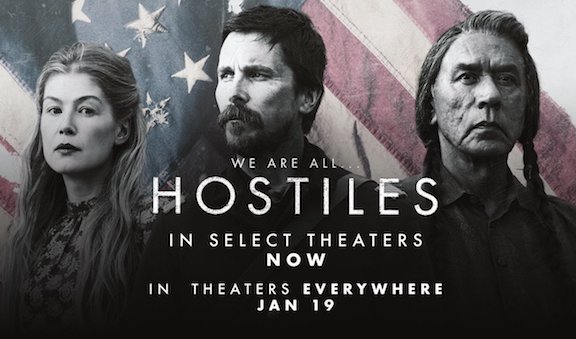
This is a split decision on the L and D report. Not putting words in my colleagues’ mouth but I got the impression he had seen all this before…and better. I myself enjoy the Western genre as much as the next person but have never really gotten that into it. To me it’s so cliché as a filmmaker to answer the question, “What would you like to do next?” with “A Western.”  It’s like you must say this or the Directors Guild of America will swoop in on horseback, six-guns a-blazin’ and take away your filmmakers card. In my life I’ve definitely mostly watched and made what I liked: foreign film, indie film, art films, documentaries.  In fact, only recently did I catch Treasure of the Sierra Madre, which is an amazing movie.  Another Western I really enjoyed was Book of Eli starring Denzel Washington and Mila Kunis. My point is that not everyone has seen everything from every genre. So here we are at Hostiles. After The Revenant, it’s tough to go back to standard fight scenes in Westerns. But Hostiles has no problem with that. The filmmakers might even celebrate it as an homage to the old style of filming action.  Also, it seemed that there was a lot of crying in this film for Christian Bale. He cried more than most of the women in an any Almodóvar film combined. Nothing wrong with your protagonist crying. But that is certainly not part of the old school Western genre. It really pushes the audience when every difficult situation calls for a close up of Christian Bale with lots of deep breathing like Tom Selleck on Blue Bloods and then a few big crocodile tears. I will say this though, like Daniel Day-Lewis in Phantom Thread, Christian Bale is one person on set I would not like to sit next to at lunch. He is so intense onscreen that I can’t imagine him in real life, just cracking a goofy joke or talking about the weather — that would terrify me. In this film, like every Tom Hanks movie, Christian Bale’s character starts out great, does great things and ends well, you guessed it, great.  His evolution from a person who hates the Other to a person who can forgive stretches your disbelief. In other words, nothing happens on this journey to cause this change in him that would not have already occurred in his many years as a soldier. He would have seen Indian nation fight against Indian nation, he would have seen treasonous and criminal soldiers acting badly towards everyone and anyone and he would have experienced random acts of kindness on every side as well.

I did have an issue in that a lot of the heroic acts of the protagonist are told and not shown. That gets to be trying. I also thought it was weird that Chief Yellow Hawk (played admirably by Wes Studi), who they were transporting back to his original sacred land, didn’t have a tribe there anymore to greet him. This was the seeming set-up when the return of the Chief was a front page newspaper headline in Act I. So visually and story wise, these were let downs. What I really enjoyed about the film was the pace. It was unafraid to linger on moments. The performance by Rosamund Pike was powerful and memorable. I also liked that the film dealt with a lot of existential issues. Westerns are great for dealing with philosophical questions wrapped up in the simple justice of the wild and a six shooter. I thought that the script employed flowing and authentic language, including Native dialect which was enjoyable. If I wasn’t necessarily wowed by the story, I thought the dialogue itself was strong and believable. I would like to give a nod to Director of Photography Masanobu Takayanagi, whose widescreen landscapes and night exterior photography were beautiful and something to write home about. If you are into ontological pondering, excellent performances, enjoy historical stories and groove on truly epic Western vistas I would recommend this film. On the other hand, if you know this genre back and forth and are looking for an original Western story shot in a groundbreaking way you won’t miss not seeing Hostiles.