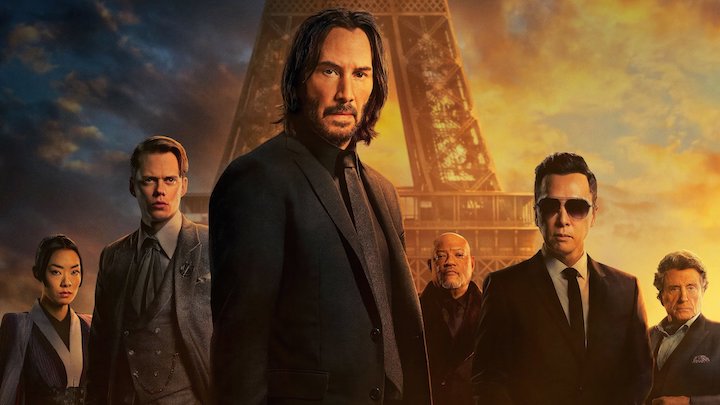
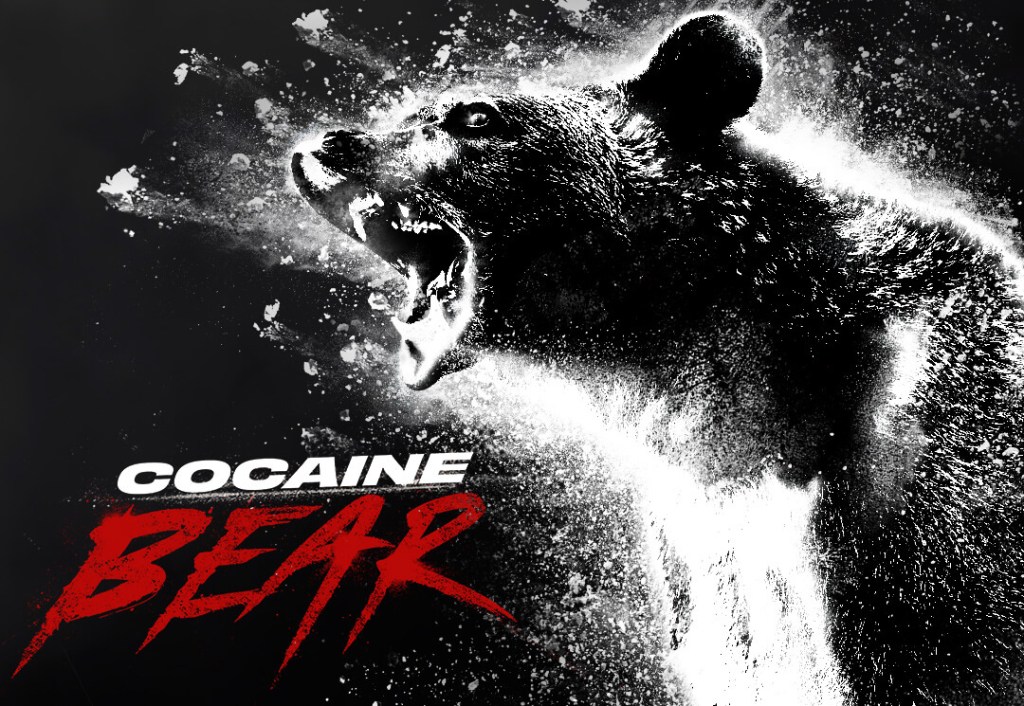
Am I going to reference Cocaine Bearin this John Wick: Chapter 4 review? You bet I am!
Now, I have said my piece regarding John Wick in a March 11, 2017 essay (6 years ago people!) here on this very blog. Let’s just say it is filed under an undignified LnD category labelled: “Terrible”. Regardless, I am coming around to John Wick. Mostly for the amazing locations and art direction. In terms of its filmic reality, it’s still an absolutely absurd video game, with only the special effect of spawning (when your player kind of electronically buzzes back to life) missing. However (here it is!) unlike Cocaine Bear, the violence in John Wick is essentially abstract. Poofs of blood-like mist emanate from people shot at close range. And the fighting…it’s choreographed like a fantastic dance. Actually, I think it would be cool if they just turned John Wick: Chapter 5 into a musical. Sure, a violent musical, but a musical nevertheless.
There was a great nod to the famous shots of a match being blown out cutting to a sunrise in Lawrence of Arabia. And the car chase scene around the Arc de Triomphe rivals anything that screeched in the French Connection. So if you are a fan of this series, you will certainly have plenty to cheer about in this installment.
In the not too distant past, L&D headed off to the late Marcus Tuesday screening to take in what was certain to be a memorable event, however it went, and it went exceedingly well.
“How good could a movie called Cocaine Bear be?” you ask.
Well, the L&D mantra of late is “To ask the question is to answer it.” Cocaine Bear is exactly as good as it can be, it’s hard to imagine that it could have been any better. It’s ridiculous, it’s funny, it’s thrilling, it’s gross, it’s surprising, it has star power, it’s remarkable across the board.
To say the movie is based on “true events” is akin to saying The Wizard of Oz is based on true events — indeed, a young woman got caught in a storm and hit her head once. As for the rest, well.
The intertwining plotlines fall somewhere between serviceable and solid. Keri Russell gets top billing as the mom tracking down her cheerfully truant explorer daughter and pal (Matthew Rhys sneaks in, as well). Isiah Whitlock, Jr. has cop buddy detail, he’s the one chasing down the big lead. Margo Martindale puts on a tub of lipstick as the lonely ranger setting a honey trap. There is a smattering of young park thugs who get more than they bargained for in the affair. And it’s Ray Liotta himself as the exasperated crime figure in what was his last major role.
There are a number of laugh out loud moments, though laughter did not seem uniform throughout the theater. The opening scene with the drug runner gleefully tossing bricks of coke out of the plane is surprisingly hilarious. The entire EMT sequence is surprisingly inspired . And the finale featuring Liotta shows some surprising intestinal fortitude.
So big ups from L&D, if you think you might like Cocaine Bear, you should head out and see Cocaine Bear.
My highly anticipated Cocaine Bear review is finally here. I have milked this bear for zingers for weeks now, so it’s only fair I at least give you, dear reader, a cursory review. But first, box office don’t lie. Let’s run the numbers. Cocaine Bear has been out in theaters for 5 weeks. It’s still a top 10 US release with a total haul of $63 million. Yesterday alone, it raked in $250,000. Not bad for a film that cost $30 million. Adding up the total $19 million internationally, to date our wired ursid has grossed $82 million.
Huuum.
Is it a good movie? Ohhh. (Deep sigh.) It’s an absurd movie based on events that did actually occur but then are exploded with creative license. It’s alternately funny — though I’m sure we were laughing at the wrong places. Viscerally and gratuitously gory. And held together by some sincere, grounded performances and a few believable bears…and a few unbelievable ones. …And bear cubs! C’mon. That’s not fair.
As D mentioned while the opening scene unfolded, a movie called Cocaine Bear only has to deliver on two things. And this it does. A Universal Pictures release, there is at least one homage to Jaws, early on, which sets the tone.
The marketing of the film as a horror comedy doesn’t quite get it right. It’s more like a gore comedy. How do I mean? If the sight of someone’s head being partially blown off elicits a shrug or chuckle or perhaps a belly laugh from you — this film was made for you. I’m only slightly squeamish but in general I don’t care for that in movies. I find this kind of normalization of gore to be troubling. This also happened in Violent Night. It’s incredibly, over the top gory. I’ve personally worked on and shot gory, violent movies. It’s not a problem that these depictions occur in films. What grinds my gears is that it is being presented to a mass audience as run of the mill and now mainstream. A cinematic bait and switch. Obviously I’m expecting violence but it’s a lot. There is a film class at a local state university that studies historical times when gore is popular vs times when psychological horror films reign. Maybe this is simply the zeitgeist. All I know is that since Midsommar, I feel like my stomach is on a trampoline at a lot of movies. Thanks, Sweden!
Finally, Cocaine Bear is Ray Liotta’s final performance before his passing. And it’s a good performance. A solid one. So there is that too.
If you miss Cocaine Bear, don’t fret, my sources tell me that Cocaine Shark is already in production.
In theaters for this coming Tuesday we have a bio of Emily Brontë, the spiritual journey of a Christian hippy, and a pair of psychotic bears (see above). I vetoed the Ant superhero movie — Paul Rudds me the wrong way — and L probably saved us both by vetoing what appears to be a bungling new attempt at Marlowe.
What we have seen hasn’t been that great, either. Here are two blurbs:
80 For Brady **½ This is not a good movie despite its 53 on Metacritic. For $5 you get some great actors (Fonda, Fields, Tomlin, Moreno, and Harry “Clash of the Titans” Hamlin) and a few laffs. There are one or two scenes that are well put together, but it is mostly mush. For the L&D guide to Metacritic scores, see our earlier post on giving free passes to novelty movies and tv-to-theater productions that “fans of the genre will love.” Extra half star for Guy Fieri.
A Man Called Otto ** It was a not a big decision for a Man Called Otto. Let’s just say that L&D agree to disagree on this one. Tom Hanks isn’t a credible grump. And when is the last time it was sunny in Pittburgh during the winter?
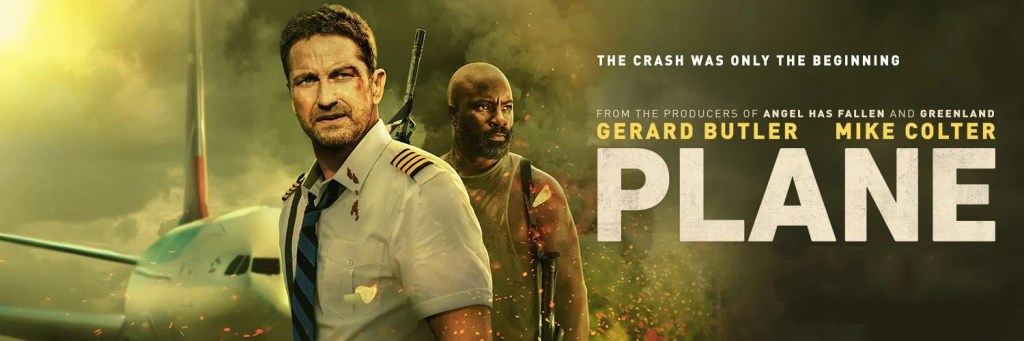
While enjoying Mr. Butler’s most recent offering as star of Plane, I continued thinking about his credits as Producer.
LnD first noticed this role in his thriller Angel Has Fallen and so I was intrigued. Butler’s first major Producing credit came in 2009’s Law Abiding Citizen. That film cost $50 million and grossed $128 million worldwide. That’s a healthy start to a producing career. However, Butler isn’t a nominal Producer. He’s a role up your sleeves, develop the script, choose the cast and director type of Producer.
And it shows. The films he makes seem on the surface to be straight to streaming affairs. But as you watch them, you notice the craftwork and talent involved. For example, I was really enjoying some of the cinematography in Plane. There were these artistic shots, contemplative ones, that broke up the action. It showed a concern for and understanding of pacing. Would it surprise you, as it has me, that the film was shot by Cinematographer Brendan Galvin, Irish Society of Cinematographers, who lensed the classic, The Crying Game?
I watched a 15 minute behind the scenes video of Plane on YouTube and it reaffirmed my feeling. Every character, no matter how small a part, has developed a backstory for themselves. None of the players here are just phoning in their performance. Mike Colter, who plays Gaspar, an accused murderer and French Foreign Legion vet, has got all of the conflicting aspects of his character and those of Captain Brodie Torrance played by Butler, down pat. Even though his character is involved in some of the most gratuitous and even absurd violence, since, well since Violent Night, there is a lot of depth to the performance in the scenes where Colter can show his dramatic range.
As an involved Producer, Butler is tuned in to the story. He is thinking about what happened before and what is going to happen next. He works as a creative partner to the Director. It’s effective, because he chose the director in the first place. They have been partners on the film from its inception. It’s a chemistry that translates to the big screen. And on that note, I encourage you to watch Plane on as big a screen as possible. Not because the special effects are great, they are not. But because you want to watch the true pathos in these performances come through in as epic a way as possible.
A Man Called Otto is an old school After School Special for adults. Handily Directed by Marc Foster of Quantum of Solace, Monster’s Ball and Finding Neverland fame, the film never feels like it’s breaking new ground, yet each vignette carries the story along. I found myself entertained from moment to moment and before I knew it, the ride of Otto was over. Interestingly, some of the imagery and situations that were depicted have stayed with me, even several days after watching the movie. There was a lot to process though at the time everything seemed innocent enough.
The inclusivity aspects of the story at times feel forced and stretch to the point the story enters, “suspend your disbelief” territory. And so we are simultaneously and ironically once again looking at the white savior narrative trope. Yet overall, the film works. It’s because the audience wants it to work. A lot of this has to do with Tom Hanks. In this film, thankfully, he doesn’t start out good, continue to be good and end good. Don’t remind me about Sully. The Otto character has a great narrative arc. When the classic curmudgeon says, “I’m not unfriendly”, it’s a laugh out loud moment in the theater. This film delivers several of those. And the supporting stories: the immigrant family, the insidious real estate speculators, the stricken and neglected neighbors, even an abandoned cat! They all work in shoring up the main narrative; how Otto got to be this way and what can be done about it.
The more I think about it, the more I really enjoyed this film. It sort of develops this fantastic world but there is a lot of truth in it and in what it’s ultimately trying to say. Your life isn’t over unless you think it is. And in life, empathy can take you much further than bitterness. I hope you all get to catch this one.
I had always heard of the films of WKW but his oeuvre lived in a blind spot in my viewing. Recently the Criterion Collection released a box set of his films on Blu-ray. The visual style of the films are lush. The dark colors are heavy, crushed. As a viewer you are completely sucked in. Not dissimilar to an experience I had sitting in front of a Rothko for 25 minutes in the Seagram Murals room or what I call the Red Room of the Tate Britain in London. It’s mesmerizing, transcendent and a little scary. You need to re-calibrate to reality afterwards — but it’s never quite the same. In the case of WKW, now you know how beautiful a film can actually be.
The collaboration of WKW and Cinematographer Christopher Doyle is now legendary. Doyle, an Aussie who lived in Hong Kong and spoke fluent Cantonese worked hand in glove with WKW. He is featured prominently in behind the scenes documentaries in the Criterion set. However, years ago I had seen a BBC doc in which he walked the audience through Hong Kong. Describing how, for example, certain streets or lights from buildings inspired his style. It’s not surprising that in both directing and cinematography the craft of these films is derived from the surrounding world. Consider that the inspiration for one film, Happy Together, came from a lamp that long time WKW Art Director and Editor William Chang found at a local shop in Buenos Aires.
Which leads us to WKW’s directing style. As Western filmmakers, at my grad school, UCLA and in my own role as a teacher, I have always followed the rule, been told and taught that the script is the Bible. And on large productions this holds true. All the department heads look to the script to help find clues to or straight up answer questions. No stranger to this method, WKW had 50 TV & Film screenwriter credits before he directed his first film. But his own directing method is antithetical to this. He works 100 percent from improvisation. It takes many months to complete his films. The actors have time to sink into their roles, costumes, movements — their world. Curious about this method, also shared to an extent by Wenders and Fellini, I tried it myself on my last film. The way to pull it off is to be working with smart actors who have great ability to pivot depending on what’s happening. Actors with great intuition and ability to go with the flow. Sure, there are adjustments from the Director, notes. But setting the scene, creating the environment, is the main job of the Director when working this way. WKW was certainly one of the most successful —and intense— Directors to achieve results with this method. Combined with the visual style, he tapped into raw human emotion and created a parallel reality in front of the camera.
— If you’d like to experience this reality firsthand, then head over to The 602 Club in Appleton, Wisconsin. I’ll be screening In the Mood for Love on Blu-ray on Friday, January 13th.
Too scared to venture out on our own, L&D turns to a guest reviewer from our friend and Reuben expert, Tommy Bergler, soon to be proud owner of the coveted L&D tee!
In these days of escapism, the Marvel Cinematic Universe, Baz Luhrmann, and the insane CGI of Avatar, whichever version we are on, Darren Aronofsky brings a different view.
The first film I saw of Aronofsky’s is Pi, and just let’s leave it at his is a special oeuvre, to be savored at the right time and with the right people, and with a certain expectation. His work is not light. It is not flighty. It is not a cream puff of a film, to be swallowed and for the sugar rush to give you a pleasant warm hug all over. Aronofsky flays you. He turns you upside down. He isn’t afraid to dig in.
To truly see how challenging he can be with your vulerabilties, and make you uncomfortable. I noted that when the lights came up on The Whale, the audience I was with, all middle-aged white Brooklynites from Park Slope, Ft Greene, and Dumbo, got up and left and there were a smattering of what I distinctly heard were really uncomfortable laughs.
To say that this was Brendan Fraser’s greatest cinematic performance is an understatement. I remember watching Fraser opposite Pauly Shore back in the 90’s as an unfrozen Cro Magnon specimen in modern day Encino (Encino Man was the title of this great film), and this film shattered all opinions I previously had of Fraser.
The Whale is set in Idaho in the late fall of 2016, when Fraser, who portrays a brilliant though mortally emotionally damaged, kind, and sensitive man named Charlie, who realizes he is quickly dying, and seeks to reconcile with his estranged daughter Ellie, played by Sadie Sink (Stranger Things). Along the way, this ensemble piece, originally written as a play, shows us the relationships Charlie has with his friend Liz (Hon Chau), who is also a nurse, and who is his closest friend, as well as Thomas (Ty Simpkins), a complex young man with some familial estrangement issues.
Look, there are moments in this film when I was desperately uncomfortable and even disgusted. Aronofsky has a talent for challenging the audience. But I was prepared for what I was going to see, and I enjoyed it. My wife, however, was not amused nor entertained. So let me just offer that it’s not necessarily a “date night” movie. The play — yes, it’s a film, but really, it’s a play — takes you on a psychological journey through the valley of despair but rest assured that Aronofsky doesn’t leave you there in that chasm, there is redemption “at the end.” So go see it if you’re interested in taking that journey and see a tour de force performance by the actor previously known for playing Tarzan the Ape Man.
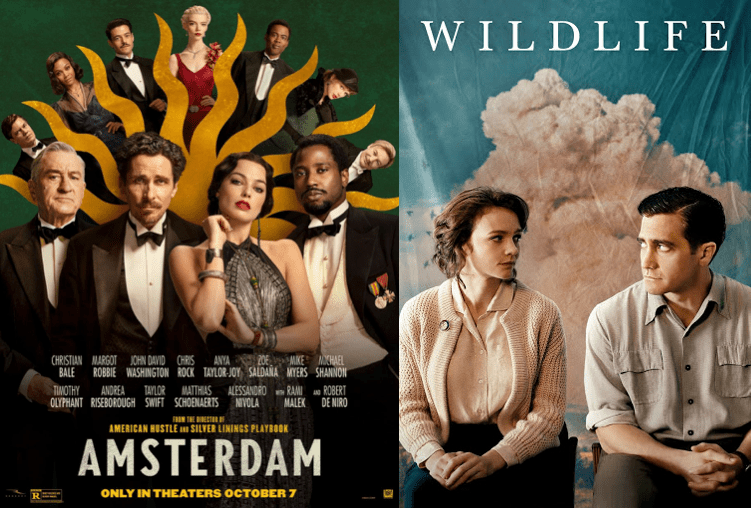
I was so uncomfortable during Amsterdam. It was so self-indulgent. I was wondering when it would end. It never seemed to end, though it had long past had anything to say. It was just in love with saying things.
I wondered what this film would have been like with a halfway decent Director. Then was surprised to learn that it was directed by David O. Russell. It was beautifully shot but some of the shots seemed unsteady, not the greatest. Except the Director of Photography turns out to be one of the greatest, Emmanuel Lubezki. The cast was just a powerhouse of talent. Though they seemed unsure, stepping on each others lines, seemingly uncertain of what to say next. One actor gave the world’s flatest performance. Didn’t the Director notice? Was his note to act like a piece of wet cardboard?
It was a beautiful film, though. It’s too bad that you can’t just hang each frame in a museum and admire them without the rest. Maybe watch it with the sound off? Even still, there were a few great lines: Are you with someone because you choose them or because you need them? And…If you’ve had your heart broken, well it just means that you were living. Kudos to Russell for some depth there.
This film, which takes place in the 1930s had a certain haunting nostalgia. Meanwhile, the protagonist was doing a major Columbo rip-off. Yet there was no homage to Columbo which could save this film. Like the infamous Jerry Krause, the General Manager who broke up the Michael Jordan era Chicago Bulls, this film didn’t know how to get out of its own way. And maybe we should be grateful because I don’t think there would have been a dry eye in the house if they could have figured it out and pulled it off.
Meanwhile, I was also able to watch Paul Dano’s 2018 Wildlife starring Carey Mulligan, Jake Gyllenhaal and Ed Oxenbould. Also a period piece, this time from 1960 but with a distinct 1930s flavor. The film’s compositions owed much to Hopper and his isosceles trapezoids, which you can read about in Mark Strand’s Hopper. And Hopper’s light as well. It certainly felt like a depression-era story. And yet, a timeless story. Not nostalgic and unrelatable like Amsterdam’s fever dream. More like the slow burning forest fires that always menace these characters from a far off yet not impossibly distant place. Wildlife is a domestic nightmare, seen from the eyes of its 14 year old protagonist. There is no sledgehammer voiceover here, like in Amsterdam, telling you what to think. The story is told visually. In close-ups of cigar smoking. In tracking shots revealing the sunrise. In fantastic vistas of ever expanding, majestic mountains. It’s an allegory about pride and desperation and it never feels distant. If you get a chance to see Wildfire, it’s well worth the emotional deep dive.
I enjoyed The Storied Life of A.J. Fikry but you probably won’t. …This is a film that has a lot of continuity problems. But if you are willing to suspend disbelief (a film phrase right up there with diagetic space, persistence of vision and the martini shot) then you might enjoy it, too.
Here’s an example. For starters the story is specific to New England, yet the accent is only discernible briefly in one character, in one scene. What gives? On an isolated island like this people wouldn’t talk like they were emerging from an LA nightclub. And I could go on and on. On the other hand, who cares. Not really me, it turns out. This movie has a lot of heart, a lot of spirit, it’s intriguing at times and laugh out loud funny a lot. …So why was the theatre empty? What do people want? More The Ring knock offs? (Smile, I’m frowning at you.) …To ask the question is to answer it, as D would say.
Well, you know what? They can have all the cheap jump scares they can handle. I’ll stick to the unlikely but still thought-provoking and interesting movies on this side of the megaplex, thank you.