EPiC is an acronym for Elvis Presley in Concert. That’s pretty cool Baz Luhrmann! Now you may recall that Baz Luhrmann directed an eponymous narrative film, Elvis, in 2022. As for me, it was forgettable. However EPiC will not face that same fate. Maybe it takes an Aussie director, or simply anyone from any other country, to tell us something that we all can’t see clearly: Elvis was great.
Some people may always have known this, but to a lot of us, it’s a revelation. And EPiC is really a celebration of someone who wanted more and gave absolutely everything to be himself and to entertain. What I learned most from this film was that Elvis was a funny person, with a real sense of humor. And maybe in an ironic way, he was probably most naturally himself when performing on stage.
The film is peppered with several hard hitting interviews. And it’s telling because Elvis reveals things to these reporters that expresses a desire to be taken seriously, almost an anguish or a hope. It’s mind-boggling that someone so successful could feel that he had so much more to prove. But it’s obvious that he felt that he did.
Ultimately, no matter what you may think of Elvis falls by the wayside once he starts singing and dancing. It’s almost trancelike for him and the audience. And I think it’s right there in the music where Elvis is able to knock down the boundaries and really connect with people. He’s not the King of Rock ’n’ Roll for nothing.
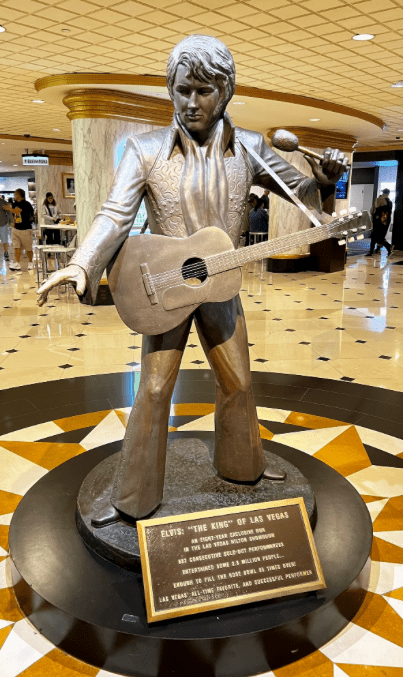
EPiC covers Elvis’ 1970s residency at the Las Vegas International Hotel. He played 636 consecutive shows there over a seven year period. Today the hotel is called the Westgate Resort. There’s an iconic statue to Elvis in the lobby that I enjoy visiting any time I stay there or am in the neighborhood. It’s not just fun for a selfie I can send to D — which I do! — but it sort of encapsulates that moment in time when Vegas was that wild rollicking place. EPiC captures parts of that moment as well.
Our movie attendance continues to outpace our reviews, so day 59 of year 2026 seems like a reasonable time to square the accounts.
Good Luck, Have Fun, Don’t Die *** Caveat Spectator, this Sam Rockwell showcase about man back to alter the future starting at a Norm’s Diner in LA is seriously deranged. And not always in the fun deranged way. It cleared the $6.32 bar for L&D, but we forgive you if you give this one a hard pass. Or have a heart attack.
Crime 101***½ A homage to Robert Altman, Columbo, the City of Angels, and probably a lot of other things, too. Hemsworth, Berry, and Ruffalo, oh my! Lots of action, star power, the makings of a first-rate thriller. Possibly part of a concerted studio effort to showcase warm-weather settings in cold-weather months.
Melania *½ Why am I watching this, right? If you can live with the premise that President Trump is a benign presence, this has some interesting elements — Mrs. Trump spends *a lot* of time in motorcades, that’s for sure. I don’t have too much too add, except to say I would have liked this better without a lot less of her narrative and some more of the footage from her big gala.
Is This Thing On? ***½ I’ve been writing my review of this one for a month now, seems L got the drop on me. A very solid drama that takes adulthood seriously, with dozens of laugh-out-loud moments.
In retrospect, mabye we have been keeping up better than I thought! Here are a few more:
Marty Supreme *** Timothee Chalamet plays a table tennis phenom in post-WWII America. A lot of people I talked to loved this and encouraged me to see it. I would have liked this better if it hadn’t played out, for the better and the worse, as a very vivid fantasy (a view I shared with The Bergler).
Kill Bill: The Whole Bloody Affair **** If you have five hours to kill, you could do worse than to see this on the big screen. I found it interesting how much the tempo changed after the break. Tarantino has the capacity to be such a great story teller, and I find a lot of the stories within the story more interesting than the main story arc. Visually spectacular throughout, though not necessarily in my favorite sequence where the Uma Thurman character trains with Pai Mei, learning the Five Point Palm Exploding Heart Technique. We left the theater dazed and staggered directly into a public library — and the librarian was jealous! True story. The Whole Bloody Affair, indeed.
Christy *** Sydney Sweeney does a nice job portraying female boxing pioneer, Christy Martin, in the ascendancy of that sport during the early 1990s. Ben Foster is, of course, extremely convincing as her deranged, abusive, trainer and horror show of a husband. This is one of those films where you head to the internet to check the accuracy of things you saw in the film that couldn’t possibly be true. Incidentally, Don King (Chad L. Coleman) makes an appearance. I find that King is underrated as an American icon and is often caricatured in these affairs — easy enough to do. I appreciated that Christy takes the man seriously.
Wuthering Heights NR Despite obsessive requests from near and far for L&D to review a film adaptation of something resembling the Brontë classic, we did not manage to make it in the theater to see this one yet. Once Valentine’s Day passed, the point seemed moot.
Good Luck, Have Fun, Don’t Die *** Not for everybody is our big takeaway. You might say this is not even for most people. This cautionary tale has some fun elements, some really troubling attempts at black humor, and, above all, a lot of Sam Rockwell.
In the spirit of Back to the Future, Terminator, 12 Monkeys, Deadpool 2 and probably lots of others, Rockwell arrives from the future to try to change the historical trajectory. This year’s villain is the dual threats of human complacency and AI run amok, slouching toward Idiocracy, I suppose. The movie begins with Rockwell showing up at a Norm’s in LA to recruit a band of diner-goers to aid him in his quest.
I really like Sam Rockwell and he is great as far as these things go. We thought the supporting cast was also pretty solid in what were patently absurd roles, Michael Peha, Juno Temple, and Zazie Beetz. We especially liked Haley Lu Richardson as the enigmatic princess in black lace-up boots. That said, I could easily tell you five things about this movie that would make you not want to see it. Defintely cleared the $6.32 bar for us, but you are welcome to take a flyer or just walk out if school shooting jokes aren’t your thing.
Did Norm’s really go out of business? Perhaps the apocolypse is nigh.
When life isn’t fair, should you settle your score through some extralegal channel? And, if so, does that make you a bad person?
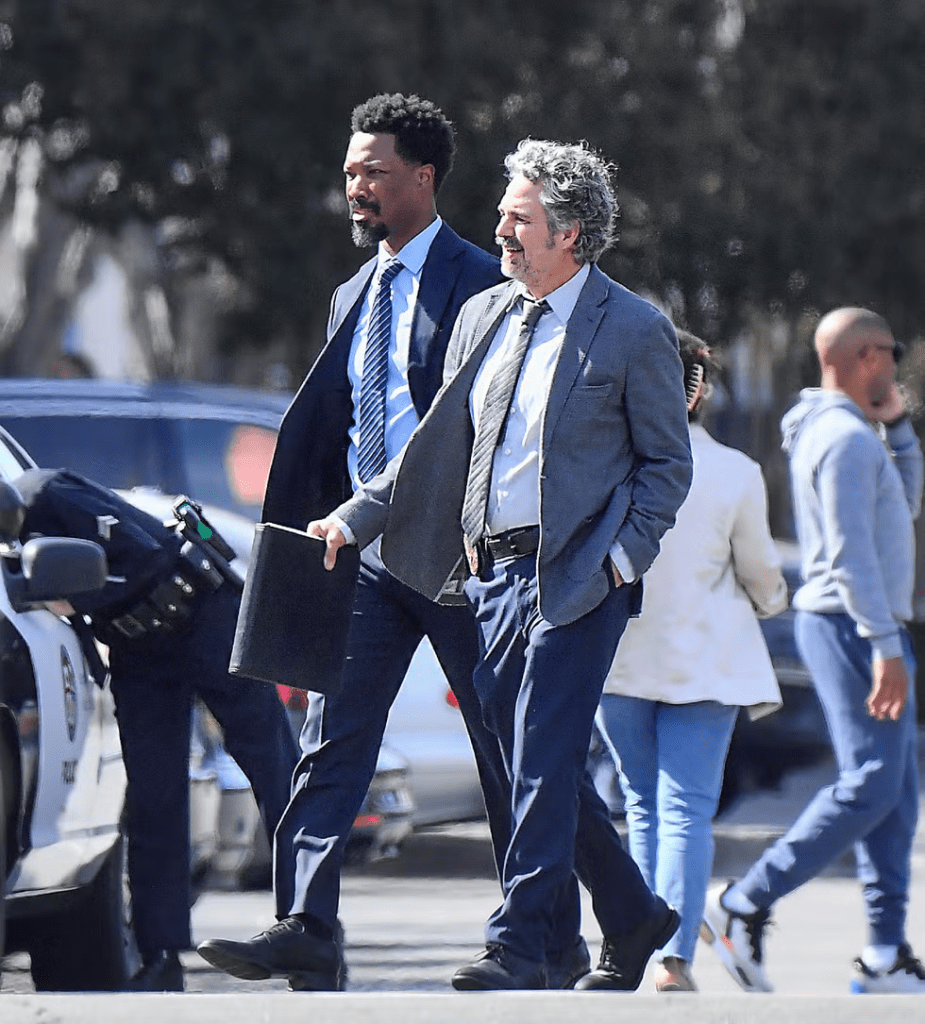
Questions Asked in Crime 101, a star-packed Amazon Theater release featuring the likes of Chris Hemsworth, Halle Berry, Mark Ruffalo, Monica Barbaro, Barry Keoghan, Jennifer Jason Leigh (!), and a guy who looks just like Nick Nolte.
In addition to the many Hollywood A-listers, the movie also features the city of Los Angeles itself, as we travel the city by car and by air, for better or worse, throughout the film. Indeed, the wide, panoramic overhead shots reminded me as much of as Midsommar (poor L) as the camera turned the city upside down–or at least pour something out of it. I’m guessing there is a metaphor there. Not exactly a love letter to the City of Angels, but not hate mail, either.
The movie definitely pays more than a little homage to Robert Altman, interweaving character arcs and story lines for Hemsworth, Berry, and Ruffalo. Hemsworth plays the master criminal with the heart-of-gold, targeting opportunities with minimal risk of violent confrontations. His character is written as the lost child longing to be normal. His non-violent proclivities don’t necessarily square with his enabler (that is Nick Nolte (!)).
Berry, meanwhile, works for a firm that provides personal risk insurance for the types of high-end clients that Hemsworth targets. Although she’s been at it for 11 years, her partnership is in the balance.
And then there’s Ruffalo, the rumpled detective with some strong theories and a low clearance rate, and his theory doesn’t seem to square with his commanding officer. His character arc brings the second major Question Asked — what if, instead of being an infallible homicide detective, Columbo was actually a 21st-century good-but-not-great cop on the LA bunco squad? The answers here are a more than a little unsettling — would he still bowl, or perhaps take up yoga? Would he be a cat person? How about his nephew, Andy Parma? L&D reveled in the Columbo parallels throughout. Ruffalo excels in the role, though I’ve seen him better.
The rest of the cast playing fairly straight-forward supporting roles. Except for Keoghan, who is perfectly cast as the smarmy blond nihlist dude. Unsettling, for sure.
All in all, two big ups from L&D. Probably won’t make the year’s best list, but closer to ***1/2 than **1/2 on the star chart.
This film is what’s known as a “vanity” piece because it’s funded by the same person who stars in it. In this case, the First Lady of the United States of America, Mrs. Melania Trump. Now I’ll stop right there to steal a line from Melanie McDonah, who opines in The Standard, and I paraphrase, “If you don’t like Donald Trump to the point where seeing some of him is actually a neuralgic thing, this may not be for you.” That is some classic movie reviewing right there and probably better than anything I’m going to come up with.
However, if you’re a political wonk, I’m not sure how you could miss it. A few things about this movie you may already know. It boasts one of the highest acquisitions ever for a documentary. We can thank our Amazon Prime accounts for that. Mr. Jeff Bezos found it expedient to expend 40 million for distribution rights and 35 million for global marketing. He also has a cameo in the movie sitting at the President and Melania’s table during the 2025 inaugural gala dinner. An event that ties together the entire narrative. Another element to note is that the director of this film is Brett Ratner, you may be familiar with his work in the Epstein Files.
I noted that there were many interesting things in this film. And D noted that many interesting things does not make an interesting film. There are a few things we learn along the way. For example D leaned over to ask me where Melania was from? I knew the answer was not Queens. I shrugged in the dark. …Slovenia! Our first lady is an immigrant from Slovenia. Also, she uses an Apple computer when Zooming with world leaders like Brigitte Macron, who you may know from her work slapping her husband in the face.
It feels like the entire first third of the film includes more dress fittings than anything before or after Phantom Thread. And there are more motorcades in an hour and 44 minutes than in all 4 seasons of Succession combined. We learn that Melania’s mother died on January 9th, 2024. Exactly one year later, Melania decides to light a candle for her at a church. If you’re Melania Trump, this requires police cars, the Secret Service, a limo, the closure of Saint Patrick’s Cathedral to the public and a personal blessing from the clergy. As she walks out, a crowd has formed on 5Th Avenue. No one boos, no one cheers, no one takes pictures. Melania is an enigma. And this film doesn’t do much to dispel that hard plastic feeling that you sense from her aura.
There is one scene where she meets with Aviva Siegel who was held hostage by Hamas for 51 days. At the time of the meeting, her husband Keith is also being held hostage. There was a lot of humanity in that scene. Aviva says, “There is too much hate in the world. Too much hate.” An important message. I don’t doubt Melania believes this as well. However, she is so detached from reality, I’m not sure how much it matters. It’s her film, though, so it’s her message.
I find a movie like this interesting for the Rashomon effect moments. More than one person sees the exact same event but interprets it in totally different ways. Traditionally, the incoming President and first lady spend the night before the inauguration at Blair House. In the morning, they are asked to take a photo with about 20 household staff members on their way to the ceremony. Melania, in her black dress and infamous, D would say Hamburgler style, massively brimmed hat is so incongruous with this group. Dental work is easier to sit through than watching this upstairs downstairs collision. And yet, if you’re a Melania fan, you don’t see the cringe, you simply see your heroine being cool with the staff…or however they might characterize this. Again, it’s a vanity piece, and I’m certain that this scene made the final cut because depicting empathy is the intention.
The film ends with on screen text listing Melania’s accomplishments and, as she would say, initiatives. And these deal with helping foster kids and supporting legislation against using AI deep fakes unethically, as in revenge porn. Who could really argue with this? Melania also touts her 2020 Rose Garden renovation. Of course the President paved over the grassy area she installed with a stone patio in 2025. And let’s not even talk about what he did with her office (hint, it was in the East Wing). But Melania truly doesn’t seem to be phased at all by these changes. In one genuinely brilliant scene, she is on the phone with “Mr. President” and he is asking her if she has seen the final election results. You can tell she is busy with so many other things, isn’t interested and can’t wait to get off the phone. “I’ll watch it later, dear.” It’s great comedy and probably the only scene that organically grows from real life. Melania has other pressing initiatives on her mind. Other state dinners to organize featuring gold leafed eggs stuffed with caviar. Her Style to maintain in exacting detail.
One thing D mentioned in passing which I can’t stop thinking about is how this film would play without the constant voiceover from the first lady. She’s a #1 NYT best selling author, after all, so I’m sure she can’t help herself. But if this film only featured found sounds, diegetic sounds, like a classic cinéma vérité Frederick Wiseman film, it would truly be elevated. Instead, this slice of life has more akin with an IMAX nature documentary than anything a person can really relate to.
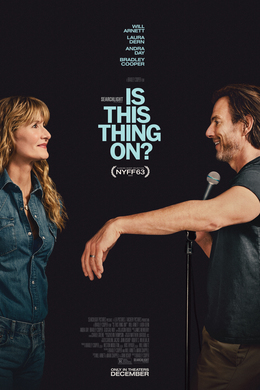
This will be a particularly subjective review of Is This Thing On? starring Will Arnett because I’m a Smartless devotee. That is the podcast that features Arnett, Sean Hayes and Jason Bateman. It’s my go to pod for snow shoveling. And also was my go to for flying before I was turned on to The Rest is History (The Abraham Lincoln two parter. So good. You. Have. Got. To. Be. Kidding. Me.) If you have never listened to Smartless, start with the interview of José Andrés, the celebrity chef and humanitarian. It’s inspiring and enlightening.
The strange thing is that since I listen to Arnett often, I almost didn’t want to watch this movie. If I’m into a podcast and don’t know what the hosts look like, I enjoy my imaginary idea of how they look. Do you do that? And so I thought, well this may be weird to see this person on the screen with the voice of Will Arnett. But I’m here to report that no such phenomenon happened. I was able to watch and enjoy this film without thinking about the podcast. Will Arnett did a great job creating the character of Alex Novak, a guy who’s down on his luck and finds salvation in stand-up.
That said, there were times when the real Will Arnett poked through. The football (Liverpool) chant in the restroom, for example. This would be a non sequitur if you didn’t know Arnett’s fandom. Though later, he wears a Liverpool T-shirt as he emerges from his bed. In these cases, the nod to Liverpool took me out of the story. Not because I dated a girl who was a Liverpool fan, I did, but because there is no reason given, no indication why Alex Novak would be a fan. Also, where does Alex Novak work? He is in finance we are told. That’s convenient but does he work from home? These ideas are tied because there is no backstory, if you will, no history for Alex, or life for him outside his pain and drama. Does this guy have a job? Is he a real person? Is he simply self-inflicting wounds and self-centered? For the audience, it’s tough because his marital separation is just as murky. The whys threaten to creep in and overwhelm the story. And if they did, the film would die in its tracks. Because we the audience would feel that at any point, Alex Novak, the trust fund kid and Liverpool fan, could simply fly himself to Saint Martin, or Sint Maarten for that matter, when things start to fall apart.
But these filmmakers are too savvy for that. Perhaps starting and ending with Director, Actor and Co-Producer Bradley Cooper. He knows how to keep an audience interested in a story and empathetic to the main character. Even one who gets on stage at the comedy club, sets his drink down on a table in the front row and says, “Don’t roofie me. …No actually roofie me. I would love to be roofied.” Frankly, I thought the depth of darkness in that line was genuinely funny. It gives profound insight into the loneliness of the character. And yet, someone who is reaching out to others. And it’s a reason I enjoy stand-up. A sphere where everyone agrees ahead of time, we’re all grown ups here. We are gonna vent and laugh, be vulnerable together in a way that may be acceptable in few other places outside of this club.
Laura Dern also drops in a heartfelt performance, filled with nuance. She and Arnett have a strong chemistry together that’s sometimes even stronger when they are at odds.
As a fan of stand-up, I enjoyed Is This Thing On? It felt like a great balance between the art of telling a story and the art of learning a craft like making strangers laugh.
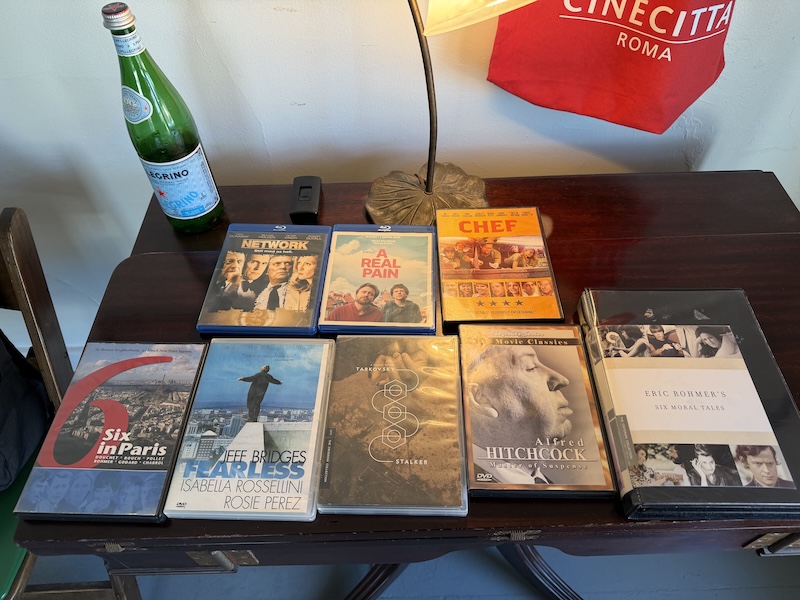
Here’s what I’ve been watching on DVD and what I thought of it.
Network (1976) – “I’m mad as hell and I’m not going to take it anymore.” Ned Beatty won an Academy Award for his performance in one incredible scene. This is a portrait of power, the overly ambitious and greed. I watched it with the Sydney Lumet commentary on as well. He gives a lot of credit to Paddy Chayefsky, the writer, whose life story and career is almost as interesting as the movie.
A Real Pain (2024) – I watched this one and then a BTS video. It’s a powerful film. A Jesse Eisenberg vanity film about anything but vanity. Kieran Culkin controls his characters’ mercurial nature so it’s as sharp as a knife. And his performance is reason alone to check this one out. However, there is a visit to a WWII Polish concentration camp, Majdanek, that will leave you with a lump in your throat, at least.
Three Short Films by Werner Herzog – Featuring The Dark Glow of the Mountains (2008) I’d like to teach a college course on the early documentaries of Werner Herzog. Seriously. What impresses me is how he is unafraid to ask the most direct questions. Like, “What was your mothers’ reaction when you told her your brother was dead?” Herzog means serious business. In Ballad of the Little Soldier (1984), he gets caught in a fire fight between Nicaraguan rebels and counter-revolutionaries along the Honduran border. Most people would be packing their bags but Herzog is just digging in.
Chef (2014) Jon Favreau inspires in this feel good movie about the pain and pleasure of making cuisine. I listened to the commentary on this film, which included the thoughts of celebrity Chef and co-producer Roy Choi. I loved the Latino-centric vibe of the film which also stars John Leguizamo and Sofia Vergara. And I enjoyed how it becomes a road movie, traveling to some of my favorite foodie places like Austin, New Orleans and LA.
Stalker (1979) This Andrey Tarkovsky film is based off of the sci-fi novel Roadside Picnic which involves an alien invasion and a room that will bring your single most desired wish to life. Sounds like a good deal except that the room has penchant for killing people. The eponymous Stalker refers to the guide who smuggles daring folks into this heavily guarded zone. This allegorical and philosophical film is difficult and I had to break it up into two viewings. It’s a slow slow burn. Characters disappear and appear in unlikely locations. Characters sleep. But at least for me, the payoff was worth it. So I’d say if you are a total film nerd or love a deeply intellectual and even absurdist film, it’s a must and well worth the effort. Stalker is also prescient in its dystopian imagery of the towers of a nuclear power plant, only a few years before the Chernobyl disaster.
Six in Paris (1965) – I was looking forward to this collection of 6 films from famous New Wave directors. Ultimately it was rough and amateurish. Disappointing and not memorable. If you’d like an anthology of films about Paris I’d recommend Paris, Je t’aime (2006). Olivier Assayas’ segment is titled “Quartier des Enfants Rouges”, stars Maggie Gyllenhaal and is one of my favorite films ever, long or short. It’s a perfect moral tale, which leads to my next viewing.
Eric Rohmer’s Six Moral Tales (2020). All of these films are interesting on their own merits. And this Criterion box set includes other cool short films, a documentary and several TV shows from the 1970s with the actors, producers and Rohmer himself. It also includes a book from which these films are based on. If that’s not the definition of literary film, I can’t imagine what is. What absolutely stopped me in my tracks is a film called “My Night At Maud’s”. There are long scenes in this film of people talking about philosophy and religion and relationships. It’s amazing. I have to say it blew my mind to watch people talking at length in a movie. I didn’t think it was possible. But here before my eyes Rohmer proved it’s more than possible and if the characters are interesting and have something to say, it’s mesmerizing, enlightening and inspiring. The other noteworthy film for me in the series is La collectionneuse, shot by Néstor Almendros, who would go on to win an Academy Award for Days of Heaven. There is a similar all natural aesthetic here, in the beautiful countryside around Saint-Tropez. La collectionneuse has to be in the top ten bougie films of all time and is great viewing for a cold, dark winter’s night, as the song says.
Fearless (1993) – Directed by the great Australian, Peter Weir, this film stars Rosie Perez, who was nominated for an Oscar for her role, Jeff Bridges, Isabella Rossellini, John Turturro and the Bay Area. The strangest thing about this film for me is that I didn’t recall ever watching it until a powerful scene with Perez and Bridges toward the end of the movie. That scene jarred my memory. I must have watched this film 30 years ago! So that was a strange phenomenon. It’s a heavy film, dealing with post-traumatic stress from a plane crash. And is based on the stories of survivors from the crash of United Airlines Flight 232 in Sioux City Iowa in 1989. It’s a solid film that I think has been overshadowed by Weir’s more popular works.
Brazil (1985)- This is peak-Gilliam in my humble opinion. It’s wrapped in all of his visual mastery, Monty Pythonesque humor, his steampunk sensibility and an absolutely sick supporting turn by Robert De Niro. Jonathan Pryce stars in this film and as I’ve watched it three times this year, I’ve come to appreciate his physical comedy. There is a moment early on where the Marx Brothers’ Duck Soup, another one of the great political satires of all time, is playing on a tv monitor. It’s an apt homage as Brazil is another film in that great tradition. Shameless plug, if you are in the Appleton, Wisconsin area, or want to be, I’ll be screening Gilliam’s Time Bandits and The Fisher King in February and March of 2026, respectively, at the 9th Annual 602 Club Winter Film Series. Join us!
LnD were fortunate to get out of the house a few times this year, and we bring you our Best Of list amongst the universe of movies we saw (mostly together). Here’s the faves out of that group:
Splitsville: This is the second phenomenol effort from Michael Angelo Covino and company, following up on the brilliant The Climb. If you are looking for hilarious adult dramas, I recommend you put these two on your watch list. It is #1 on our Best Of list and there is not a close second. Hilarious and poignant is a good combination.
Bugonia: Another provocative and wildly entertaining piece from our main man, Yorgos Lanthimos. Jesse Plemons is a great actor and turns in another intense performance in his role as a would-be lunatic. L&D readers certainly know we are huge fans of Emma Stone, and she also delivers in a challenging role. It is #2 on our list and there is not a close third.
One Battle After Another: I am a bigger fan of the Paul Thomas Anderson canon than my partner, but I didn’t think this was his best effort. This is a great action movie, for sure. Leonardo DiCaprio as the Lebowski terrorist is a solid running gag, and Benicio del Toro is blessed with another great role for him to dominate. That’s heavy metal, man. If the subject matter was right-wing terrorists, my guess is that the critics would be less sympathetic towards this one.
F1: The Movie: As a movie-length F1 advertisement, this works like a champ. Highly enjoyable. Very loud. Brad Pitt. A legitimately great summer movie.
Materialists: It’s possible that I liked After the Hunt more than I liked this one, but I did like this enough to recommend it to people. And I also saw it twice! Who would you pick as your life partner — Pedro Pascal or a Chris Evans? Decisions, decisions.
Honorable Mentions:
Sacramento: A very solid comedy from the land of fruits and nuts.
Eddington: I really liked this movie and had no idea where it was going an hour in. Then it went where it was going and I realized what it was actually about. Yeebus. We didn’t know it was Ari Aster until it flashed on the end credits. Of course it was Ari Aster! We laffed.
After the Hunt: Kind of a ridiculous set-up from my perspective of an academic insider, but some good characters and a lot to talk about. Julia Roberts is superior. And there’s Chris Evans again!
Nouvelle Vague and Blue Moon: Two solid efforts by Richard Linklater exploring the inner workings of great artists, Jean-Luc Godard and Lorenz Hart, respectively.
Dishonorable Mention:
The Amateur: Rami Malek dropped at least two spaces in my book from this one. Enough said.
Bride Hard: I was ready to get up and leave before the opening credits even wrapped up, but I figured it couldn’t get any worse. I was wrong.
More positives than negatives. Always fun to get out with L and Dr. B and our assorted cast of characters. See you next Tuesday!
Splittsville wins for my picture of the year, 2025. While watching a film, a lot of times I wonder, “How did they do that?” referring to some technical aspect of filmmaking. But the duo of Michael Angelo Covino and Kyle Marvin amazed me with their combinations of slapstick, portrayals of the depths of human anguish and holding this comedic and dramatic tension for the entire film. After watching a lot of predictable, blockbuster, franchise films recently, Splitsville renewed my faith in movies. However, I’m certain at least one goldfish was injured during the making of this film. I’m sure these filmmakers made up for it somehow. They seem like those types of people. This duo also made a film called The Climb , which D reviewed.
Click the link and read all about it. I’m looking forward to rewatching Splitsville and whatever Covino and Marvin come up with next.
Anemone
We were very excited to watch DDL do his thing. And he comes out of retirement to do it in this movie, directed by his IRL son. There were some deeply moving and even painfully amusing scenes in this film but I could never escape that it was Daniel Day-Lewis, Acting. There is DDL looking serious…there is DDL having spit run out of his mouth because he’s so angry…there he is running on the beach! You get it. However, if you’re a DDL completist or someone particularly interested in The Troubles of Northern Ireland, Anemone is worth watching. For the rest of us, a rewatch of Phantom Thread is in order.
One Battle After Another
When a new Paul Thomas Anderson film is coming out, we have tickets weeks in advance. That expectation is ultimately why I felt disappointed by OBAA. It’s essentially a comic book, with big broadly painted characters doing over the top things. I recognized the writing as something I could have come up with, and that’s not good because I’m objectively not a very good screenwriter. Benicio del Toro is already being nominated for awards for his performance, which, yes I did enjoy. But I also felt it was so easy for him. I would love to see him in a part with some teeth. I felt like, there’s BdT telling a funny joke…there’s BdT kicking someone out of a car…there’s BdT being cool. You get it. One person who did deliver a really astonishing performance was Sean Penn. At one point towards the end, D leaned over and said, “That’s Sean Penn.” and I had to laugh. But that is exactly what a truly great performance is all about. The actor, no matter how well-known or famous, transforming themselves into this other person.
I was rapt during moments behind the scenes at the immigration detention center. Since even our elected officials are denied entry into these places, it’s left up to the Cinema to shine a light on their inhumanity for us. However the film runs off the rails and becomes a Quentin Tarantino parody. And sadly, the characters here have no arc. They start out one way and end up that same way. That’s another real disappointment. Finally, the ending doesn’t ring true for the main subject. I’m not sure who’s supposed to be excited about OBAA apart from a political partisan. If he’s supposed to be inspired by The Battle of Algiers, PTA missed the greater message about how there are no winners, no good guys, in war. Ultimately, the story feels like pandering instead of understanding the logical motivations and possible choices that these characters would make. D keeps saying he wants to watch this again, which makes sense since he’s a self-described PTA junkie. But I’m good.
After the Hunt
This film was truly well acted, honest and believable. Julia Roberts sinks into this character. Sometimes I’d think, “There’s Julia Roberts.” I’d follow it with, “I love watching her act.” And then I would forget, falling back into the story. Michael Stuhlbarg deserves a Best Supporting Actor Oscar for his role has her psychiatrist husband. One scene of his is particularly hilarious and biting.
This story tackles difficult topics and does a French intensive gardening method with our recent social, philosophical and political situations. The characters at times do illogical things but not enough to break the spell of the story. The worst parts of the film for me were the strange musical and non-diegetic sound choices. It’s not a horror film, what is going on here? Maybe because the Director is Sicilian, there is a loose, European sensibility with the score. It was anachronistic to the verisimilitude of the character depictions. Also, things have been written and said about the final scene. I found it absolutely unnecessary. We’re all adults here and can come to our own conclusions. You don’t need to throw these characters under the bus. Overall, I found this film to be thought-provoking, fearless at times and included some fine performances. Certainly worth watching if you are in for some serious Cinema.
Blue Moon
D said we are going to Linklater film. And that’s all I knew going in. I didn’t even know the title. As I’m writing, I still don’t know the title! What’s amazing about this film is how it is contained essentially to one set, a bar. Luckily the bar happens to be the famed thespian haunt, Sardi’s, in Midtown Manhattan, so the possibilities grow. Of course, anyone who has seen 12 Angry Men, knows that a great script and great acting can transport you. Blue Moon doesn’t feature any flashbacks, it leans on the great Ethan Hawke and the great Ethan Hawke delivers. His character is so pathetic and repulsive at times, cringy. And then at others sympathetic and even empathetic as well — most people have acted like absolute fools at some low point or another. So that as a viewer, you are emotionally spinning. This certainly feels like a film that would not have been made at the peak of the #MeToo movement. It’s unapologetic about advancing a story that’s still feels uncomfortable. The phrase warts and all may never have been so applicable. After the film, I asked D, “I’m not sure who this film is for?” And without missing a beat, he said, “No one.” We both laughed. I’d say that if you’re interested in the history of musical theater in America, or that you might enjoy a period piece from 1943, or absolutely love watching Ethan Hawke at the top of his game, this one is for you. I did find it to be a solid and I’m sure memorable piece of filmmaking.
It’s been a good run the past few months. Somewhat hit or miss but these movies are all asking thought-provoking, intriguing questions, include great performances and are well over the $6 Tuesday bar at Marcus Cinema. Free popcorn too. …Meet us at the movies!
The Materialists *** I think you will enjoy going to this movie and talking about it with your friends. I don’t think this is a terribly good movie, but it does have a lot to say about life in the Big City, much of which is probably true. Lucy (Dakota Johnson) is a professional matchmaker for Manhattanite-types that can afford professional matchmaking services. Harry (Pedro Pascal) is a zillionaire “unicorn” (a perfect match for pretty much any female looking) and John (Chris Evans) is a bumbling idiot from Lucy’s past. There is a lot of “math” in this movie — for men the key addends are height and income, for women being young and rail thin (say, BMI < 20, not ≤ 20). The movie is billed as a rom-com, but I didn’t find it terribly funny (though there were several amusing sight gags). Does that make it a drama? There is definitely a meditation on how financial resources — or the lack thereof — shape life’s possibilities, especially in New York. There are some interesting exchanges and conversations throughout, but some baffling plot elements that are worth at least one * off.
The Phoenician Scheme ***Wes Anderson’s latest features Benicio del Toro as an industrialist and international man of mystery, Mia Threapleton as his daughter and would-be heir (or perhaps his heir and would-be daughter, tough to say), and with Michael Cera as the traveling secretary, Bjorn. The cast is also littered with supersars, Jeffrey Wright, Tom Hanks, Bryan Cranston, Scarlett Johansson, Benedict Cumberbatch, Willem Dafoe, F. Murray Abraham, and, of course, Bill Murray. Unfortunately, there aren’t many writers that can support that kind of cast, and this is no exception. I saw this a few weeks ago and couldn’t tell you the main takeaway from the movie, though I can recount a half dozen amusing moments and scenes. As per always, Anderson makes it clear who is directing with the set pieces and the props and the deliberate, sharp color schemes. If you are an Anderson fan, this one is a no brainer. If I was in the market to re-watch an Anderson movie, this one would be at least five or six deep in the queue.
Bride Hard ½* Ostensibly a Die Hard spoof set at a ritzy wedding, this one falls flatter than Hans Gruber from the top floor of the Nakatomi Plaza. Within the first minute of watching I sensed I was in for a long evening. Rebel Wilson in the lead has a couple of moments (using curling irons as nunchucks gave us a moment), but what appears to be a pretty talented cast (Wilson, Anna Chumsky, Da’Vine Joy Randolph) wasn’t enough to overcome a bad script and lazy writing. L liked it quite a bit more than I did, and my estimated rating for him is *½.
F1 ***, ***½ if you see it on the big, big screen. This is a summer action film, big stars (Brad Pitt, Javier Bardem), loud music, rumbling cars, some reasonably strong plot lines. Not that strong, though. Mostly, but not entirely, predictable. If you are looking for two hours of extraordinary film production from Daytona to Budapest to Belgium to Abu Dhabi and back again to Baja, then this one is a good choice.






 L&D Report