Air

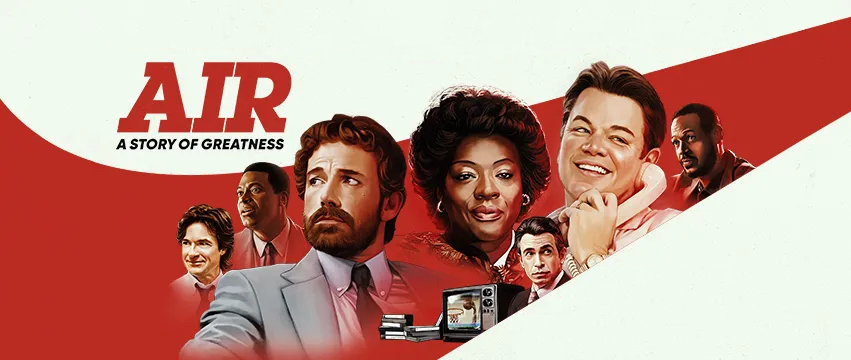
The first thing to know about Air is that you already know the ending. …Or do you? You know that Nike makes kicks called Air Jordan. But did you know that the sneaker behemoth was once, before Air Jordan, a hair’s-breadth from dismantling its entire fledgling basketball division? Nike was predominantly known as a running shoe company in 1985. 

The other thing you know going into Air is that any film with Ben Affleck and Matt Damon as the main talent, as the producers and directors aka above the line, is going to be good. And Air is good. It doesn’t hurt when you cast the great Viola Davis either. Or this other actor you may have heard of, Jason Bateman. And the film lets these talents get right to it, lets them show off their range. 

It easily answers the question, can you make an interesting movie if the audience already knows the outcome? Yes you can. The movie is also a love letter to 1985 and all the products that went along with it. The montages of TV spots, the costumes and art direction were on point.

The film also flips the script on your traditional white savior story trope. In this movie, the savior is a 6’-6” African-American with an incredibly silky jumper, ice in his veins and a mom with a savvy business sense. It reminded me of The Founder, the story of Ray Kroc and McDonalds, in some ways.  As D pointed out of the comparison, Damon’s character, Sonny Vaccaro, becomes obsessed with a singular mission. Not to be cast aside, the character of CEO Phil Knight is played with hilarity and pathos by Affleck. But we are left to wonder about the means of production. Who makes these ethereal, leather bound beauties, that allow a man to defy gravity? That part of the story, besides a passing line by Bateman’s Marketing VP Strasser, never gets the spotlight. The film isn’t about a few folks reaping billions from the work of below minimum wage off-shore laborers, forced labor, child laborers in sweatshops. That’s a different movie. This one is about the tenacity and vision of someone who risked it all, thinking outside the box and who ultimately championed athletes. …Though that other question is left to float like the iconic Air Jordan logo. 

The epilogue of the film, the little montage you often see of, “Where Are They Now” is simply jaw-dropping. And I didn’t wonder, as I had before the movie started, why Damon and Affleck chose this particular story to tell. 

John Wick: Chapter 4

Am I going to reference Cocaine Bear in this John Wick: Chapter 4 review? You bet I am! 

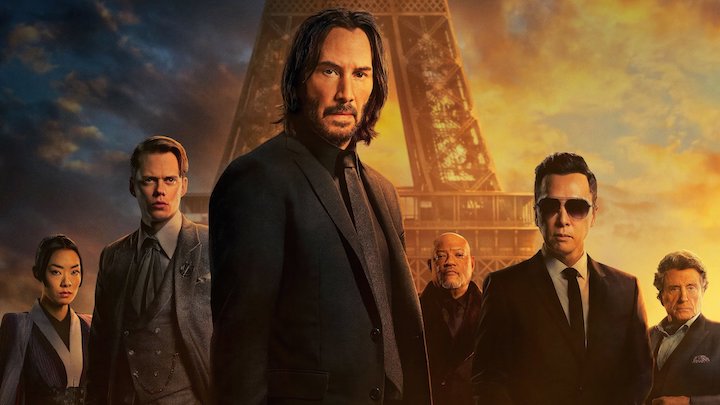
Now, I have said my piece regarding John Wick in a March 11, 2017 essay (6 years ago people!) here on this very blog. Let’s just say it is filed under an undignified LnD category labelled: “Terrible”. Regardless, I am coming around to John Wick. Mostly for the amazing locations and art direction. In terms of its filmic reality, it’s still an absolutely absurd video game, with only the special effect of spawning (when your player kind of electronically buzzes back to life) missing. However (here it is!) unlike Cocaine Bear, the violence in John Wick is essentially abstract. Poofs of blood-like mist emanate from people shot at close range. And the fighting…it’s choreographed like a fantastic dance. Actually, I think it would be cool if they just turned John Wick: Chapter 5 into a musical. Sure, a violent musical, but a musical nevertheless. 

There was a great nod to the famous shots of a match being blown out cutting to a sunrise in Lawrence of Arabia. And the car chase scene around the Arc de Triomphe rivals anything that screeched in the French Connection. So if you are a fan of this series, you will certainly have plenty to cheer about in this installment.  

Cocaine Bear

In the not too distant past, L&D headed off to the late Marcus Tuesday screening to take in what was certain to be a memorable event, however it went, and it went exceedingly well.

“How good could a movie called Cocaine Bear be?” you ask.

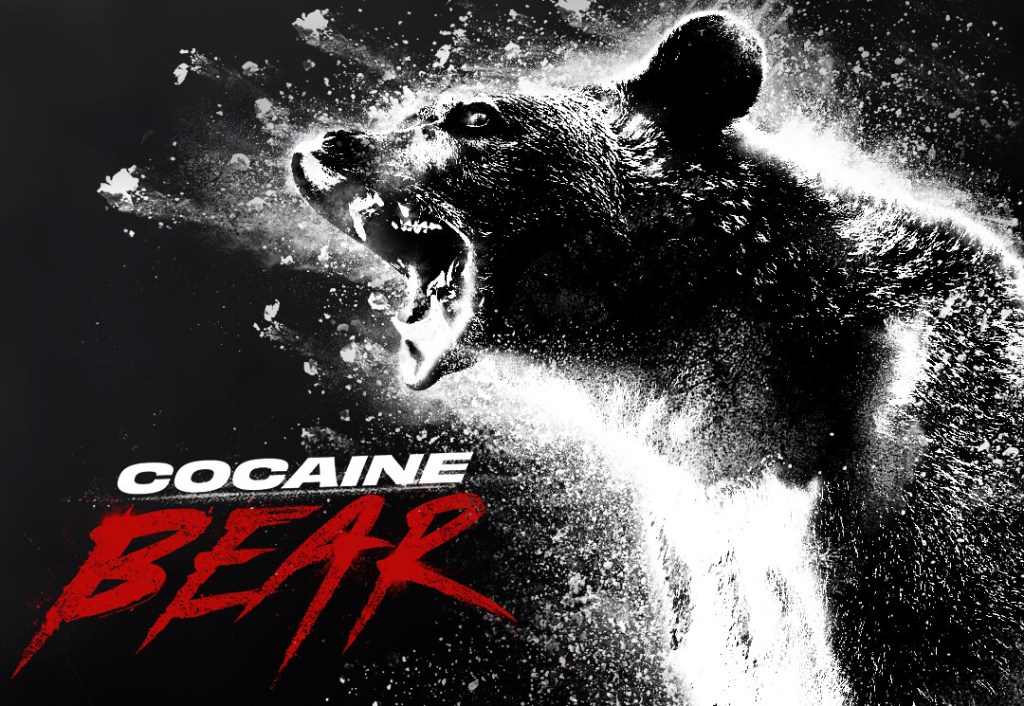
Well, the L&D mantra of late is “To ask the question is to answer it.” Cocaine Bear is exactly as good as it can be, it’s hard to imagine that it could have been any better. It’s ridiculous, it’s funny, it’s thrilling, it’s gross, it’s surprising, it has star power, it’s remarkable across the board.

To say the movie is based on “true events” is akin to saying The Wizard of Oz is based on true events — indeed, a young woman got caught in a storm and hit her head once. As for the rest, well.

The intertwining plotlines fall somewhere between serviceable and solid. Keri Russell gets top billing as the mom tracking down her cheerfully truant explorer daughter and pal (Matthew Rhys sneaks in, as well). Isiah Whitlock, Jr. has cop buddy detail, he’s the one chasing down the big lead. Margo Martindale puts on a tub of lipstick as the lonely ranger setting a honey trap. There is a smattering of young park thugs who get more than they bargained for in the affair. And it’s Ray Liotta himself as the exasperated crime figure in what was his last major role.

There are a number of laugh out loud moments, though laughter did not seem uniform throughout the theater. The opening scene with the drug runner gleefully tossing bricks of coke out of the plane is surprisingly hilarious. The entire EMT sequence is surprisingly inspired . And the finale featuring Liotta shows some surprising intestinal fortitude.

So big ups from L&D, if you think you might like Cocaine Bear, you should head out and see Cocaine Bear.

Cocaine Bear

My highly anticipated Cocaine Bear review is finally here. I have milked this bear for zingers for weeks now, so it’s only fair I at least give you, dear reader, a cursory review. But first, box office don’t lie. Let’s run the numbers. Cocaine Bear has been out in theaters for 5 weeks. It’s still a top 10 US release with a total haul of $63 million. Yesterday alone, it raked in $250,000. Not bad for a film that cost $30 million. Adding up the total $19 million internationally, to date our wired ursid has grossed $82 million. 

Huuum.

Is it a good movie? Ohhh. (Deep sigh.) It’s an absurd movie based on events that did actually occur but then are exploded with creative license. It’s alternately funny — though I’m sure we were laughing at the wrong places. Viscerally and gratuitously gory. And held together by some sincere, grounded performances and a few believable bears…and a few unbelievable ones. …And bear cubs! C’mon. That’s not fair. 

As D mentioned while the opening scene unfolded, a movie called Cocaine Bear only has to deliver on two things. And this it does. A Universal Pictures release, there is at least one homage to Jaws, early on, which sets the tone.

The marketing of the film as a horror comedy doesn’t quite get it right. It’s more like a gore comedy. How do I mean? If the sight of someone’s head being partially blown off elicits a shrug or chuckle or perhaps a belly laugh from you — this film was made for you. I’m only slightly squeamish but in general I don’t care for that in movies. I find this kind of normalization of gore to be troubling. This also happened in Violent Night. It’s incredibly, over the top gory. I’ve personally worked on and shot gory, violent movies. It’s not a problem that these depictions occur in films. What grinds my gears is that it is being presented to a mass audience as run of the mill and now mainstream. A cinematic bait and switch. Obviously I’m expecting violence but it’s a lot. There is a film class at a local state university that studies historical times when gore is popular vs times when psychological horror films reign. Maybe this is simply the zeitgeist. All I know is that since Midsommar, I feel like my stomach is on a trampoline at a lot of movies. Thanks, Sweden! 

Finally, Cocaine Bear is Ray Liotta’s final performance before his passing. And it’s a good performance. A solid one. So there is that too.

If you miss Cocaine Bear, don’t fret, my sources tell me that Cocaine Shark is already in production. 

The Batman

What the hell was that?

The question constitutes the quick take from our L&D special guest, who joined us for the world premier of The Batman Thursday evening.

My answer? That was a limited Netflix-type series condensed down into three hours and change. There are clearly four or five separate episodes here, replete with the cuts between ‘episodes.’ Indeed, at one point I thought the movie might be over, it had that natural break feel about it. But, after lingering a beat or two, we moved on.

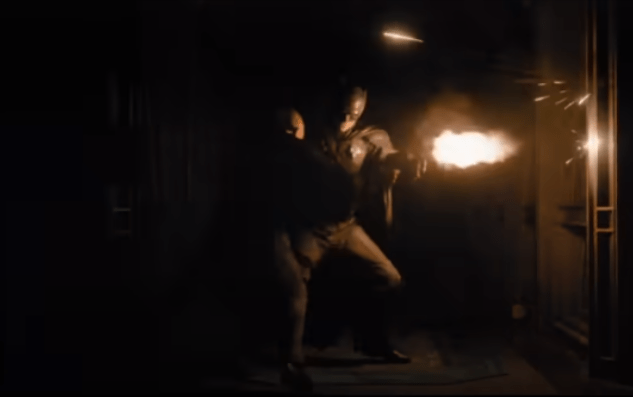
I am endorsing this one because there was so much I enjoyed about it and I will enjoy discussing it with other Bat-fans. For example, I liked how the entire musical score is built around Nirvana’s “Something in the Way” (which serves to tell you pretty much all you need to know about the mood of this one). I loved Robert Pattinson in the leading role; he put the goth in Gotham, for sure. Now there’s a Dark and gloomy Knight for you! There was good action throughout, including the sequence where muzzle flash provided the only light. And a great car chase!

But the verdict is that this is a case of trying to do too much and, as a result, not doing enough things well, and leaving too many things undone. Case in point, there is a great To Live and Die in LA chase sequence, but why were they even chasing him? What was the payoff? (Those familiar with the White Knight story arc should certainly see my point here). The purpose was that they needed to introduce the Batmobile (I doubt that constitutes a spoiler). Yes, following the chase there was a pretty fun back and forth with Gordon and The Batman here during the grilling, but ultimately this defied credulity even moreso than usual.

But my biggest gripe is certainly that the writers grossly overestimated the payoff from their “big” plot reveals. I am not sure exactly how we were supposed to respond when that news came out, but my response was: Yawn! I saw that movie already! So pretty disappointing on that front, pretty good story, not a great story.

Plenty of starpower, including Peter Sarsgsaard, Zoë Kravitz, Jeffrey Wright, Paul Dano, John Turturro, Andy Serkis, and Colin Farrell. That’s a lot of characters to introduce, develop, and complete a story arc on. The Batman doesn’t, and couldn’t, without another few hours of exposition. I listed the actors in descending order of how I thought of whether the character worked, from Sarsgaard as the DA to Farrell as a pretty forgetable Penguin. What a waste of makeup and acting talent (though I am definitely the minority view on this assessment). Kravitz as Catwoman is certainly remarkable in the true sense of that term. Another something to chat about on the ride home. I thought Dano was good in spots as the Riddler, but, meh.

So, there you have it, a dark, brooding eight hours of entertainment mushed down to three. If you go to these types of movies, you will almost certainly find something to like. But this feels more like The Dark Knight Rises than The Dark Knight in terms of the overall quality and payoff. It’s going to be in theaters for a while, so you’ll have plenty of time if you want to see this one.

No Time to Die

Wait, Felix is from Milwaukee?

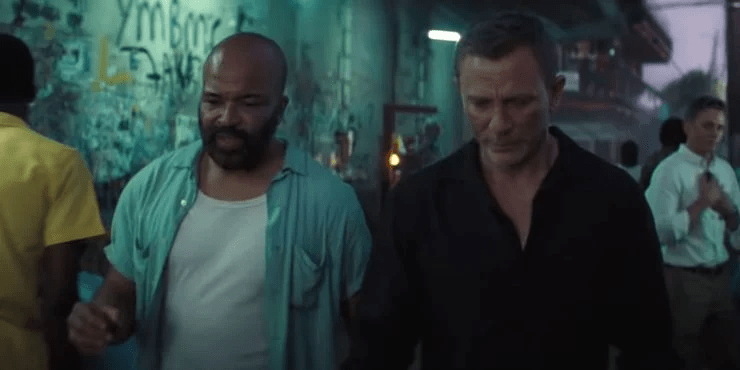
Alright, then. We headed off to opening night of the latest, but not the greatest, edition to the Bond canon, which gives a well-publicized sendoff to Daniel Craig in the title role. The movie is, in my estimation, the second or third best of the Craig era, and right about tenth in my personal rankings in the series.

I don’t really have a full-blown review here, but I do have some notes from some texts I shared with one of our loyal readers. First off, Daniel Craig is bored. This shows up intermittently throughout the film when he isn’t doing his best to pretend otherwise. Unlike the aging prizefighter looking for that last paycheck, however, he came in in excellent shape!

Second, the story is not a bad story, all told, but the villain by committee is both unsatisfying and uncharacteristic of the series. It’s like watching a baseball game where the manager keeps changing pitchers. I guess the writers sacrificed the prospect of one last great Bond villain in the service of a bunch of other things they wanted to include.

Third, the action is OK. There are a couple of very cool scenes, including the first part of the opening scene (this is a really long movie), but nothing that holds a candle to, say, the opening scenes of The Dark Knight Rises or Tenet.

I bring up those latter two because it is difficult to discern whether the many, many, many similarities and parallels to action films generally (including The Dark Knight Rises (!)), or Bond films specifically, are hat tips or homages or just mere coincidences. That said, many things happen in this movie that are new to the Bond series, the types of things you can probably read about in reviews that have ample spoiler alerts.

In my estimation, there are a handful of Bond films that are good, stand alone movies. Then, depending on the day, there are five-to-ten in the series that are durable as fun action movies, but aren’t terribly good stories and you wouldn’t consider watching them if it didn’t have the Bond pedigree. No Time to Die is probably in the former category for now. The novelties herein will probably have people revisiting this one more than they might have otherwise.

Reminiscence + The Protégé

These films both held a lot of promise but ultimately illustrate the idea that sometimes the sum of a film is not greater than its parts. If you had a recipe like: one part Hugh Jackman, one part Steampunk art direction, one part underwater fight scene — instant hit, that’s what you’d get. It’s not lost on me that a film called reminiscence, which includes all these ingredients, will soon be forgotten. 

Reminiscence, which features spectacular special effects of a not-too-distant future where cities are half-submerged in water, lags due to the self-indulgent and confused tone of the story. It’s a dystopian action/comedy/romance/thriller/sci-fi — and none of these. It also needed to be at least 30 minutes shorter. I held in check the urge to walk out. And I’m the type of person who would enjoy watching a film where grass grows. It pushed my patience as the director followed up every loose strand and tacked on egregious monologues regarding Greek mythology. Not necessary. As was the constant voice over narration by Jackman. It became an almost instant parody unfolding in real time before me. A disappointing experience. 

The Protégé at least had some interesting fun and games involving the incomparable Michael Keaton and the talented Maggie Q.  Though at some point in this film it becomes apparent that the story hinges on an absurd fantasy that Maggie Q’s character, the take-no-prisoners fighter and intellectual Anna, would be interested in Keaton’s Rembrandt, who seems to be wearing an ascot. That’s when you realize it’s a story tailored for old guys though ostensibly featuring a strong female lead. The fight scenes with Keaton and whoever his stunt double is were ridiculous. On the other hand, the Maggie Q action sequences where on par with Die Hard and fun to watch. The film goes off the rails with a shark jump to rival the original shark jump of Arthur Herbert Fonzarelli’s. And Act III becomes predictable, preachy, involves gratuitous violence and is irrelevant. The filmmakers let this one slip through their hands and there was nothing that the great acting of Samuel L. Jackson could do to save it. Another bummer. 

In this latest batch of releases I would recommend Free Guy for a fun action film. For a strong drama, look to Stillwater, where I think Matt Damon deserves to be nominated for an Academy Award.

Free Guy

I just played a game of online Asteroids to warm up for this review. It was on the Atari site and sponsored by AARP. Free Guy is a film that will either appeal to the 14 year old in you or your actual 14 year old. It’s a cross between Her, War Games and It’s a Wonderful Life. The film is loud and brash and original if not in plot, then at least in the graphics department (excluding the direct but well-timed references to Star Wars and Marvel) since it is not based on an existing game —or even amusement park ride!

The film doesn’t really poke fun at itself in the sense of breaking the fourth wall. However, it does have a point to make about breaking out of how you think your life is supposed to be. This theme will be obvious to those of us who know what AARP stands for but I think it’s a good message for people of any age.

Speaking of graphics, the special effects were flawless and fun.  If you are the type of person who finds yourself playing a video game and trying to say, land a fighter plane on the Golden Gate Bridge…or figure out where the edge of the simulated environment is…and try to hack it, you will probably enjoy this film too.

The other interesting aspect for those who get into metaphysics and ontology…when is something real? If an AI character is evolving on its own and believes it is feeling, is it feeling? This question motivates Act III and is covered specifically by the NPCs (non-player characters) themselves in a strong scene between Reynolds’ Blue Shirt Guy and Lil Rel Howery’s Buddy the security guard.

This isn’t a totally dude-centric film either (though there is a very big dude in it). There is a strong female character, Molotov Girl, played convincingly by Jodie Comer. Finally, Ryan Reynolds, this time as producer and star, is able to unleash every facial expression imaginable. Overall, this film certainly had its moments and I enjoyed it.

The Green Knight

What follows is a guest post from the Good Doctor himself. For a Stoopid American, he sure knows a lot about English literature!

Dark: And so Sir Gawain sets off, traversing forests and mountains to find The Green Knight, where he meets a talking fox who warns him: 'You will find no mercy, no happy end'

The Gawain doctor is in—and like most doctors, he’s running a little behind.

I should probably start with the patient’s question, which was about how faithful Sir Gawain and the Green Knight is to the 14th-Century poem of the same name. It’s not particularly faithful, but since we’re not 14th-Century readers, that’s not necessarily a bad thing. It is deeply engaged with the original poem in ways that are probably more interesting than would be the case in a more direct adaptation. Knowing the poem will give you a framework and additional material to think about, but it won’t “explain” the film or leave you with nothing to do but listen to some English professor carping about what the director misunderstood or didn’t get right.

The original poem explores the themes of courtesy and mirth, reflecting on how a society genuinely inspired by the medieval Christian understanding of those virtues might operate (and on how the actual medieval world falls short). David Lowery’s movie has almost no mirth, and courtesy always turns out to be a deceptive mask (as it sometimes is in the original as well). It feels more like the world of Beowulf or Game of Thrones than the refined and civilized world of the movie’s source material.

Fittingly, Lowery’s Sir Gawain is a flawed everyman rather than an innocent embodiment of courtesy. He has a hooker-with-a-heart-of-gold girlfriend, and his drunken excess is always set in a brothel or a tavern to distinguish it from the equally-inebriated, Christian-sanctioned mirth of the original poem. I think this revision is probably designed to make Gawain a relatable character, allowing modern film-goers to identify with his trials and tribulations over the course of the film, in much the way that medieval readers were invited to identify with the courteous but inexperienced Gawain of the poem.

At the same time, Lowery nicely captures the sense in the original poem that things are rarely as simple as they seem, and that forces at the edge of our understanding—if not entirely beyond it—are at work shaping the course of events and giving them meaning. His approach is more in the form of a fever dream than the subtle and teasing allegorical undertone of the original poem, but it feels properly medieval in its rejection of naturalist or realistic plot in favor of symbolic or allegorical meaning.

There are definitely easter eggs for readers of the original poem. There is a brief mention of the five virtues, an important set piece from the original poem in which Sir Gawain’s shield is allegorized for its “endless knot” pentangle front and painting of Mary inside. When that shield is cracked and destroyed in the opening episode of his journey, it confirms what you had probably already guessed about how far those medieval virtues would get you in the movie’s world.

The film also follows the basic structure of the original poem: the Green Knight’s visit to Arthur’s court, fast-forwarding to Gawain’s departure a year later, a Christmas over-nighter at a mysterious castle, and a final conclusion of Sir Gawain’s “game” with the Green Knight. Readers familiar with the poem will find significant resonances with the critically important castle episode immediately prior to that final encounter, and may be particularly interested in the decision to cast the same actress as the hooker-with-the-heart-of-gold and the lady of the house.

The final confrontation with the Green Knight is as confusing and counter-intuitive as in the original, but works to a different end. My own reading is that, where the original invites the recognition of our fallen nature in even the most virtuous of Christian heroes, Lowery is more interested in revealing the systemic injustice of patriarchy. Ironically, Lowery’s Gawain must pass his test if he is to succeed, whereas the 14th-Century Gawain can become a hero despite his all-too-human failings. But there is plenty of material (friendly robbers, lady ghosts, talking foxes, earth giants) to fuel other interpretations, which is one of the things that makes this movie so rewarding.

If you can figure out what those creepy giants are up to, you’re a smarter reader than I am. Len tells me that they’re Czechoslovakian anime, and who am I to disagree?

The Green Knight

We rallied the troops and hit The Green Knight on opening night, the new cinematic adaptation of the classic 14th-century poem, “Sir Gawain and the Green Knight.” So the big question you are asking, I’m certain, is whether the film is faithful to the poem?

And my answer, of course, is that you are asking the wrong guy.

There is so much about this movie that I don’t have answers to, starting with who is this Green Knight? Is it the rocky, green-tinged shrub guy, or is it the inexperienced Gawain himself? Does his mother actually like him? Is she a lady or is she a tramp? What do you think happened to that little guy? And shouldn’t King Arthur be perhaps just a little more buff?

So L&D called a doctor for this emergency. Not an M.D., of course, but the type of doctor with command of lyric poetry and pop culture (!). So keep an eye on this space.

Meanwhile, a few of my unvarnished observations: Firstly, this is really great entertainment. Great story, great acting, great intrigue, great fun. It is not Hollywood fare in that you can’t really see where this one is going. And it is not Hollywood fare in that once you get where this one is going, it is unlikely you will be able to sort it out neatly. Yes, there is magic and there are spirits and there are even a handful of mushrooms for you and your handsome friend, so that doesn’t add to the clarity. But my advice to anyone overwhelmed by mushrooms, as always, is to stay put and see what happens.

Secondly, you should see this before it gets displaced by all of the (would-be) August blockbusters. Ugh. If it sticks around, I will see it again. Grab a friend and go.

And, finally, as we were watching, we started a running list of films that this one draws upon, including (but not limited to), Monty Python and the Holy Grail, Fantastic Planet, Midsommar, The Last Temptation of Christ, Phantom Thread, Cruella, Guardians of the Galaxy (I or II), and I’m sure this list will continue to grow.

Big ups from the entire crowd. It’s highly likely you will find this on the year-end list…

One Year Hence.