Yesterday

yesterday.jpg

D was mentioning to me that Yesterday had a Metacritic score of 54. That sounds bad. Is Metacrtic based on a scale of 100? Let me see. … … … Okay Wikipedia says that in Metacritic if you give something an A it equals 100 and a B- is 67. Oh brother, really? The point is that 54 doesn’t come anywhere near this movie. I’m left to ask, what’s wrong with people? What do they expect and what more can they ask for? If you don’t like The Beatles, or think your brain will explode if you have to hear even one more Beatles song or hear even one more person say they are their favorite band, I can understand that. Even though it’s indisputable about The Beatles being the greatest band of all time, you certainly are entitled to poor taste and your overall contrariness — though you should get that checked out. So okay, if that is you then this film isn’t for you. There won’t be nearly enough point blank range brain spatter, sideboob or underbutt to keep you happy. Hey, I don’t understand you but Yesterday is art and the value of art is certainly still in the eye of the beholder.  

Now that that is out of the way, there is another issue I have. If you think the theme of the film is something like, “Imagine a world where The Beatles never existed”, you’d be off. Maybe not way off, but importantly off. The theme is, “What happens when bringing joy to all means devastation to you.” Okay, fine, there is probably a better theme out there but the point is there are many alternate themes. There are a lot of ways you could think about this film and a lot of ways it could affect you. Or maybe you just go for the music and to laugh and have fun? 

But do think about this. What if it was up to you to bring The Beatles to the masses? Could you think of all the lyrics to Eleanor Rigby even if you proclaim The Beatles as the greatest or your favorite band? Try it. I don’t think I can get past the first two lines. How about if it was up to you to bring Van Gogh to the masses? Could you paint The Starry Night? It would be tricky and your friends would wonder why you were up all night these days, looking like a maniac, trying to paint these odd landscapes. And though I have many favorite scenes in this film, I really love the scene where Jack, played effortlessly Himesh Patel, is standing alone in the rain, facing the precipice of the choice before him. He looks at his reflection in a storefront window and asks himself, Can you do this? 

This is a moment we all face all the time. Can we do this? Can we challenge ourselves. Fill the canvas, the page, the 1s and 0s, the sensors, transform the wild flowers. Take a chance. 

After writing this blog for two years now, it’s come clear to me that a great film must: 1. Have a heart. 2. Be thought provoking. — And I don’t mean thought provoking like, “If the concierge at the hotel in John Wick 3 isn’t a fighter how the hell can he survive all those armed storm trooper dudes shooting automatic weapons at him? …Oh because he played a cop in The Wire.” No, not thought provoking like that. Thought provoking like, What is beauty? What is talent? How do you express love? What does a Faustian bargain really mean? If you are not eating all those sandwiches can I have one? This film raises a multitude of questions about the paths we take, about destiny, about art. If Matacritic is still at 54 will it still need me when it’s 64? 

Is Yesterday a perfect film? No, but the day I see a perfect film I will stop watching films because the robots or aliens will have taken over. It is however an utterly human film. We heard a few folks clapping during the credits. I can’t remember the last time I heard that. Also, this movie made me happy about life. Like last years’ amazing doc Free Solo, about Alex Honnold, who climbed El Capitan in Yosemite without ropes, Yesterday gave back. I think of it less like a movie and more like a gift. So my advice is to go and enjoy it unless you are knee-deep in a game of Fortnite, passed out with a needle in your arm or copying and pasting bogus Metacritic reviews. Then, you know, carry on, keep calm and keep a stiff upper lip. 

Anna

Anna.jpg

Luc Besson’s Anna stars supermodel actress Sasha Luss as the achingly — in the sense that she produces a lot of physical pain for anyone she who gets on her wrong side — beautiful killer in the titular role. The part is somewhat reminiscent of Charlize Theron’s in the take no prisoners action film Atomic Blonde which recieved a double review from L & D. I was interested in watching Anna knowing it was the work of auteur Writer/Director Luc Besson. He is known for one of my favorite films, Leon: The Professional, which was Natalie Portman’s first film and had a great performance by Jean Reno. You also know his work with The Fifth Element and another one of my favorites, Lucy, starring Scarlett Johansson. Lucy is another style first, kick-ass woman in a take no prisoners role. Besson knows how to visually translate style and action from his screenplays.

I’m a fan of unmotivated elements of style in the films I make and watch. Why did the camera move that way? Well, it just felt right. Or, where did that pink light come from? Well, that pink light came from exactly where you think the music in this film came from. It’s not like there is a musician actively scoring your life. Yet music that isn’t actually in the physical reality of a scene (aka non-diegetic sound) is given a free pass in our movie viewing. It’s a little tougher to get away with unmotivated, unnaturalistic elements in terms of lighting, camera movement and editing but it’s something that I appreciate and an audience will get behind or “suspend their disbelief” if it is done well. And to answer the question, the music and lighting all come from the same place, the imagination of the Director. 

Interestingly, most Directors work in obscurity. For example, can you tell me who directed Saturday Night Fever, War Games and Blue Thunder? The answer is John Badham. You’d think that this would be common instead of trivial knowledge. To be known as a Director, it helps to have a distinct style, whether you work within a movement or blaze your own trail. And even then to say something is _________ esque means that you weren’t taken seriously at some point. But also that you stuck to what you thought was the most honest version of storytelling for you — your distinct style. Sometimes films that are made by particular directors don’t have their stamp. Perhaps it was a studio film where they didn’t have control. But in this case Anna is one hundred percent Bessonesque from the John Wick meets Hardcore Henry throwdown in the restaurant to the really beautiful plan sequence (aka oner) in the bedroom closet, which reminded me of the confessional scene in Coppola’s masterpiece, The Conversation. If you have never seen The Conversation on DVD with the audio commentary by sound editor/ designer Walter Murch on, do yourself a cinematic favor and check it out. There are other nods to The Conversaton in Anna as well.

Anna contains a lot of the scenes and elements which we have come to expect from the recent heroine driven international spy genre: the car chase in little European streets, the lesbian love affair, the plain ol’ just ass-kicking of entitled / douchey / know it all men —  and it’s all pretty satisfying stuff. It is also executed with a ton of silky yet heart pumping style. I’m already looking forward to Besson’s next offering.

Shaft

Shaft.jpg

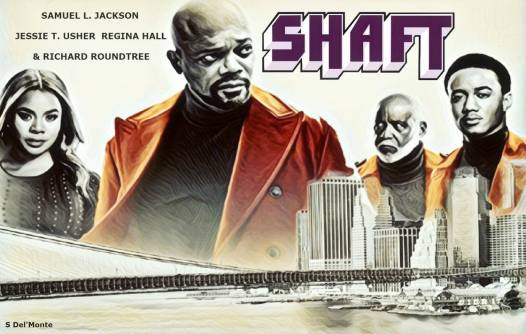
I think the Taco Bell by the movie theater has finally closed down. Maybe there aren’t enough people to work there anymore? — We are winning, America! — And so it was prophesied that L & D sat in an essentially empty and quite large multiplex theater to see Samuel L. Jackson star in Shaft. The film started off on shaky ground with some intensely stiff acting and dialogue. But luckily for everyone involved it loosened up once Mr. Jackson arrived on scene. 

If you’ve ever watched any Blaxploitation films, say on the Bounce network, (which I get on TV airwaves here in Northeastern Wisconsin — though if that’s not enough for you, Bounce owns Brown Sugar, a 1970’s era Blaxploitation on demand service) there’s one common denominator, namely low production value. Bad, I mean bad! lighting, awkward, I mean distractingly awkward! editing and poor, piss poor! composition people. Is there a reason for this? I’m sure there is. The reason has to do with low budgets. Those days are gone, as the new Shaft has the production value of a James Bond film. The lighting, camera movement, wardrobe, art direction and sound are of the highest caliber. The film has enough confidence in itself to make light of the genre. For example, when Shaft is about to enter a shady nightclub, there is a blatant smoke machine hidden behind a trash can spewing way too much non-motivated smoke. It’s confusing at first until you get the joke. Then, in a most excellent scene, Shaft is in the apartment hallway of his ex-wife. He is at her door, pleading to be let in, when he is interrupted by a neighbor who gives him the stink eye. Suddenly the groovy music winds down like someone pulled the plug on the Rev. Al Green 33 that was spinning on your record player. As soon as the neighbor gets a look at Shaft’s gun, he is terrified and slams his door — the song cranks up to speed again. It’s a great breaking the fourth wall moment. 

I would be remiss in writing about Shaft without mentioning the great African-American writer of hardboiled novels and social narratives, Mr. Chester Himes. If you’ve never heard of Chester Himes, click on that link already. He delighted many readers and inspired many writers and filmmakers with his series of nine Harlem Detective novels. It’s safe to say what Raymond Chandler is to Hollywood, Chester Himes is to Harlem. And with this in mind, I really enjoyed Shaft. I have no idea if I was laughing at the appropriate places but I was definitely laughing. Even D, who was not impressed with the wobbly opening, started laughing. There is just something about Samuel L. Jackson, he really is like a funky Mr. Miyagi. After all, he has already portrayed a Jedi Master. Also, in one scene he reminds us that he is tired of the Laurence Fishburne comparisons! 

At its core, Shaft is a generation-gap-father-son film. It at least acknowledges that times have changed, even if it sticks to stereotypes. However, the stereotypes are with tongue firmly planted in cheek and with the good intention of the audience having a little fun. Of course here, the good guys win through violence, the Dad teaches the kid how to be a proper manly man and the women in the film either step aside, need to be rescued or forgive the unforgivable — or at least the truly shitty. It’s still a Blaxsploitaion genre movie but Shaft does have his heart in the right place even if sometimes his actions and words betray him. His character flaws and redeeming values are identical to Himes’ hardboiled heroes.

Yeah, it’s a family movie if your family eats expletives for breakfast, doesn’t mind people getting shot up with AK-47s and finds glitter all over a bare chest quite amusing. I’m not going to tell you if I found it quite amusing. I’m also not going to tell you where the glitter was on Shaft. In the final analysis, Shaft checked all the kick up your feet and enjoy a summertime movie for 6 bucks boxes but it wasn’t a great movie and certainly something you could enjoy in your La-Z-Boy recliner or loveseat at home. Also, motherfucker. A lot.

Rocketman

rocketman.jpg

Normally it happens that a film doesn’t live up to the sum of its parts. Yes, it has some good scenes and other things going for it, a great performance say, but it doesn’t quite hit the mark. Rocketman is the total opposite. You could rightly say that there is no character development outside the protagonist, that the musical numbers are unevenly spaced throughout the narrative, that we ourselves L & D could have written a better storyline. These and many other things like the flat ending, you could certainly ding this movie with…and D did, on the car ride after the movie. Though I agree with all the critiques, the sum of all these sideways elements didn’t stop me from liking the film. 

First and absolutely foremost is the music. Even as I write this review, the song “Someone Saved My Life Tonight” is going through my head. I’m not even sure if it was in the movie. It most likely was, but the point is that even several days later I’ve been singing all kinds of Elton John songs to myself…and it’s great. Who do I think would like this movie? For any Elton John fan, this is “must see TV”. Though it could be considered an extremely elaborate vanity piece, I was actually surprised that Elton John himself produced the movie. I don’t think it necessarily shows him in some type of perfect spotlight. It’s definitely a warts and all depiction. I didn’t know a lot about Elton John it turned out. For example, his most famous songs were written by his friend Bernie Taupin. It would have been fascinating to know about the inspiration for these songs. This goes back to the supporting character development critique.  Rocketman could be read as a “buddy movie” where only the motivations and situations around one of the buddies is explored.  But maybe Bernie’s story would be more justly told in a stand alone Bernie Taupin feature? So who else would like it? Anyone interested in a good gay coming out movie. Anyone interested in rock music of the 70s and 80s. — I’m increasingly convinced that no one made it out of the 80s unscathed. Who else? Anyone interested in stories about families and father, son relationships. I thought Rocketman had more in common with Billy Elliot, the story of a boy who wanted to be a dancer, with music by, you guessed it, Elton John, than with say Bohemian Rhapsody. In fact, though I have knee-jerk cringe that comes up when characters start breaking into musical tunes in the middle of scenes, I was thankful that Rocketman really told the story of a 70s/80s British rocker in a different way. 

I appreciated that beyond the elaborate camera moves, choreography and stunning production value there really was a story in there about a little kid who wanted a hug from his dad that he was never going to get and about the same guy who had to learn to love that little kid. I thought it was a cool story and the flaws just piled up to make it interesting, different. Kind of how a camera lens with a bunch of aberrations can actually give a soft, warm feeling.  — We didn’t like Bohemian Rhapsody anyway.  

I’m not exactly sure what makes a great rock biopic. The clichés just kill the genre. I’m a fan of Anvil: The Story of Anvil. Though that is technically a documentary. I love Ladies and Gentleman, the Fabulous Stains, though The Stains are not a real band.  I remember liking Last Days, Gus van Sant’s offering about Cobain and 24 Hour Party people about the scene in Manchester in the 80s. Ultimately, I think Rocketman though flawed in many aspects will be remembered as solid statement about who Elton John was, what his songs meant and how he came to be the rock icon that he is. 

Booksmart

booksmart.jpg

Booksmart is an intelligent and funny mashup whose ROFL parts don’t necessarily add up to a must see movie night. And even though my job as a high school film teacher was on my mind entering the movie (with the end of the school year upon me, as in the film). And even though the film is ostensibly about high school, it nevertheless did help me laugh. So if you want to kind of get away for a while and have a few good laughs I would recommend this film to you. But if you are looking for a solid all around film on the par of a Lady Bird or Eighth Grade, Booksmart isn’t going to cut it for you. 

As a mashup, Booksmart incorporates the awkward feeling of Eighth Grade, almost like a sequel but without the sense of predestined gloomy finality. It’s not the funniest thing you’ve ever seen (The 40 -Year-Old Virgin) or the most exploitive (Assassination Nation) or even one of the funniest things (Office Christmas Party). But like Long Shot, it certainly has its moments. There is also a feeling here reminiscent of the classic Scorsese comedy After Hours and Blockers with the primary action taking place over the course of one twisting crazy night. 

Many of the characters in Booksmart do seem familiar in spite of their one dimensionality. And the film does to its credit try to go into a little more depth with some of the characters. There is also a shout out to Gilmore Girls, which is apropos. If you’ve ever seen His Girl Friday or any screwball comedy, the lines come fast and furious, the banter withering, the re parteeing. So it’s unrealistic in that sense but some will find the style engaging. There are also just absurd moments that I loved like having fencers in the background of a scene in the high school courtyard. But this is followed up with grounded conversations about real world dilemmas. Falling off the edge of high school, like The Graduate. As I mentioned in my Eighth Grade review, it’s not easy being a kid and that certainly comes through in Booksmart as well. I found that though the film pulled from many sources and familiar storylines it also seemed to create an original synthesis. The pool scene and airport scenes were beautifually shot, the graduation scene, reminiscent of Stripes was also well done. 

There are some great cameos here by Jason Sudeikis, Lisa Kudrow and Will Forte. But I think the film is stolen by the eccentric and totally out there frenemy Billie Lourd as Gigi.

Booksmart certainly hit the 6 dollar Thursday bar, kept me laughing and thinking and covered some original cinematic ground with a strong mashup style. Do I think that you could also happily wait for it to stream on your favorite platform. Yes, I do.   

Us

us.animated.gif

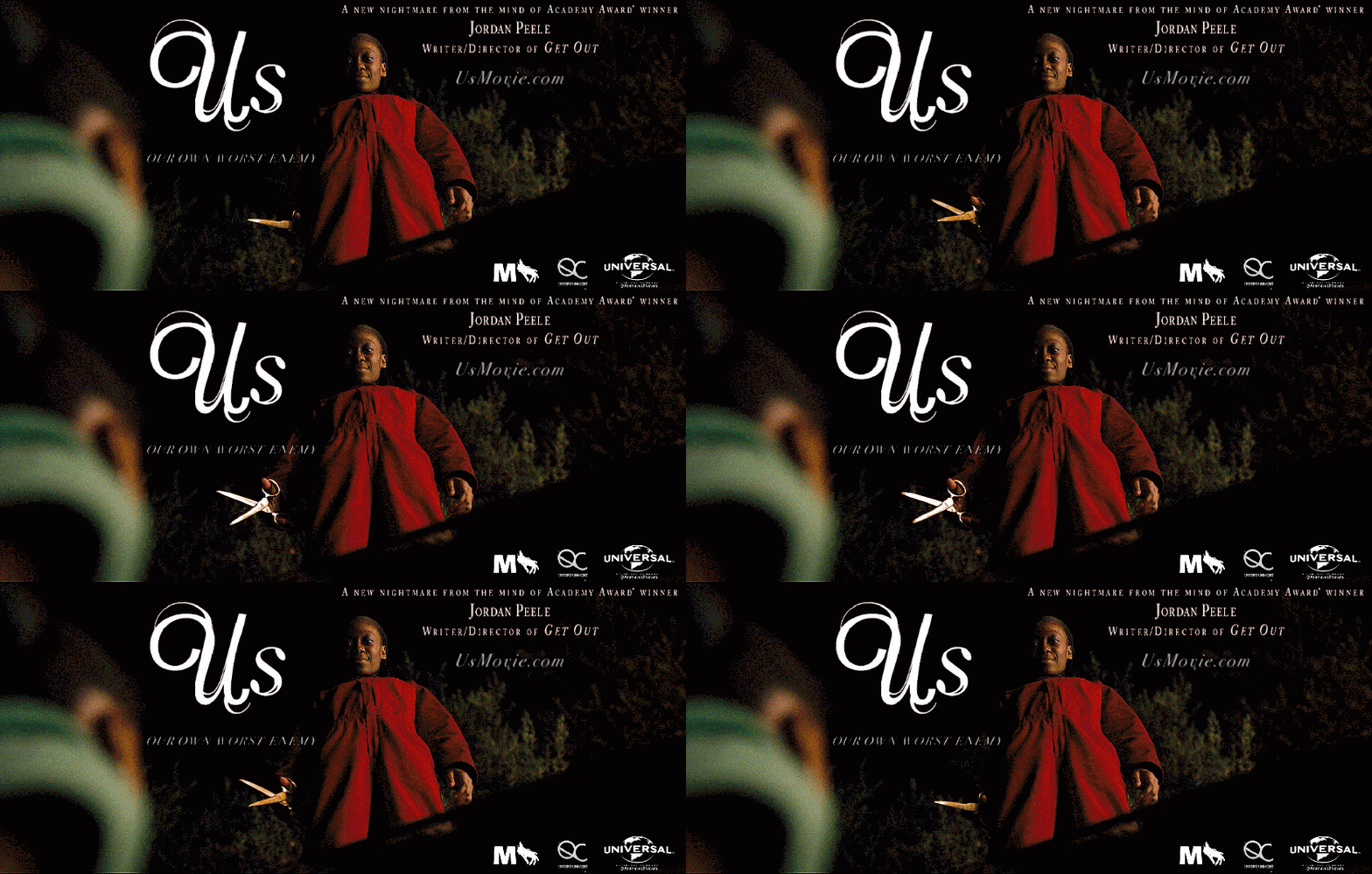
Us is a bad LSD trip the inner mind of Jordan Peele is having that we, the audience, communally share.  As a former Banana Slug, I can attest to the utter appropriateness of Santa Cruz as the location. It’s a proudly weird place, a vortex of time and space, a living breathing acid test in motion. The film draws inspiration from and pays homage to some pretty varied sources, most notably Dante’s Inferno (but also Dante’s Purgatorio), Oscar Wilde’s The Picture of Dorian Gray, the Bible, The Shining, The Lost Boys, Stranger ThingsHot Tub Time Machine, Zombieland, Thriller, Charlie Chaplin’s City Lights, Jaws, Black Flag, Bernard Herrmann’s iconic scores for Alfred Hitchcock, Childish Gambino’s This is America music video etc. etc. etc. And it’s all tastefully and often humorously done. 

Our clerk at the concession stand did an amazingly good job summing up the movie, even though his tag said his favorite film was La La Land. His 1 minute critique was concise, precise and didn’t include any spoilers. He said it was not a horror film but more of a slasher, suspense film that was very entertaining and had a great ending. We replied — Yes, we would like butter. We would always like butter.

The density of the film in terms of references and symbols made D and I both come to the conclusion that we could watch this film many more times and still not be able to get everything Jordan Peele was trying to express. And at least for me, that’s okay. Us made my heart beat fast for its entire 2 hour and 1 minute run time. When I was using the restroom after the film, absolutely everything was freaking me out. The sound of the paper dispenser, the feel of the water faucet…my senses were certainly heightened in a way I hadn’t felt since Besson’s Lucy had me freaking out, sweating and staring at all the surveillance cameras on the traffic lights in L.A. 

In the sense that Us has a profound ability to move you, Us wins. The plot is most certainly flawed, the density of references and meanings may turn off some people but ultimately, it is a thought provoking allegory and entertaining film. If some gore, violence and blood don’t turn you off, I’m sure you will heartily enjoy Us. In Slug parlance…doood, the flick is a total trip. 

Alita: Battle Angel

alita.jpeg

I was afraid that Alita would boil down to a cool special effect searching in vain for a story. And it was sadly just that. Not even the all-star team of Robert Rodriguez, James Cameron and Bill Pope could save this snake of story from eating itself. A homage to everything from Blade Runner to Ready Player One the remarkable visual effects creating the protagonist Alita, played by Rosa Salazar, particularly stand out in a fresh way. In fact, if you considered Alita simply from the point of view of the effects it would be a fantastic film. We watched in 3D and the depth of a few of the shots were sick without making us sick. Though some foreground elements did seem distracting at best. You would think that by now people would have gotten the hang of how to shoot 3D. Not yet. But compared to other 3D films, Alita seemed almost designed for the experience.

In the same way that the sum talents of the all-star filmmakers didn’t add up to a stellar film, all the effects in the world in and of themselves, didn’t make for a compelling story. There are plenty of interesting supporting characters but there are also obvious and cringe worthy tokens. And for a film co-written by a woman, it’s disappointing to note that Alita: Battle Angel glaringly fails the Bechdel Test. According to an interview with her in the Hollywood Reporter, co-writer Laeta Kalogridis likes to tell the story of how she got fired off Bionic Woman in part because she was told that she didn’t know how to write women characters. I don’t think the intention was that she stop writing them completely.  

The sort of Running Man meets roller derby aspect of the film to me is where credulity breaks. Where the film a la Arthur Herbert Fonzarelli on a waterski on a lake jumps the shark. It’s an obvious, and as D would say Deadpool would say, bit of “lazy writing”.  An absurd ploy for action that unnecessarily moves the film into “Feed the Hollywood Machine” territory. If the writers had as much faith in the life and stories of these characters as they do in computer generated imagery, Alita would have had a chance to breakout of the stockpile of special effects driven yawners. Note: Thankfuly it’s the end of Oscar season and we can expect some more interesting films to be released soon. 

If you are really into sci-fi or computer graphics driven films you might find Alita entertaining. I know we were actually highly entertained but mostly because we were saying the lines out loud about 10 seconds before the characters delivered them. 

Curiously, the only two other sentient beings in the massive theater were a man and his dog. The man was laying down across a few seats fast asleep but the dog seemed to be really into the ending credits. There is a scene in Alita where a pack of robotic dogs goes after a bad guy, so who knows, maybe the canine in your life would really enjoy this film. 

Serenity

hero_serenity-2019.jpg

ABSTRACT

Conclusions and Relevance  If you like watching Matthew McConaughey do anything or nothing at all with his shirt off, this movie was made for you. Further, if the idea of a topless Matthew McConaughey trying to reel in a giant tuna makes you involuntarily gnaw at whatever it is you happen to be holding in your hand then this is must see cinema. For the rest of us, not seeing Serenity will add 1 hour and 59 minutes to what poet Mary Oliver calls our “wild and precious life”.

With a TBI (Taco Bell Index) of 1, i.e., one car in the Taco Bell drive thru near the movie theater, Serenity was doomed from the start. Consequently it happened to be an extremely low turnout for opening night. Word must have gotten out. Do people read reviews? Or at least the headlines of reviews? In any case, I came in open minded and found there are actually a few things that Serenity has going for it. In terms of production design, it’s fantastic. The creation of Plymouth Island is impeccable down to the Maersk logo on the shipping container that professional fisherman Baker Dill (Matthew McConaughey) calls home. And it’s enough to throw you off in an interesting way. Examples: Speaking French but driving on the British side of the road. Caribbean style street vending carts and the typical pastel colors of that region but in a Polynesian landscape. Shrines to Hindu deities yet a constant spin of zydeco on the radio thrown into the mix. All to seal the idea of a place that is everywhere and nowhere. There is also some genre bending, with a noir drama meeting a psychological sci-fi thriller. Serenity is an elaborate Twilight Zone episode peppering you with some well-thought-out clues along the way. Solid performances by Anne Hathaway, Diane Lane, Jason Clarke, Djimon Hounsou and Jeremy Strong shore up this tangled web of McConaughey letting lose and going Full McConaughey — in the best way. 

So where does Serenity go sideways? I was going to say where does Serenity sink but my better half (not D, but rather my wife) informs me that I am too young to be making those types of jokes. However, I’m not too young to make dudity jokes, of which many were made at the theater as there is a fair amount McConaughey dudity (aka male nudity) as referenced in the abstract to this review. Back to the point being that the reveal, the twist, is exposed too soon. The denouement spreads into a facepalm inducing news reporter VO, then into a vomit-in-my-mouth-a-little inducing slo-mo hug of father son saccharine sap and mercifully crashes in an epilogue of a drone shot into the sunset. As the lights come up in the theater I commence with the head shaking. Why did the filmmakers let ACT III unravel like that? Was it a spell that McConaughey cast over them? I believe it was something to that effect. Not unlike the protagonist of this film, the filmmakers had a hard time viewing the story objectively. Some of this films’ strongest points come when issues of PTSD and existential epistemology are explored. But these lines of inquiry are quickly abandoned in favor of the noir yarn and so neither philosophy or McConaughey’s bare ass can cary the amount of credulity needed for this exploding can of worms narrative. In Serenity, the big one does get away. (Sorry, can’t help it.) Ultimately, as the TBI indicates, if you pass on Serenity you won’t be missing much. 

Ben is Back

Ben is Back Still.png

Ben is Back takes on a pressing issue in our society, the onslaught of opioids that have flooded our communities, as drug overdose deaths have tripled since 1990. This morning I was reading an article, “Massachusetts Attorney General Implicates Family Behind Purdue Pharma in Opioid Deaths” about a company so obsessed with sales that it paid 600 million in fines for intentionally misleading the public about the addictive qualities of OxyContin. The kicker being that even after that admission and pay out the company expanded its efforts, sending even more sales reps to convince doctors, nurses and pharmacists to prescribe even more Oxy. Why? For perspective, one company memo details how through overprescribing just two doctors made the company 800,000 in only two years. 

I believe Ben is Back will find an audience with the people and families who most need a message about addiction. Even though it plays like an extended Afterschool Special, with implausible situations that make you ask yourself, what exactly are the elements of an interminable movie? After a moving Christmas Eve mass scene, the plot shifts gears into modern day parable territory. A Dante’s Inferno meets Dickens’ A Christmas Carol mash up. It’s a good technique for the story but the pretext motivating the plunge back into the depths of Ben’s utterly messed up and devastating life choices seems flimsy at best for one so easily triggered. One character says out loud, “This doesn’t make any sense. What we are doing is not worth it.” I understand characters’ statements like this as a verbal agreement between the filmmakers and the audience. It goes something like, “We don’t actually expect you to suspend disbelief but if you don’t leave we can tell you what we have to say, which you will agree is a good message.” 

I am not saying that I could have come up with a more convincing story. Or that telling a story like this is easy. I actually sympathize with this film and feel like the filmmakers and actors were trying their absolute best. The film does boast powerful performances by Julia Roberts as Holly, Ben’s ever hopeful and grieving mother, Kathryn Newton as Ivy, the skeptical with reason sister and Lucas Hedges as a convincingly angsty Ben, who knows that there is little he can do in the face of this crippling curse, his addiction. The situation is as terrifying as A Quiet Place but even more so because we all know that this national scourge and personal tragedy is happening in real life as we speak.

In spite of the strength in the acting, production value and sentiment in this film, the parts don’t ever come together to form a greater whole. The cause is a meandering story that strains plausibility and telegraphs its plot points miles ahead of when they occur. However, this is an intelligent film with a lot of heart that also has the possibility of spurring on conversations around this most critical of social issues. It may not rise to the level of a classic family drama as say Ordinary People but Ben is Back will provide a powerful message for those closely dealing with the problem of addiction and as a cautionary tale for many others. 

Power

Power JPG.png

In the last calendar year and in this year so far, the political biopic, i.e., biographical movie, has been a constant movie occurrence. Or is it eternal? It seems we will always wonder about the lives of people who shape history. 

In this essay I cover some of the political biopics that caught my eye and moved me one way or another. Though there are others, the recent depiction of Winston Churchill comes to mind, that don’t make the cut here. 

But let’s take these: L and D’s top film of 2018, The Death of Stalin, Chappaquiddick, The Front Runner, The Favourite, Mary Queen of Scots, Vice and On the Basis of Sex. 

One of the foundational rules of filmmaking is to show, don’t tell. Just keep that in your back pocket as you read this. Another rule of thumb is that in a short film, having one strong protagonist is the best way to keep an audience involved in the story. And you can extrapolate that to features. It’s easier to keep the audience if your film isn’t meandering or involving many points of view. There are exceptions of course. The most recent Murder on the Orient Express had a fantastic cast and even though I deduced who the murderer was in the first 5 minutes it didn’t fail to captivate me as a story. A film can also cover many years and still be powerful, it’s just more of a challenge. Citizen Cane does a good job of it. As I said, there are exceptions. Now if it were just a case of dramatizing a given situation, some kind of winning formula, I wouldn’t have had one of my greatest movie going disappointments, Sully. Moments after take off a plane crashes into the Hudson River. The pilot is able to land the plane without loss of life. Sounds like an incredible movie but really, it’s just an incredible moment. There is no formula for a hit movie, just some guidelines. 

I won’t rehash our review of The Death of Stalin here. Suffice it to say, you get to know Stalin in the exposition. You witness his death. There is a mad power vacuum that ensues. Society, which was absurd and unjust during Stalin’s lifetime, threatens to absolutely unwind in the time shortly after his death. The performances are outrageously good. It’s a true masterpiece of dark humor and grim reality. It gracefully paints a portrait of one dramatic moment in time.  It trusts that you understand something of the workings of the Bolshevik revolution and something of what happens after the time in question. 

Chappaquiddick and The Front Runner are films that needed to come out around the time of the incidents they portray. They are past relevancy, poignancy.  They, Like Mary Queen of Scots, would have you support protagonists who are well past complicated and simply obstinate. I would say that the Mary Jo Kopechne drowning scene in Chappaquiddick is so powerful that you could never argue that the filmmakers are Ted Kennedy apologists but they are not far from it. And though that film does concentrate on a specific moment in time, the drama gets completely bogged down in rooms and meetings. It fails to show as it falls back on telling, on merely depicting people talking into phones and scheming. “But that’s what happened” you could argue. Well, it’s not cinematic. 

The Front Runner also gives us a clueless presidential candidate who seems totally out of touch with the times. But it does smack of apology for bad behavior. I will never get over how the defining moment for presidential hopeful Gary Hart was a trip on the boat Monkey Business but it is somehow not even the title of the film.  In the film there is a scathing one minute monologue by Johnny Carson via a TV set Hart is watching.  The entire film is summed up by Carson. Like Chappaquiddick, Front Runner tries to milk this one defining moment and devolves into representations of phone calls with his wife and spin meetings with his staff.  Talking not showing.

Mary Queen of Scots certainly does a fine job of depicting action. There are plenty of horse rides, a battle, a stabbing and even a decent explosion. But if you have a political character that’s not likable, whose motives aren’t honorable or who feels entitled and again, out of touch with the people, all the action in the world will not save that story. There is also plenty of staring into space by the protagonist, the movie seemingly falling in love with its very existence. There is also no backstory whatsoever besides titles. I’m not sure if titles are even worse a sin than talking vs showing in film. Again, there are always exceptions, like the opening titles of Star Wars. One of the more interesting aspects of another film I will get to, Vice, is the depiction of the early, more formative years of Dick Cheney. You may never agree with him but you understand where he is coming from and his drive for power. This never happens with Mary Queen of Scots. The audience never gets invested in her story. 

Which brings me to the aptly titled, The Favourite.  The audience here is instantly invested in the fortunes of a former lady as she attempts to regain her status in proper society. As the intrigue at Kensington Palace thickens the feeling of suspense only grows. There is plenty of blood and guts, scars and plain ol’ wild outbursts in this film. You understand exactly the perils which the protagonist must endure, the indignities she has to suffer and the level of cunning needed to ascend. It’s a startlingly good performance by all of the main players and easily a top L & D 2018 pick had it been released sooner. But to go over what works, it focuses on a main protagonist, during a specific time period with well established obstacles and goals. As each scene should have obstacles and goals for the players so should each film for its story.  It’s completely cinematic at every opportunity and lets the audience sympathize with the plight of the protagonist and share in her plots, schemes, victories and defeats. There are moments when the star of this film stares off into thought, but those are moments of gravitas that are not overused and therefore dulled or self-serving. 

I had high hopes for Vice. It starts off strong enough, as we discover the ne’er-do-well Dick Cheney. The man is a simple mess, looking at life through the bottom of a beer bottle. This really sets the story up nicely. However, it goes off the rails, at once blaming Cheney for every ill in society since 1974 and trying to excuse his politics. The side splitting laughter of then secretary of defense Rumsfeld when asked by Cheney, “What do we believe in?” is all you need to know. It’s tough for an audience to get behind a character whose own moral compass blows with the wind. And perhaps to answer why he did what he did in a word would be — power. Because he could. The yin to the yang of Alex Honnold free solo climbing El Cap is Cheney being the puppet master behind the 2003 Iraq war.  

Vice’s meandering is quite unlike On the Basis of Sex, which is a beautiful and elegant movie that surprised me with a succinct narrative. Cinematically told with great period shots of Harvard, Denver and New York City. Focusing on Ruth Bader Ginsburg’s days at college, starting out as a professor and eventually arguing a case before a federal appeals court.  It didn’t try to cover all of her cases and therefore the story never gets muddled. It stays specific to one early case, complicated enough to be interesting yet simple enough to be enjoyable. And obviously we follow the one main point of view, Ruth Bader Ginsburg’s, as it evolves into the voice of a generation who fight to set a new legal landscape for women in America. 

So power can be represented in many ways. There is no formula for a successful political biopic film. But there are things that work. Letting the audience get to know the characters, their early lives and motivations. Remaining cinematic throughout the film and not getting bogged down in conversations and static shots of one actor on a phone in a small room. Understanding that one event alone does not make a film. Not trying to cover too much historical ground but creating a story around specific defining moments. Establishing a few simple obstacles and goals that the audience can be involved in as the protagonist strives and achieves. Is it easy to make a great film? It’s not easy.  But it’s fair to say that of this most recent slew of biopics only a few filmmakers have been able to surpass this high bar.