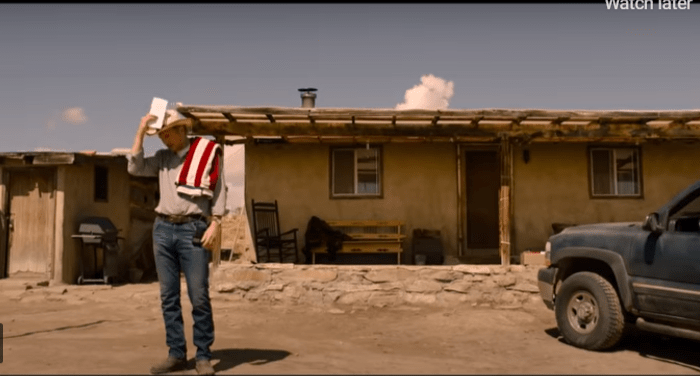
The Marksman *½ This is an uninteresting movie wherein America’s lugubrious and potentially unhinged uncle (Liam Neeson) plays a retired USMC soldier in Trump-era Texas. Jim Hanson now (mostly) pays the bills herding undernourished cattle while assorted would-be immigrants make their way across his land and on into the States. The opening of the film shows Hanson in all his beleagueredness, a master class in American dismay cliché, when he happens upon a tense border-crossing. The conflict involves two immigrant innocents and the ruthless Cartel thugs that want them butchered, with a non-English speaking boy insinuating his way into Hanson’s consciousness. Trump-era Texas isn’t the friendliest place for an only child on the run from The Cartel, so Hansen takes it upon himself to take him to the next of kin.
The metaphors (and the parallels between this movie and News of the World) are thick in this one.
Early in the movie there are many interesting shots of the landscape, where you can see almost as far across Texas as you can see into the plot of this one.
Well, I know it’s hard to make a film, so let’s accentuate some positives. I did sort of enjoy Neeson in the anti-Taken role as the bumbling idiot of a savior. And I did smile at the film’s nod to the 80s classic, Witness, though I have to wonder where that farmer went. The bit about Chicago hot dogs not having any ketchup was right on target. And an extra half star for the dog.
So that’s a wrap. Time to get on a bus and take a nap.
News of the World *** This is a potentially interesting movie wherein America’s dad (Tom Hanks) plays a retired Confederate officer in postbellum Texas. Captain Jefferson Kyle Kidd now pays the bills reading the news aloud on the Texas circuit amidst the Yankee troops and assorted miscreants (including L&D fave, Michael Angelo Covino). The opening of the film shows that Captain Kidd picked up some scars in the conflict, but those scars run much, much deeper, of course. In his travels, he happens upon a butchered family with an adolescent, non-English speaking girl as the sole survivor. Postbellum Texas isn’t the friendliest place for a child separated from her parents, so Kidd takes it upon himself to take her to the next of kin.
The metaphors are thick in this one.
Overall, worth a look. I really liked some of the visuals, particularly the shots coming into town. Hanks is super, of course, as is Helena Zengel as the child. Lots of nice inside-outside comparisons with light and mood (testy crowds seem to be everywhere).
Everything about the movie is completely believable except for the hour in the middle. If it’s Trump-era metaphors you are looking for, this one’s a winner.
Promising Young Woman is an interesting and frustrating movie. If you’ve seen the trailers, you know that one of the principal plot elements is that Cassie (Carey Mulligan) spends her free time pretending to be outrageously drunk and allows men to take her home. What happens after that doesn’t appear in the trailers, so I’ll leave it out, but the root cause is due to a horrible incident that happened to her best friend some years ago.
The movie is much better than the trailer promised, a bit predictable in spots (plenty of foreshadowing), but not really for the long game. My frustration is that Cassie’s approach to the problem doesn’t seem particularly healthy, the people who have “moved on” seem a bit too dismissive of the underlying problem, and Cassie’s response to those people is rather glib, often snarky, and ultimately unsatisfying. We’re all in a box, nobody gets absolved. In this context, the resolution of the film seems logical enough, but hardly a satisfying outcome.
In the minus column, we hit a stretch just past midway in the movie around the Dean and her daughter that I could have done without. I am not sure if the script was poor of if the plot-line was unwriteable from the outset. Possibly both.
In the mixed column, the pop culture references were quite thick herein. I was aware that I was being bombarded with allusions to things, but I am too old and too square to know what they are. I am certainly not the target audience and I’m not sure quite how the target audience would respond to this. But the first 40 minutes it’s pretty thick. I did like a lot of the sets, including a living room scene where I was the only one in the theater laughing out loud at the décor, suggesting that maybe perhaps there was something for everyone.
In the plus column, Clancy Brown did a nice job as Cassie’s dad and L&D favorite Bo Burnum is outstanding and often hilarious as the tall doctor guy. Almost hilarious enough to recommend this movie straight up. And Mulligan is mostly very good in a rather challenging role.
This was by far the most crowded we’ve seen the theaters, possibly because they quit showing the late films on Tuesday. But, weirdly, it seemed like a lonely crowd. I am looking forward to the end of the pandemic and the reunion of L&D for movie nights.
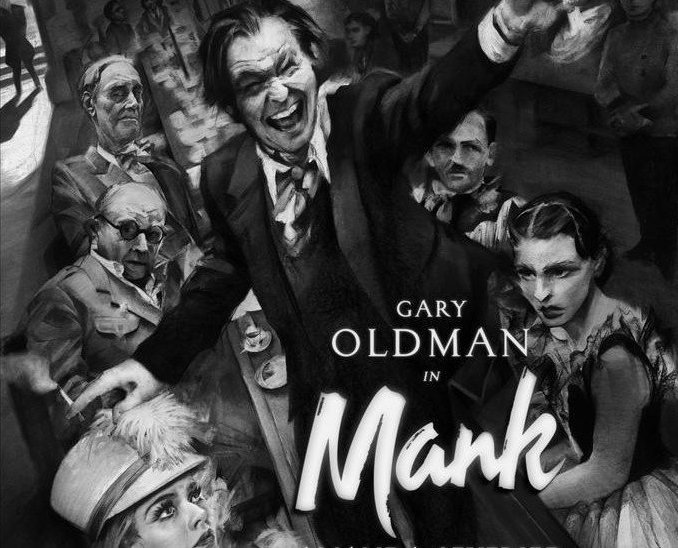
With a David Fincher movie, you know you are going to see a well crafted work of art at the highest standards of the cinematic craft. Fincher himself championed (the rumor was part-owned) one of the first cinema grade digital cameras, the Viper, which was groundbreaking back in the aughts. With Mank, I’d also congratulate Cinematographer Erik Messerschmidt on some exquisite and indelible images. If you’ve ever been up to Hearst Castle for a visit and imagined what the grounds must have been like back in the days when Chaplin was a regular house guest and tickling the ivories after dinner, this film will give you some idea. Famously, newspaper mogul W.R. Hearst kept a menagerie including escaped zebras that still roam San Simeon to this day. In short, it’s really a beautiful movie.
Gary Oldman is transcendent in the role. He becomes Mank in a way that we will forever associate with someone who we hadn’t really thought that deeply about before. It’s a profound performance in its subtlety. He takes on a character under all kinds of pressure and brings levity and in turn empathy from the audience. Gary Oldman is someone else who merits our high expectations.
Perhaps oddly, Citizen Kane, the film that this one revolves around, though drummed into my brain in the countless film classes I’ve taken — and the subsequent passing on of such drumming to my own film students — has never really spoken to me. I’d rather curl up to say, It’s a Wonderful Life or Strangers on a Train. If I’m supposed to go crazy for deep focus shots, there is always Ozu (Master Japanese Director, not Greek alcohol, though I’m sure there’s an argument that can be made.)
What does strike me about Mank and Kane are the close-ups. As was done with great precision and emotional effect by Director Neil Butler in this years’ fabulous short, “Herzog & Morris”, the extreme close-up can work like a punctuation mark on an island all its own. Editorially, it doesn’t have to graphically match on action, it doesn’t have to flow seamlessly from the previous or following shot. It can just be there saying, check me out.! Just like that.
The genius here is the threading of these purely cinematic punctuations within the great theatre that, in this case Gary Oldman, brings to the role of Herman J. Mankiewicz. Mank, a mensch who saved an entire town from the Nazi’s but is himself drowning from the bottle. In real life, he would die the year after writing the script for Citizen Kane. The film also gets into his battles with Meyer, his employer and unscrupulous if not downright evil head of MGM. Though Meyer, Wells and Hearst for that matter, are painted in caricature in order to focus more on the relationship between Mank and Hearst’s mistress, the Brooklyn actress and future philanthropist, Marion Davies, played convincingly by Amanda Seyfried.
The film also takes a stab at the sociopolitical milieu and the crushing hand of the studio and dominant political class. These sub-plots work in the sense that we can get to know Mank better in relief; as a man with a conscience, a backbone, a gift for storytelling and ultimately a disease that he couldn’t escape.
If you have Netflix, I highly recommend this adventure and if you don’t, I’m sure that this title will find its way to your library’s shelves or streaming service soon enough.
What can you reasonably expect going into a Jackie Chan vanity project with a Metacritic rating in the 30s? A big bucket of popcorn, a few laughs, a lot of stuff blowing up, and some hand-to-hand fisticuffs?
I guess we got that, but, boy was this one tough to sit through. The story was stupefying. The CGI was objectionable. The car chases were worse. The movie kept trotting out a series of unconvincing villains. The jingoism was omnipresent. And the action wasn’t really that good.
There were some high points. There was one guy who made a funny face when he got knocked out and zapped with a cattle prod (we thought it would be a running gag, but it wasn’t). The man pictured above had a really hilariously large gun. There was a not bad kitchen scene where the good guy kept besting the bad guys with various dimensions of culinary splendor. And the end credits were actually quite a bit more entertaining than the rest of the movie.
I would say the best part of the movie is thinking about where you draw the line on stupidity. The entire project is so bafflingly stupid that any specific complaints probably reveal something about the element of the complainer. My companion, Dr. B., was particularly annoyed at the young woman who cuddled lions in the wild like kitty cats, and at the guy who was dead for 10 minutes (spoiler alert) and then was miraculously revived. I thought a car falling 100 feet and landing intact was a bit of stretch and two cars was a bit stretchier. But, in fairness, they were Volvos!
So if you want a chance to enjoy a movie in the comfort of your own theater (who in their right mind would go see this?) this is the movie for you. But let’s just say that 35 Metacritic rating is at least 10 points too high.
The major questions of The Last Vermeer are (1) Why isn’t there more Guy Pearce? (2) Why isn’t there more Vicky Krieps? (3) Who cares about the Claes Bang character? And, (4) who wrote this, anyway?
I had only a vague idea of the movie’s subject matter as I walked in, so it took a while to figure out what the big reveal is. But after reading a few reviews, perhaps the big reveal is known to most going in? If that’s the case, this is a big, big strike against the movie.
Leading with the positives: Pearce, especially early in the film, has a very intriguing, relaxed manner about him in the role of Han van Meegeren, the sketchy Dutch artist wheeler dealer. He sports some spectacular eyebrows and an impeccable wardrobe to go along with his splendid household and liquor collection. Yet, his character never gets fully fleshed out, so it’s never clear exactly what to make of him. Or perhaps it is? Good, but underutilized.
We are also treated to August Diehl and his quasi-comedic portrayal of a Dutch law enforcement bureaucrat, clad in what appears to be the bad-guy costume from Raiders of the Lost Ark. His hat with the flat brim is spectacular. I’m not sure what to make of this, but I laughed and you will too. Winner.
On a less positive note, Vicky Krieps is pretty much wasted. She plays an assistant to Captain Joe Pillar in his investigation of some untoward art dealings, but we don’t get very much of her on screen, and we don’t learn too much about her. Her character development and acting was so splendid in The Phantom Thread that I was waiting for a wooden shoe to drop in this one, but it never did. Her character isn’t important to the story in any way that I can remember, and that’s a problem.
I guess the bigger problem is that the story revolves around the Captain in the first place. Big mistake.
And so that’s it. The more I think about this movie, the less I like it. Technically it was fine to good — someone spent some money here. There were a few striking images of post-war Dutch cities, but far behind, say, Jojo Rabbit. There is also a bit of an art history lesson making its way through despite the awkward script. I enjoyed watching Guy Pearce mix the paints and discuss the art world, though the characterizations of the Big Art establishment play out as caricatures.
Mostly, though, it’s hard to get around the odd focus on the forgettable main character and the obviously contrived courtroom “drama” that unfolds. Remember the Brady Bunch episode where Mike Brady drops the briefcase behind the whiplash claimant? That strikes me as more plausible than what transpires here.
This seems destined for your Netflix queue purgatory, something that you imagine you would like to see, but you never get around to actually seeing. Then one day it’s gone and you aren’t that sorry you missed it. I did enjoy seeing the big art on the big screen, so if you are hitting the theaters regularly, this isn’t a terrible option. But that says more about what’s available in theaters these days than what this movie has to offer.
A friend recently sent a letter via snail mail to ask my opinion of a NYC 80s cult classic titled, Liquid Sky.
I couldn’t find Liquid Sky in the fantastic collection at my local library (APL I’m lookin’ at you!) and was feeling stumped. So I asked another friend who happened to have been a NYC filmmaker for quite a few years and might have some insight for me. She tracked it down on the Dark Web, a place called…YouTube.
Liquid Sky refers to heroin and this opiate takes center stage in the drama. Apparently, the unseen aliens who zap anyone reaching orgasmic ecstasy within range of the saucer they have landed on the protagonists’ downtown penthouse are into any type of endorphin rush.
The odd part of this at times difficult film (you have to pay attention to keep up with the patchwork plot) is that it’s not a celebration of Bacchanalia or the hedonism of late 70s & early 80s NYC New Wave/No Wave culture. I’m not sure if the death by sex theme here, a mainstay of any slasher movie you’ve ever seen, is not simply a moralistic take by the producer/director and writers. (This 1982 film is pre-HIV/AIDS hysteria as revealed by one character who references that she might get syphilis —as a worse case scenario). Is it merely a critique of American society by the Russian filmmakers, using as a cultural trojan horse the ultrahip stylings of New Wave fashion and music and the general vibe of 80s underground New York City (of which I’m a sucker for). Certainly, it’s an intelligent film, under the far-fetched script and cheeseball special effects. And the bad guys (and a girl!) get what’s coming to them—or more accurately stated, what they are coming to.
I watched a film made this year called Execution, directed by Stavit Allweis, that was even more raw and had arguably even cheesier graphics. Basically it takes place in one room. The guys are rolled in one by one. Their heinous crimes against women are announced and they are killed before us in one way or another by a group of women. Not exactly a parable, as in Liquid Sky, but more honest in many ways. That is, if the point of Liquid Sky is revenge. I’m not exactly sure about the point. The more questions I seem to answer for myself, the more pop up. I know that the film is a kind of ethical minefield, with complicated and unsympathetic characters. I think Liquid Sky would certainly appeal to any nihilistic readers (or readers with nihilistic tendencies) of the L&D Report.
Another feature in Liquid Sky is the language. It’s got more blue streaks than a Midwest hair salon. The amount of F-bombs that get dropped would would make Tony Montana look up from a pile of blow. But it never seems inauthentic. It just seems New York.
Anne Carlisle creates a stand out performance of both characters, Margaret and Jimmy. This rivaled, if not surpassed, Cate Blanchett’s double turn as Cate and grungy cousin Shelly in Coffee and Cigarettes.
I certainly would drop Liquid Sky solidly in the NYC indie film, New Wave genre canon, along with Smithereens and Downtown 81. There’s hints of Scorsese’s After Hours and Jarmusch’s Permanent Vacation. There’s an air of Daryl Hannah’s Pris in Blade Runner. There’s the flair of David Bowie and there is a charge that’s reminiscent of Prince’s First Avenue in Purple Rain. Not even the film’s own disparaging take on the scene can erase or beam up the intrigue and excitement of that particular NYC zeitgeist.
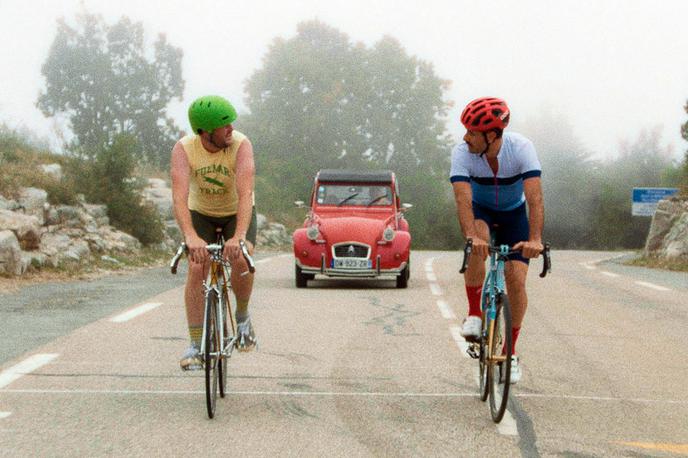
The Climb is a fantastic movie. It has the trappings of a buddy movie, but it also seems to be something of an anti-buddy movie. Right from the get go there is tension and conflict and violence, and that continues for the duration through a series of emotional set pieces.
The main characters are Mike (Michael Angelo Covino) and Kyle (Kyle Marvin), and that they both take their own first names as characters probably says a lot. Mike is extremely convincing in his role and is cast pretty much perfectly. The script is constantly telling us things about Kyle that we can’t quite see otherwise, which is really my only real complaint with the film.
The film does cover a lot of ground, mostly with a single scene or series of scenes within a short time period where the action and dialogue fill in what has happened in the interim. Indeed, there are a lot of elements that just go unexplained and it’s just as well (what were they doing in France?!?). The film offers a lot to think about, particularly about friends and family and relationships and loyalty and obligations and, ultimately, the capacity for forgiveness. It’s really great.
I was struck by the many recurring symmetric plot elements and settings sprinkled throughout the film. The characters get to engage with similar circumstances on multiple occasions, and the movie challenges the viewers to think about action and motive and why people do things for their friends and family, or do things that hurt their friends and family. The film has a surprising amount of physicality, often violent, occasionally touching and intimate (though not that hip thing intimate), not quite predictable.
(There is also a considerable amount of heavy drinking (Jägermeister shots, of all things. Smooth), so if that’s a trigger for you, perhaps you should avoid this one.)
Along with that, we are treated to several set-piece interludes, including an African-American cemetery crew, a Ukrainian three piece featuring some wicked accordion, and some middle-aged synchronized skiing! Perhaps visceral is a better word than physical.
Once again Dr. B was riding shotgun on this one, and once again we had the theater to ourselves, so far over the $5 I can’t even tell you. If you are immune to Covid, you should definitely make The Climb.
Let Him Go is in the theaters and L&D sent off representatives to investigate. It’s a Diane Lane, Kevin Costner vehicle, spanning the great Rocky Mountains of Montana to whatever you call those crazy rock formations in North Dakota. The film delivers intrigue, tension, and more than its share of nauseating moments, but ultimately it feels like one of those **- movies you come across on FXM at 2 a.m.
The main attraction of the film is that it is dramatic, spine tingling, dread inducing, just generally a tense affair. About 15 minutes in I was asking Dr. B whether we maybe should have picked another movie. That it wasn’t entirely predictable really helped keep me curled up in my seat.
The major downside, and there are many, is that this is a genre film that hasn’t figured out what its genre is: The writing is all over the place. The two most developed characters are Ladd as the Type-A mother, and L&D fave Leslie Manville as the mater familias, and a doozy at that. Ladd was good in her role and Manville very good, but I still never really cared that much one way or another.
The big loser here, I think, is Kevin Costner, whose character isn’t really even one dimensional. A former lawman, grieving father (?), inept husband, excellent driver (!), what exactly is going on here? We learn a bit about his glory days and some vagaries about the heroics of his past life, but not enough to drive the car or to make sense of this mess of a script.
I suppose this is another modern Western, with an abundance of wide angle shots of the mountains and landscape and far off places. The film is putatively set in the 1960s and I’m not sure how much the crew actually had to do to transform rural Montana and South Dakota back to that age? But the film makers did do a very good job of ensconcing western remoteness and vulnerability into our consciousnesses.
What does Let Him Go ultimately mean? Dr. B and I ran through a number of candidates as the movie plodded along, but lost interest almost as soon as we exited the theater.
So if you are stir crazy and temporarily immune to CoVid (and you haven’t seen The Climb), you could do worse.
LnD not so recently experimented with the Netflix Party Chrome screen sharing extension. This really didn’t go anywhere as there was no one there in person to poke D awake, like there is in real life.
Since then I’ve learned that Netflix Party Chrome extension is most popular as a hack that kids use to thwart parental controls — cool!
Once we got past the need to use an emphasis in the word biopic (/ˈbīōˌpik/) I was off to the races on my review. These two films include some high powered talent but only one hit the mark for me.
In The Two Popes, Jonathan Pryce as Cardinal Bergoglio the future Pope Francis and Anthony Hopkins as Pope Benedict leave you with the feeling that they were both born to play these roles.
But this is not your Dad’s Pope movie. And it’s not a simple good Pope vs. bad Pope story. The one major standout element of this film, besides the uncanny acting, is the scope and originality of the cinematography.
If you’re settling in for a film where two dudes sit on a bench and have a theological conversation for two hours you are going to be sadly disappointed. Two Popes moves, even wide angle shots track, overhead shots go right through helicopter rotors and the torture scene will stand your hair up at attention. It’s not a movie about romanticizing the past but examining the current situation through it.
On the other hand, The Iron Lady is a film where you never get away from the fact that this is Meryl Streep playing Prime Minister Margaret Thatcher. The camera lingers on her. You start to wonder, who was the Director? Was Streep the Director? (No. No she wasn’t. (Phyllida Lloyd.) This isn’t some vanity piece. And Streep who no doubt uses an Oscar statuette as a toothbrush holder has got more chops than Chopin at an Austin BBQ. In fact, she slays in another Netflix film with Antonio Banderas and Gary Oldman, directed by Soderbergh, The Laundromat. But here, she never gets lost in the character and so we can never transcend her being her fabulous self. We can never really understand the complexities of the times and the struggles she may have had with her choices. (Yes, Streep won her, yawn, third Academy Award for this role).
You don’t have to agree with someone in order to find them interesting. Often, it’s quite the contrary. But The Iron Lady seems stuck in a debilitated present, that lacks movement, that lacks a living history—and motivation. If a film doesn’t offer the audience transcendence, even on a visceral level, the most basic level that cinema can give, then the audience will also never get perspective on either the historical figure as real person or their own lives in relation to that figure.
In terms of biopic, it’s really a challenge to make a sweeping historical film meaningful. There are so many possible storytelling detours and dead ends. It’s easier and I’d argue more effective to take a situation, like in the 2018 Ruth Bader Ginsburg film, “On the Basis of Sex” and turn your narrative around that. That film was about the late great Notorious RBG’s first time arguing a case in court as an attorney. And by concentrating on those specific events, the story speaks to universal truths. However, this is not to say a sweeping biopic can’t hit you hard or inspire you, because it’s achieved with aplomb and passion in The Two Popes.









 L&D Report