Aquaman

rev-1-AMN-TRL-89421-UM_High_Res_JPEG
Yes, that’s soldiers riding on sharks.

L&D continued our busy December with tickets for the late opening-night showing of Aquaman this past Thursday.   Regular readers probably know that we don’t particularly like trailers and try to time our arrival right for when the Marcus Theater promotion hits the screen.  This turned out to be something of  a problem, as the building was locked when we arrived, and we had to wait a good five minutes before an errant customer finally exited the building, allowing us to get into the theater and to our seats during the opening aquarium scene starting around midnight.

Well, let’s just say that we probably would have been better off had we remained locked out the the building.  The movie is spectacular and it is a spectacular mess.  By 12:20 I was looking at my watch.  At 12:45 I almost asked L if he wanted to leave.  After that, I just kicked back in my recliner and got what I deserved from expecting more from a DC movie.

So what about all of those critics and fans who say this is a triumph?   I’d say, yes, Jason Momoa plays the title character with gusto.  And, yes, the underwater visuals are pretty “trippy.”  Actually, the above-water visuals are pretty outstanding, too — I’m definitely up for a trip to the beach.  And, yes, it is an action packed affair.

But, there’s always a big but…

This story?  Really?  It’s a combination of canned story (evil stepbrother, disputed line to the throne, quest for world domination) and make-believe backstory rubbish thick enough to make the writers of the Star Wars prequels blush.  Even if there are seven kingdoms of Atlantis, do we have to visit all of them and have the evil stepbrother (Patrick Wilson) carry out a gratuitous execution followed by a series of explosions at every one of them?  It’s like Thor and Loki meet Jar Jar Binks and Kylo Ren (Black Manta?).  At least there were no annoying alien sidekicks in this one.  Even the extra scene during the credits is a disappointment:  that guy was mad before, but he’s really mad now.  Sorry for that spoiler.

As for the acting, aside from Momoa, the script doesn’t really allow for much.  L&D favorites Willem Dafoe and Nicole Kidman are both in the movie and both remarkably forgettable.  Is that fun for them?  Were they even in it?  Or is it just a CGI recreation?  Maybe we can ask next time they are in town.

What we are left with is $200 million in beautiful visuals and lots of drama-free action, and I just shake my head and wonder what could have been.  It amazes me what some of the most talented people in the world choose to spend their time doing. The recommendation for this one is to keep your money in your pocket.  On the other hand, “box office don’t lie!”  But, in this case, it might be telling you a little bit of a fib.


The Mule

598168050_XS

After battling off illness and a last-minute cancellation last week, L&D finally made it out to see The Mule at the fabulous Marcus $5 Tuesday special.  As we are both on pre-holiday diets, we bypassed our free popcorns and headed straight into a reasonably crowded late showing.

The verdict?  Well, to paraphrase Lloyd Benston, it’s no Gran Torino (HT: L). In the plus column we have some very good and probably memorable performances by Clint Eastwood and Bradley Cooper, the former in the title role and the latter the FBI agent out to get him.  After that, the movie just isn’t that compelling. If you’ve seen the trailers, you probably have a reasonably good idea how this all unfolds.  The third lead, Ignacio Serricchio as Julio, the handler, doesn’t get his own subplot and consequently doesn’t quite add up. Laurence Fishburne and Diane Wiest are each given one note to play and are uninteresting.  That said, we did like Andy Garcia as the affable cartel head, much better than those meanie thugs that want to replace him, that’s for sure.

That’s not to say that there isn’t a lot to like.   In addition to the solid lead characters, the production is pretty crisp and the movie has more than its fair share of tension.  Unfortunately, the back stories and supporting casts — Eastwood’s family, Cooper’s family, the Cartel drama — don’t add up to a story that will stay with us.  Indeed, the movie is based on a newspaper article, which isn’t terribly surprising given the strong central story line and the less fleshed out supporting material.  My guess it’s staying power will be about as great in your memory — you’ll remember the headline and a few details, but more as an anecdote than as a thesis.

So, solid fare, over the $5 bar, nice enough, but it’s no Gran Torino.

They Shall Not Grow Old

AP10_4_2016_000284B
hinky dinky parlez-vous

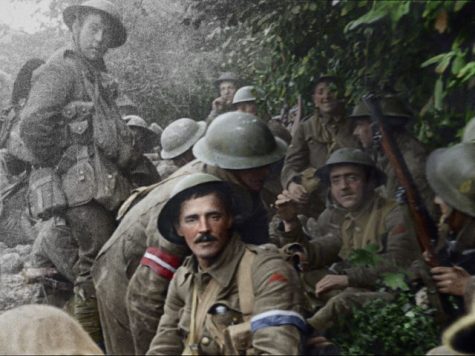
D and some of his taller brethren ventured out to the limited-engagement showing of They Shall Not Grow Old Monday evening, and it was an incredible experience.  Director Peter Jackson provides a brief introduction and then we strap on the 3D glasses and prepared to be wowed.  It doesn’t happen all at once, but, wow, it happens.  The film is just one incredible sequence after another.  Jackson draws on 600 hours of archival interviews and 100 hours of footage to depict a “generic” experience of a (surviving) combat veteran.  That depiction goes from enlisting in the armed services to training to the front lines and back again.  It is at once exhilarating, exasperating, numbing, nauseating, and humbling.

Once the film ends, Jackson tacked on a 30-minute mini documentary explaining some of the choices he made in putting the project together, as well as the methods for solving the problems of dealing with 100-year old film.  This turned out to be both bewildering and hilarious, and even of those of you used to the wonders of modern technology are likely to be impressed with what Jackson is able to accomplish and how he was able to accomplish it.  If you see the movie, definitely stay for the extras.  The New York Times provides a taste of what this is all about.

So, this will certainly go down as one of my top movie-going experiences of the year.    And unlike Free Solo, which documents an extraordinary event without being an extraordinary production, this one hits the target on both marks.  I will likely go see this again if it returns to our theater on December 27.  And given our theater sold out both the 4 p.m. and the 7 p.m. showings, I’m guessing it will.

Can You Ever Forgive Me? & Green Book

CYEFMAGB.png

There are a lot of commonalities in Can You Ever Forgive Me? and Green Book, though it may not be apparent on the surface. For starters both are period pieces, early 1990s and 1950s respectively, at least in part both are New York stories, both depict the real life of an LGBT person without their sexual identity being the focal point of the story and they are buddy movies about artists. 

Another aspect these films share is that the trailers are absolutely useless. Even the great zingers in these films build up over time. The writing is fantastic and the laughs are meaningful, not forced from an armlock. YOU’RE LAUGHING, RIGHT? 

Performance-wise Melissa McCarthy shows off an impeccable range. It’s a devastating, funny and realistic performance. You don’t doubt her portrayal of author and literary forger Lee Israel for a single moment. 

Mahershala Ali’s performance is spot on as sophisticated piano virtuoso, Dr. Don Shirley and his Odd Couple routine with ever impressive Viggo Mortensen brings out the real humanity and depth of both of these characters. “I understand that life can be complicated” says Mortensen’s Tony Lip, a man otherwise known more for his knuckles than his compassion. Their adventures on a music tour in the segregated deep south of not so very long ago America brings our history to light in a truthful and in between the laughs, heartbreaking way. 

These films are Oscar worthy in various artistic and technical categories. If you are looking for funny, deep, thought provoking, well-crafted, historical and yet personal films to watch, I recommend Can You Ever Forgive Me? and Green Book to you. 

I Fellini — Essay

271771.jpg

Federico Fellini’s I Vitelloni and Amarcord are often called autobiographical films but that is only partially true. They are inspired by actual events but those are merely the jumping off points for his creations. Take Rimini, a 4 hour drive to the Northeast of Rome on the Adriatic Sea. Fellini’s hometown. But he never shot a single frame of film there. He would return only at night and for brief periods. He didn’t want a flood of emotions to take over his imaginings. 

A Fellini character is not present in I Vitelloni. The characters depicted in the film are in their late 20’s. Fellini himself left Rimini at age 19. But he would have seen the vitelloni hanging out all night in the cafe. He would have personally known a few, even if just in passing. He would have heard their stories and legends.

He does share a similarity with one of the characters —the one who leaves. Otherwise, I Vitelloni can be considered a snapshot in time. It’s similar to the buddy movies that would come along later, Levinson’s Diner, Linklater’s Slacker, Noah Baumbach’s Kicking and Screaming, Ben Stiller’s Reality Bites. People, frozen in time and place, making due with their dreams and the best they can to reach them. Even if the rest of the world looks at their efforts and finds it not much.

If the world of Fellini were represented in a Dadaist connect the dots, the numbers to connect would be 1, 24, -52, 19, -8, 107 and then the images: a cross, a woman’s tush in a tight dress, a lonely soul walking in the night, a race car driver tearing through a town square, an exasperated, screaming adult, a naive newlywed, a little person, a strong man, an alluring acrobat, a circus clown and finally dots in a shape to make the face of Fellini himself, the ringmaster of dreams. 


Creed II

rockybalboa

The opening shot of the opening scene of Rocky (1976) is of a painting of Jesus on the wall of the Church converted to a gymnasium, with Our Savior looking down on a match between a couple of third-rate fighters, Spider Rico and Rocky Balboa.  As writer, director, and now super-duper star, Sylvester Stallone explains it,  “The character of Rocky was built on the idea that he was chosen to do something.  That’s why the first image in Rocky is the picture of Christ.” As it is said in Proverbs:

The eyes of the LORD are in every place, Watching the evil and the good.

If the Lord is lucky, he will not have to see Creed II, an abomination of a movie bringing the Rocky series to its lowest point since Tommy Gunn.   The movie is at once predictable and incoherent, one that sets up some foundational existential questions, and then inexplicably pretends like it didn’t.  Have you ever had a friend ask you a serious question and then talk over you while you are trying to answer it?  That’s pretty much how the tail end of this movie goes.

Okay, so that is probably a little harsher than it needs to be.  And I am sure my allergic reaction at least partly stems from high expectations for the rebirth of the series.  I am a reasonably big fan of the Rocky movies, particularly the original, Rocky IIIRocky IV (a guilty pleasure), and L&D really liked last year’s Creed, as a flawed but entertaining movie that had a lot of heart.

While Creed II has some heart, what it has a lot more of is the plot lines lifted directly from Rocky III and Rocky IV.  The movie opens with the title character ascending to the  heavyweight championship juxtaposed with the spawn of Ivan Drago beating down challengers in the dingy gyms Moscow has to offer.   The elder Drago is in his son’s corner, and we see an (obviously) American fight promoter gym rat keeping tabs on both sides of the world.

This is essentially the set-up of Rocky III, comfortable champ, hungry challenger. Instead of Mr. T, however, we get the Son of Drago, who lacks the charisma and intrigue of his father, so the film just decides to focus on the elder Drago (Dolph Lundgren).   You may recall from Rocky IV that it was Ivan Drago who killed Apollo Creed in the ring back in the 1980s.  Rocky, of course, “avenged” this tragedy by not only defeating Drago on his home turf in the Soviet Union, but also by winning the heart and minds of the Soviet crowd in spectacular and ridiculous fashion.

Fast forward to Creed II and we learn that the elder Drago has yet to live down the loss. His moneyed countrymen spurn him, and his charismatic wife (Brigitte Nielson) walked away from both Ivan and their son, Viktor.   As Jung famously observed, “the greatest burden a child must bear is the unlived life of its parents,” and, indeed, it is up to Viktor to make amends for the shortcomings of his father.   Together with the American fight promoter, the Dragos visit Philadelphia to goad the new champion into a match.  That the young Adonis Creed feels  compelled to fight under his late father’s flag puts the basic geopolitical tensions of Rocky IV into play, along with Drago-Balboa, Drago-Creed, Drago-ex-Mrs. Drago, Creed-papa Creed, Creed-mama Creed, Creed-Bianca, Donny-Biancas-baby Creed, to name a few.

Although there is way too much going on and I have many issues with what the movie actually attempts to resolve, I will just mention that my primary objection has to do with the treatment of fighter safety, particularly the question of a corner’s decision to stop a fight.  Because it is bad form for a fighter to “quit” it is often incumbent on the referee or the corner to step in and save the fighter from himself.   Firstly, it is the referee’s responsibility to stop a fight when the fighter is unable to defend himself anymore.  Absent an official stoppage, the fighter’s corner can “throw in the towel” when it believes its fighter has had enough punishment.

This, of course, is a paramount issue because presumably Apollo Creed might have made it out of the ring so many years ago if Rocky or Apollo’s long-time trainer Duke Evers had thrown in the towel on his behalf.  Indeed, we learn that Rocky feels the pain two-fold because he was the champ who should have been fighting Drago, and he also was in the corner that didn’t protect Apollo.  Apollo’s widow (Felicia Rashad) also feels the pain of loss, spending her life amidst Apollo’s fortune and glory, but without the man who made it all possible.  And then, of course, there is young Adonis himself,  feeling the pain of being deprived of a father at the same time that he is about to become a father.

That actually doesn’t sound too bad of a plot, does it?  If they had to go back in time, would they have stopped the fight when their fighter was in danger?

The movie wrestles with this in a perfunctory fashion, but it ultimately throws in the towel when it matters most.  For me, this was both disappointing and stupefying, and, beginning with the tire in the ring during training, I just don’t understand why Stallone let the script follow that path.  If the rifle is hanging on the wall in the opening act, it had better go off by the end of the film — if it doesn’t get fired, it shouldn’t be hanging there!  Is this really what young Adonis Creed was chosen to do?

On the plus side, there are actually a lot of things on the plus side.  Sylvester Stallone’s Rocky continues to be a great and emergent character, and Stallone himself continues to be a modern marvel of HGH.  I half expected him to get in the ring and spar a few rounds himself.  Even better, we have Michael B. Jordan being his great self, though his greatness is limited by the more cartoonish motivations given to him by the script.  He continues on his relationship with Bianca (Tessa Thompson), and her character and her music are both taken seriously.  The principal focus on Adonis and his family continues the rightful transition toward emphasizing African-American characters, as it is, of course, African Americans who continue to dominate the U.S. boxing scene.  Indeed, Jordan and Stallone have a great exchange on this point over baby names.

We also get to see Dolph Lundgren again, and he really has this strong, silent type thing nailed.  He isn’t given much to work with, but he is entirely believable.  I will also say I was pleased that the Brigitte Nielson character is satisfyingly predictable, and she manages to light up the movie without having to say a word.  With those two taking center stage, the young Drago — you know, that big muscly guy that almost gets run over by a Hummer a couple of times — isn’t given anything to work with.  Who is the villain here, anyway?

So while the plot is just too much tried and not enough true, there is probably enough to like here to rally this one above the $6 bar.  It has played to mostly positive reviews and we are undoubtedly headed to Creed III, so if you have seen the first seven in the series, there is probably enough here to warrant seeing the eighth.  The Achilles heel is not that the movie didn’t entertain, but that it could have rivaled the “original” with a bit more imagination and work on the script side.

Next time, I’ll manage my expectations better.  And I hope the Creed III folks will either fire that rifle or keep it out of sight.

The Front Runner

The-Front-Runner-YouTube-730x410.jpg

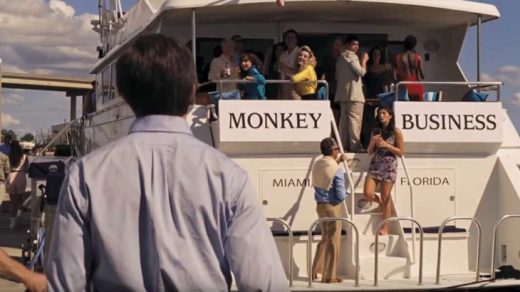
How could any film honestly dealing with the life of Gary Hart not be called Monkey Business? Even if there were already several other films about him titled Monkey Business, that would be no excuse. As Chappaquiddick is to Kennedy, Monkey Business is and always will be to Hart. 

That these filmmakers chose to call this movie The Front Runner set me up to viewing it skeptically. They must be Gary Hart apologists, I thought. And it does seem that way as the film bends credulity in trying to have you somehow sympathize with a man who after becoming the lead candidate for the Democratic presidential nomination in 1987, decided to charter a boat, Monkey Business, for a week long trip to Bimini. Here he openly has an affair with one Donna Rice. It comes at a point in American culture when suddenly the private lives of public figures like politicians were fair game for the traditional press. This could be due to the rise of cable TV, the 24 hour news cycle, the perception that the tabloid press was becoming more mainstream, all of the above and perhaps even other factors. The point being that Gary Hart flaunted his indiscretion and simply shrugged it off. 

After his affair is revealed, Hart doesn’t get the implications and completes several tone deaf moves like arguing with the editor of the paper that exposed him at the podium of what was ostensibly an economic forum and coming up flat in his response to a press conference question, “Have you ever cheated on your wife?” Defining moments for his candidacy. 

The film is especially annoying in that you are supposed to somehow feel that Hart is an anti-hero who is trying to protect all of our privacy rights. When in the end it is Hart who is calling for the spotlight on himself. At one point daring the press to follow him. So what did he expect and what are we left to think about him and his sense of judgement and character?

There is one great opening shot, a fantastic oner that floats around an on-location TV broadcast outside Hart’s hotel and captures the milieu around a presidential race. Otherwise, the film generally clunks along cinematically.  If you are a political wonk, or get into films where people take shots at each other while doing logistics and PR  around a table, some of this film might work for you. Or maybe you are a history buff and are simply curious about this episode in American political and pop culture. Okay, I can see that. But otherwise this film doesn’t do anyone justice and is the visual equivalent of stubbing your toe.

Even the casting is way off here as Gary Hart was never so buff and Hugh Jackman seems like he is about to sprout Wolverine’s metallic fangs at any moment and gouge a few reporters. Instead of maybe taking his foot off the protein powder pedal and transforming more into the actual physique of the character, Jackman doubles down including a moment where Gary Hart is doing push-ups at a meeting. It’s laughable, in the worst way.  Instead of watching Monkey Business, why not toss a few National Enquirer copies on the yule log this holiday and fire up Three Days of the Condor?

Widows

widows.jpg

I wasn’t expecting much from Widows. File under: don’t judge a movie by its trailer. However the cast, particularly Viola Davis, Elizabeth Debicki and Cynthia Erivo —who also lit it up in Bad Times at the El Royale — where stellar. Even Liam Neeson does some acting, in a film where remarkably no one gets kidnapped. There are also strong supporting performances by the incomparable Robert Duvall who brings it as a potitical machine patriarch and Jacki Weaver as Debicki’s mom who does some serious Joan Crawford channeling. The musical score was handled deftly by Hans Zimmer who is to film scoring what Morgan Freeman is to narration. 

Widows has an interesting mix of being a heist movie and a love story all in one. And like the best heist movies, it has a certain humanistic gravitas. The theme of living with loss is heavily explored. Chicago politics and crime is constantly on the surface of this story without pulling the characters’ relationships under it. My favorite shot in the movie is an exterior car oner (a single shot, with no editing) where you never see the actors but hear their conversation. The dialouge is about being trapped in a golden cage and in the real time of this drive of about 4 minutes the entire neighborhood changes from poverty to wealth. Widows is no stranger to gory and shockingly violent moments—but it’s not more violent than the This is America music video. Plenty of violence is implied and one murder happens completely off screen as the volume is turned up on a TV set. But the film carries a slow simmering tension throughout which is punctuated by sparks of graphic violence being perpetrated by many of the main characters. No one is absolutely without guilt in this modern take on Robin Hood. The characters are complex and grounded with enough backstory that you care. Widows has the immediacy and realism that Ocean’s 8 could only wish for — Awkwafina aside. The stakes are epic and unlikely but also within the realm of believability given the circumstances of the story. 

There are moments where the pacing lagged for me. Moments where actors are staring at themselves in the mirror too long. However these were a mere annoyance in what is a beautifully shot and crafted film. There also happens to be a very good twist in Widows that I won’t reveal to you.  Regardless of story, the acting here is the real star. I would recommend Widows on the performance of Viola Davis alone.

Free Solo

freesolo.jpg

Free Solo is a movie that sneaks up on you. It’s a National Geographic documentary so you might at first be like, “Meh. How entertaining will this possibly be?” But it’s extremely entertaining and thought provoking. Suffice it to say that at an utter fraction of the budget of the next film we saw, Bohemian Rhapsody, Free Solo has enough raw intensity and emotion to make ten rock bio-pics. 

It actually took me a day or two to process everything I saw and experienced watching Free Solo.  I won’t say more because I don’t want to give anything away. There is one Achilles heel in the film for me and it’s the portrayal of the main characters’ girlfriend. There is a lot of drama built up around her, suggesting she is a bad influence or some type of bad luck that for me is unnecessary. Attempting the ultimate free solo, i.e. climbing the face of El Capitan in Yosemite without the aid of ropes, seems like more than enough of an obstacle for drama. She does however suitably relieve the intensity of the climb preparation in comical scenes where they contrast one another. For example, the scene where they buy a house in Las Vegas is pretty classic. You see Alex Honnold for the wild man he is, eating food out of a pot with a wooden spoon and talking about how he would be happy to sleep on the floor. 

If you take the time to watch this movie it’s something that will actually give back to you and enrich your life. There are not many movies you can say that about. And definitely catch it in the theater so you can truly appreciate the scale of this almost unimaginably epic undertaking.

Hunter Killer

hunter-killer-lg

Hunter Killer is nostalgic.   It’s nostalgic for some of the great submarine drama films like Das Boot and Hunt for Red October and Grey Lady Down (one of the first movies I can remember seeing in the theater; it gave me nightmares).   It’s nostalgic for a time when men were men and were at one with their careers.   And, it’s nostalgic for the time when people thought Hillary Clinton would win the presidency.   That’s a lot of nostalgia for just $5!

The movie stars Gerard Butler (no relation) as Joe Glass, a tough-as-nails, salt-of-the-earth, macho man first-time submarine captain — but not so heartless that he would put an arrow through a mama caribou out for a walk with all her little cariboos.  Joe takes the helm of a submarine en route to the icy waters of eastern Russia (or was it western Russia?), where he is to investigate the mysterious disappearance of another American submarine.   He explains to the crew that he is one of them, a career man, worked his way up from swabbing the deck and cleaning tubes and that he has saltwater in his veins.  This is a central point of the movie.

Glass’ counterpart on the Russian sub is also a career man who has dedicated his life to his underwater duties. This is clearly explained to us at least one point in the film, possibly four.  The Russian commander is decidedly shorter than Glass.

Meanwhile, back on terra firma, we have a team of rugged Navy SEAL-like characters, led by Toby Stevens, kicking ass and kicking more ass.  They are going to get  dropped into the s-h-you know what and things are going to get hot.  There is some great commando action for sure.  Stevens, it turns out, has also dedicated his life to the cause.

Back in Washington, we have Gary Oldham, who inexplicably shares top billing with Butler here.  This is not inexplicable because Oldham doesn’t have Butler’s acting chops; it is inexplicable because his character is so poorly written.  Oldham spends most of his time on screen pretty mad, possibly because he got cast in such a lousy role.  If you told me he was playing the role because he got drunk and lost a bet with Gerard Butler, that would make more sense than whatever actually happened to get him to waste his talent here.

Oldham is joined by, among others, Jayne Norquist (Linda Cardellini) in the military intelligence corner of the film.  Although Norquist is not in uniform, she does have a higher level of security clearance than her uniformed counterparts in the room.  But despite her elevated egghead standing, she has not dedicated her life to the cause, arriving at the crisis center war room straight from one of her kid’s school events.  The movie does not give you the sense that double duty as a mother is a mark in her favor.

Finally, in the fourth corner of the movie, we have some action taking place just off the icy waters of western Russia (or was it eastern Russia?) involving the Russian President (Alexander Diachenko) and assorted military personnel.   This is pretty interesting and not terribly generous to the Russians, perhaps explaining why the film distributor is having trouble releasing it in Russia and the Ukraine.   That’s probably a pretty interesting story in and of itself.  Google it and let me know.

Despite my objections to some of the cliches, the wooden story lines, and the pervasiveness of retrograde mentality, the story is compelling and the throwback action is generally fantastic.   If you long for a movie with some great scenery and lots of military tech on display, I’m guessing you will find a lot to like here.

As for the thematic elements, there is a guest appearance by a would-be Hillary Clinton-type presidential character (Caroline Gooodall), suggesting that production started prior to the 2016 election!  I suppose there is something interesting to be said about a movie that longs for days when men’s identities were at one with their careers would tacitly imagine a Clinton victory in 2016.   I’m just not sure what that is.

Overall, above the $5 bar for a fun story, good action in many “theaters,” a couple of compelling characters, and pretty awesome visuals along the way.  It won’t join the canon of awesome submarine thrillers, but the location scouting was magnificent, and this one should be enjoyed on a very large screen somewhere.