A Star is Born

Dlnynm5U0AAwicDL&D haven’t been this amped for a movie release since the disappointing Sully, so it was with a wary eye that we cruised past the extended line at the Taco Bell drive through to see Bradley Cooper and Lady Gaga do their thing in the new A Star is Born incarnation.

Surprisingly, it was not a festival crowd, with the theater virtually empty.  Perhaps the special Wednesday showing soaked up some of the advance crowd?   At any rate, to the extent that opening night is the pulse of the wider movie audience, this one does not seem to be destined for blockbuster status.

The movie has some really great parts to it — Cooper and Lady Gaga are really spectacular in the lead roles, some of the music is pretty good (some isn’t), and Sam Elliot continues to have a really low voice.  We also get Andrew Dice Clay as a would-be crooner degenerate gambler (and there are no quotation marks around “Dice” in the credits) and Dave Chappelle appearing as a Friend-of-Bradley.  Talk about star power.

Another big plus is that the film takes the time to let the characters and story develop something beyond a Hollywood romance, with some scenes daring to linger on well past the usual Hollywood time allotment — I was almost surprised, for instance, that Cooper didn’t pull out his frequent shopper card when he was purchasing frozen peas at the Super A.  I also felt that it is one of the best meditations on alcoholism, for one, and wealth and power dynamics, for two, that I can remember in a mainstream film.  Indeed, the alcoholism is portrayed as if Cooper knows from whence he speaks, and parts of the film are so uncomfortable that they are virtually unwatchable.

On the other hand, I really didn’t buy the plot after the turn.  That is, I found her rise far more convincing and emotionally satisfying than the fall, which made for kind of a weird ride for me.  When Lady Gaga hits the stage for the first time, you’d have to be made of stone not to shed some tears when she becomes overwrought and covers her face with her hands.  But the latter parts didn’t ring as true for me, and I was actually getting  kind of irritated by the end.  In some sense the story just didn’t piece together as well as I would have liked.  And as we reached the three-hour mark (or maybe it just seemed like it), some of it seemed rushed, slapped together, incongruent, perhaps making up for the time lost with the more extended meditations earlier in the movie.  In my mind, the last hour knocked it down from great to good status.

L correctly points out that if you like Bradly Cooper or Lady Gaga, you will love this movie.  Possibly true.  The guitar and bass line of “Black Eyes” is still rumbling through me 12 hours later.  There is certainly plenty to like.   But, you will have to wait for L to get here to hand out the awards for “Best New Director” and “Best Movie” for this one.

As I finish this up, one thing that I realize that I overlooked is the movie’s thesis about what it means to be a superstar in the modern world.   The Cooper character always maintained that what differentiated him was that he was true to himself, making his life an open book — that’s why he didn’t mind when the cashier brazenly snapped his picture; she knows exactly what he’s all about because he laid it all out there for her and everyone else.  Cooper’s thesis seems almost ridiculous amidst orchestral-accompaniment in Lady Gaga’s closing tune.  Did they write that with the violin in mind?  Maybe that’s what all that late splicing was about?  That was certainly not what she was all about before she met him.

The verdict:  L&D were both more impressed than not.  You will probably be thinking about this one long after the curtain closes. So give it a chance.  You’ll probably love it.

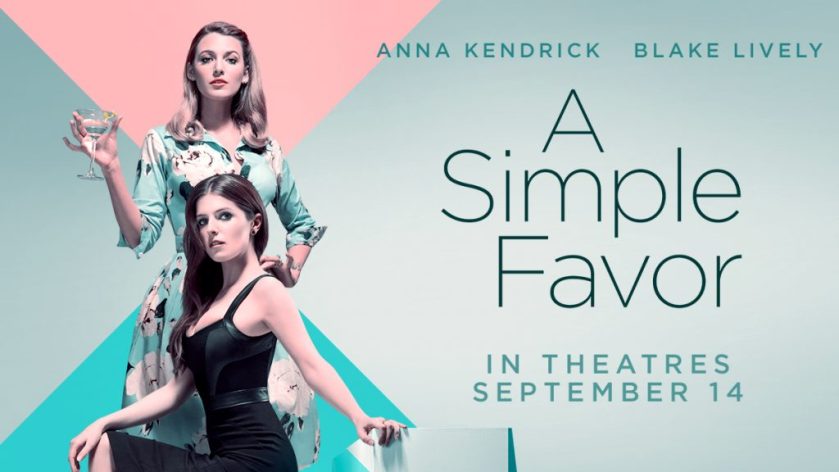
A Simple Favor

A Simple Favor.jpg

The funny thing about A Simple Favor is that it’s funny. The director and editor come from comedic backgrounds and have worked with Judd Apatow. The editor, Brent White, actually cut Talladega Nights, Anchorman and 40-Year-Old Virgin. With A Simple Favor the influences of Hitchcock, Apatow and as D ever so aptly nailed, De Palma are plainly evident.  The film is truly cinematic and could just as easily be enjoyed with the sound off. However, there are clever moments like the too many croutons in the Caesar salad loud crunching sounds at dinner, alluding to following the breadcrumbs of this mystery.

As you faithful reader are aware, the L & D are a known quantity at the Appleton Valley Grand Marcus Theater™ and our confidential informant behind the ticket counter immediately let us know that Stephanie Smothers (Anna Kendrick) uses some spicy language in this one. I promised to use my earmuffs. Meanwhile, Emily Nelson (Blake Lively) really is the one who rips a blue streak here. She’s a Porsche drivin’, Gucci wearin’, heat packin’, double martini with a lemon twist drinkin’ at noon badass…who doesn’t give a fuck. Our c.i. missed this entirely. 

On the suspense side, the film reminded me of one of my recent favorites, the under appreciated The Girl on the Train, starring Emily Blunt. On the style and sort of goofball factor side there are plenty of homages to De Palma. For example when someone gets slammed by a car —which you know, would normally knock you out— but instead gets on their knees and then punches a guy in the nuts…that’s very DePalma to me in the given context of a mystery film. And also very Apatow, in any context.

I won’t say more here except to say, A Simple Favor is an enjoyable, sophisticated, humorous, slightly absurd but never off the rails, tightly spun tale that keeps you wondering what will happen next the whole way through. It’s really a wonderful little film that I hope to watch again and again.

The Happytime Murders and Searching

ouch
                                      It’s happy time, Mr. Cho

After a ‘string’ of good to great movies, L&D ventured off to see The Happytime Murders and Searching in this, the last official week of the summer in the greater Wisconsinland area, with the results about as satisfying as cold churros from a Taco Bell $5 box.   It’s not that we didn’t like them; it’s just that they could have been so much more.

Both movies are built around a gimmick.  Happytime features salacious, foul-mouthed, NC17-rated Muppets (though they aren’t really Muppets, 😉), whereas Searching is a seen entirely as an on-line experience, with the entire story unfolding as if the audience is taking different perspectives from a first-person computer interface.   Although both movies have their strengths, neither is a strong movie.

Beginning with Happytime, although this is ostensibly a Melissa McCarthy vehicle, Melissa McCarthy isn’t funny in the movie.   Instead, we follow around a rumpled Phillip Marlowe of a a Muppet, Phil Phillips (voiced very compellingly by someone named Bill Barretta, who also handles a number of other voices).   The Phillips detective has a oddly empathetic charisma about him, despite the clumsy backstory of his going from decorated cop to down-and-out private dick.   McCarthy was his former partner and they had a falling out, but now they are reunited to investigate a murderous rampage on the Happytime gang that starred in a hit show from yesteryear. Whatever.

L laughed throughout and seemed to enjoy it.    I laughed intermittently and was pretty bored otherwise.

Those of you who saw the trailer know that the movie features some sordid Muppet-on-Muppet back-room action, culminating in an extended silly string money shot.   I counted off an initial 15-second spree, with a 15-second follow up.

If you don’t walk out, stick around for the credits, which feature shots of how the puppets were integrated into the film and how some of the green screens, etc, etc… were set up.   That, coupled with the relief that the movie was finally over, served as a great three or four minutes of cinema.

The movie also features acquaintance of the L&D (or the L, at least), Maya Rudolph.   I kind of liked her here, though she didn’t get a lot in the way of lines.

As for Searching, this is another matter entirely.  This is a much higher-quality piece of work.  The movie features John Cho as a father trying to track down his missing daughter (played by Sarah Sohn) seen entirely through the prism of internet searches and online content.  What secrets does your computer hold about you?

The innovation here has a compelling, if slightly irritating, element to it.   I sit at a computer for a good chunk of the day, so once I figured out how the movie was going to play out, I wondered if they could sustain it for the full running time.   The answer was no for two reasons.  First, there were certain parts, mostly during the back end, where the medium was a mismatch for more effective narration.  As a result, the story suffered and I sat and wondered how they might have done it differently than paying too close attention to the story itself.   Second, and more problematic, is that the story just sort of unravels.   Boomp, boomp, ba doomp, just like that, it goes from a really compelling thriller to a disappointment in the span of a few minutes.

Overall, most of the movie is seen from the father’s perspective, and these worked the best.  There were a couple integrations of other perspectives to pull the movie together, but these weren’t integrated throughout, and I think that was really problematic.   In either case, I suspect there is something to annoy you in this movie enough that you won’t find it to be the favorite thing you see this summer.  All that said, John Cho is really, really good, and, as L says, great acting goes a long way.

We continue to rack up Fandango VIP points, so Happytime definitely over the $2 bar and Searching over the $3 bar.   Happytime can definitely be seen as a Netflix or Redbox on the home screen, and I suspect that is the best place to see Searching as well.

From the Trailers:  We are both gaga for Gaga, with A Star is Born coming in October.  Let us know if you want to attend the Marcus premiere with us.   L has informed me that we will not be seeing The (Nine Unch) Nun.   Guest reviewers welcome for that one.


Mile 22

Iko-Uwais-from-Mile-22.jpgL&D were a blank slate settling into the new Mark Wahlberg vehicle, Mile 22, not realizing that the movie has been (appropriately) panned by many of our critic brethren.  Wahlberg sort of reprises his misanthropic, fast-talking Sergeant Dignam role from The Departed.  Only here he plays the on-the-ground savant leader of a special ops team of last resort, called on when diplomatic and militaristic solutions fail.   And, it’s pretty cool to see the moving technological parts of these ops, reminiscent of Enemy of the State from so many years ago.  This movie is not nearly as good, unfortunately, though I would guess that those responsible thought  it would be a home run worthy of at least one sequel. I guess we’ll see.

The plot centers on Wahlberg, Lauren Cohan and former UFC phenom Ronda Rousey (among others) tasked with transporting Iko Uwais to an airstrip 20-some miles away as a quid pro quo to stave off a large helping of cesium-enhanced terrorism.  If you don’t know about the horrors of cesium, Wahlberg will enlighten you along the way; he’s pretty knowledgeable.  By my estimate, this trek absorbs the last two-thirds of the movie and is effectively an extended action sequence through the streets of somewhere in Columbia or Georgia, I guess (though the plot was ostensibly set in Indonesia).

The movie does possess a couple of strengths.  The technology stuff is mostly well done and cool to look at and sort of overwhelming to keep track of, sort of like surveillance-state technology, I suppose.  As for the players, Wahlberg is a compelling character with his verbal rat-a-tat-tats and band-snapping intensity. Rousey is also pretty good and well cast.  But the action hero here is the asset, Iko Uwais, who is like a supercharged kung fu god, just beating the living hell out of everyone who gets in his way.  Even being handcuffed to a table can’t slow him down.  He is unbelievable.  He steals the show.   He wins the movie.

There are a couple of downers, as well.  The story line with Cohan is ridiculous, irritating filler, though she does have one great sequence where she is on the losing end of some WWF-type action from a much larger foe.   And John Malkovich shows up with a pretty cool new haircut, but otherwise it is pretty disappointing to see his talent wasted like this.

As for the action, there is certainly a lot to choose from.  Unfortunately, it’s often disorienting with those multi-camera blur sequences, and occasionally hyper violent (causing L&D to cringe laugh so loudly at one point that the small smattering of our movie-going brethren turned to see who was laughing at a man falling on his head in such a way that his neck and shoulder are perfectly parallel, ouch). It is violent even by today’s standards, though not too much in the way of gross-out gore. This is a movie not afraid to shoot you in the face.  L points out that this is another one of those first-person shooter movies, a la John Wick or, the gold standard, Hardcore Henry .  For our New Year’s Resolution, we will revisit the latter and provide a review.   What a breath of bloody phlegm that movie was.

But back to Mile 22 — the movie seemed longer than it was, and as it ended I credibly thought it might have another half hour.  My guess is that Wahlberg and the other producers thought going in that it had another hour and a half in the form of a sequel.   I have my doubts.  A better use of Wahlberg’s time might be an exploration of what that Sgt Dingham character is up to all these years later.  Or Ted 3.

So maybe at the $5 bar for this one.   Fortunately, I’ve been racking up these Fandango VIP points that effectively give me $3 for every movie I see, so we were in and out of this one, popcorn included, for just $2.   So let’s just say it soared over the $2 bar with the added bonus that we didn’t have to sit through an extra hour after the popcorn was gone.

Crazy Rich Asians (L)

CRA.jpg

Crazy Rich Asians is the Gone With the Wind of romantic comedies with its immense scope and production value. But within the vast ground (yachts, islands, mansions, helicopters, limos, penthouses etc. …) it covers, the film does deal deeply with the complicated motivations of each main character, the dynamics of families and the rift between the traditional and modern world. Within all the fun and games, extravagant sets and exotic locations, there is plenty of emotion, complexity and meaningful story to get wrapped up in. 

Beyond great acting, Constance Wu and Henry Golding have an on-screen chemistry that is mesmerizing. Their relationship and storyline follows a classic and effective Hollywood narrative arc. The legendary Michelle Yeoh carries the screen impeccably and every time she appears you feel at least some aspect of the gravitas of an aggrieved parent.  The film is easily stolen by Ken Jeong and particularly Queens-born rapper Awkwafina. Am I biased? Yes. Was I born in Queens? Yes. Did I eat a lot of really “dank” halal as Awkwafina calls it in her The World According to Awkwafina YouTube video? No. —But I would have. Earlier this summer Awkwafina starred in Ocean’s Eight and has come into her own as a bona fide movie star. As quirky, streetwise, down to Earth friend Peik in Crazy Rich Asians she is more than simply comic relief but plays a fully realized multidimensional character. It’s great to have a character like Peik who you can empathize with and relate to while at the same time knowing that she can also do outrageous things —like carry various dresses for spontaneous outings like cocktail parties or “walks of shame” in her sports cars’ frunk (trunk in the front).  

A big budget Hollywood film staring Asians and Asian-Americans is a rarity but with the current box office success of Crazy Rich Asians it shouldn’t take as long for another studio backed Asian / Asian-American focused feature film to light up the screen.

If you can get out and see Crazy Rich Asians on the silver screen, do it. It’s a big movie with plenty of stars, glam, laugh out loud moments, strong characters, charm and genuine feeling. 

Crazy Rich Asians (D)

SingaporeBanner

Crazy Rich Asians is a movie with an audacious nose.  Despite its roots as a boilerplate romantic comedy – outsider navigates partner’s family’s idiosyncrasies on the path to true love – this film undoubtedly has set the path for where movies on the big screen are headed.

The outsider and protagonist and principal focus of the movie is an Asian-American NYU economics professor (!), Rachel Chu (Constance Wu), who will accompany her ridiculously gorgeous boyfriend, Nick Young (Henry Golding), to a wedding in Singapore.  She will also meet his family for the first time.  Unbeknownst to Rachel, Nick is the golden child in the family of obscenely wealthy Chinese real estate moguls, though he has been passing himself off as your run-of-the-mill Cambridge-educated New York City financier type.   Ho hum.

So, after a stop in the first-class mile-high club, Rachel lands in Singapore and spends a jovial evening sampling the best that the food court has to offer, which is a lot.  The food scenes in this movie are outrageous.   In the morning, she heads over to see her college roommate, Goh Peik Lin (Awkwafina), who lives with her extravagantly wealthy, but not that wealthy, family in a gated estate.  It is here that Rachel learns that Nick hasn’t been forthright with her about his insane levels of wealth. Indeed, it seems that all of Asia (and, as we have seen, all real Asians) is in on the fortunes and trajectory of Nick Young and the Young family.  Awkwafina is the star of the show, for sure, and the time she, along with her family, are on the screen provides the best comedy the movie has to offer.  Her dad is Ken Jeong!  And, the stop-off at the Lin compound is sort of halfway house between Rachel’s real world and the complete fantasy world of obscene wealth and opulence that we step into on the run-up to the wedding.

Unfortunately, the owners and benefactors of all of this wealth are not beautiful people, but instead are highly territorial and not at all charitable to those outside of their sphere.  First and foremost, although Rachel is an NYU economics professor, an alpha position if there ever was one, her considerable achievements are seen as singularly American in nature, and not something to be either admired or valued by the Young family.   Despite her trappings of an upper income existence by being a highly paid professional in New York City, she is effectively a non-entity in the face of real wealth and privilege.  There are probably some ironies here of the economics professor coming to terms with real wealth that will pop into my head after I post this.  Plus, she’s an American.

Second, there are all sorts of matriarchal machinations going on here that I am sure I haven’t put together.  The movie features Nick’s mother and grandmother as the major power brokers, and I don’t even think Nick’s dad appears on screen (does he?). To put it another way, Ken Jeong is the only face of the male head of household portrayed, and his face looks a lot like a past-his-prime Elvis.  Third, Nick’s possibly wonderful sister has a husband who can’t seem to get his male mojo working as the non-primary breadwinner, although he seems to work out a lot.  And, of course, there is Rachel herself, whose mother took to America as the safety valve out of her own personal cultural entrapments.

On the man side, I don’t think we have a single admirable male character. Nick, I think, is left deliberately undeveloped, because the inevitabilities here (and what the final scene seems to suggest) is that there is just no way out of this particular box of luxury.  His destiny is that of a rich dickhead, a class which most-to-all of his male brethren have established their bona fides in the course of the film. Maybe this is why Dudley Moore’s Arthur spent his life in a bathtub drunk out of his skull? Or why Michael Corleone just gave in and stepped into his father’s shoes?

Well, anyway, there is a lot going on for a formulaic rom com – centuries of culture and history to untangle, after all.

And, yes, we laughed until we cried.

The movie features also some behavioral economics and non-cooperative game theory that I imagine is fleshed out a bit more in the book.  In the opening scene, Rachel wins a poker hand by bluffing as a way to explain the concept of “loss aversion” to her class, a phenomenon that people are harder hit by a loss of $10 than on an equivalent gain of $10.  I just read a piece on female poker players, and it turns out that female poker players don’t win a lot of hands by bluffing alpha males.  This was a minor nagging bother as things marched on, but it wasn’t until finishing up this post that I realized that when Rachel was not bluffing when she eventually went toe-to-toe with the movie’s alpha male, Nick’s mother (playing Mahjong, however, not poker.  Okay, the real showdown wasn’t about Mahjong, but, whatever).  So the movie gets the economics right after all!

I guess there is probably a metaphor about playing poker and counting up gains and losses along the way that would help us to explicate the movie better, but with the sensory overload of food and culture and trappings of wealth it is hard to keep everything straight.

A better title for the movie would probably have been Filthy Rich Asians, because I get the sense that there is nothing particularly crazy about how the wealthy – or any of us – close ranks to protect their own and keep the outsiders out.   Gates are a good start.  Armed guards don’t hurt.  And if that doesn’t work, there is the straight up nastiness.  Most of us don’t get past the gate, so the movie ostensibly puts us in the place of the rest of the world, on the outside looking into a world at this different plane, this alternate reality reserved for what is essentially modern royalty.

So, you can blanch at the naked celebration of wealth inequality, or you can sit back and enjoy the show for what it is.   I recommend the latter, though I must admit that the more I write about it, the less confident I am in that recommendation.

Eighth Grade

Eighth-Grade-movie-2018.jpg

Eighth Grade is a masterpiece. It’s a simple as that. I don’t know what’s in the water that writer director Bo Burnham is drinking but I would like to splash a little on my neck. Actually Burnham is known as a YouTube star though I am unfamiliar with his early work or later TV work. He has a following. And with Eighth Grade, it’s apparent why. While chronicling the life and times of 13 year old Kayla Day (Elise Kate Fisher) you never feel imposed upon. There is never some heavy hammer here. Just like social media itself, like a snake, it slowly envelops its prey and before you know it, you can…not…breathe.

My experience watching Eighth Grade was almost as terrifying as watching A Quiet Place, the awkwardness revealed in the film hits the highest of pitched levels. At times I wanted to cover my eyes. I certainly do not envy kids today or their parents — of which I am one. I think the real triumph of the film is that it can at one hand painfully and accurately represent the struggle of this age and at the same time entertain the audience every step of the way. Having us wonder what on earth will happen next. 

The construct of the paradoxically shy YouTuber is a brilliant intro to Kayla. Meanwhile, her earnest dad (Josh Hamilton) is trying to get through to her, like paddling out against a set of twenty foot waves. And yet you can sympathize with both people. With just wanting to be left alone, with just needing to connect with someone in real life. The social media montages are brilliantly conceived and executed. The audio was screaming as loud as the Tamil language Indian films that get blasted at Marcus Cinema here in Mid-America…we were unsure if this was on purpose but it certainly would make sense if it was. 

I can’t understand why this film is rated R. Kids today eat expletives (Fuck, okay? Fuck.) for breakfast. Frankly, this rating is a form of censorship and I think the MPAA should get off its high horse. The MPAA standards are uneven and need to evolve. Regardless, kids will be watching this film on their iPhones soon enough. I did read that there will be an MPAA approved version that 13 year olds can watch in the theater, which would be great. 

I highly recommend to anyone Eighth Grade. Bring your kids. God forbid it may start an actual conversation.  

BlacKkKlansman

BlacKkKlansman-true-story-Spike-Lee-movie-how-much-is-true-1001111.jpg

BlacKkKlansman, a Spike Lee Joint. Spike Lee has had a profound effect on me and was a true inspiration for my getting involved in filmmaking. And even though BlacKkKlasman is not wholly written by Spike Lee it has every element, including sho nuffs, to make the viewer understand this is the work of the great cinematic auteur, Spike Lee. His strength for me is the mixing of theatricality, graphics and traditional narrative conventions. There is also always something kind of off in a Spike Lee joint. The characters are not all developed, but purposefully caricatured. He paints many of his characters with broad strokes. He concentrates on his leads, their lives, their mistakes and passions. Everyone else is just a satellite to these stars.

One thing you notice immediately in a Spike Lee joint is the intense and beautiful score by constant collaborator Terence Blanchard. Terence Blanchard is a musical genius and has scored every Lee film since 1991’s gem Jungle Fever. Also, you will notice the ensemble cast. Lee uses many of the same actors in his films, sometimes I find this distracting but at the same time I think it’s cool and works. Ultimately, Spike Lee puts his style, his stamp, over just about anything else in his films. This might be an effect of his commercial work but it’s there. In Lee you find strange situations like a woman dancing not long after she is attacked by a police officer. Or strange cuts that don’t make sense, like jump cuts that seem to be simply editing errors. But again, it’s a Spike Lee joint. It’s a living organic work. In Hitchcock it’s the over the top exactitude that’s the style. And his films can be said to suffer for that too—however others love it. It’s what makes Hitchcock, Hitchcock. And the same can be said for Lee.

BlacKkKlansman includes strong performances by John David Washington (yes, the son of that Washington) and Adam Driver but the most emotional part of the film is the document at the end which chronicles the assassination of Heather Heyer by a white nationalist Nazi during a peaceful protest in Charlottesville, Virginia on August 12, 2017. It’s not just a social document for its own sake but it ties together brilliantly the naiveté of the protagonist, Ron Stallworth, in this 1970’s period piece and his assumption that America had moved forward and that its race relation problems were in the rear view mirror. As the first black detective in the Colorado Springs PD he explains to a lieutenant in a back hallway at the police station how America would never again elect a racist president.

As a nation, we shouldn’t take films like BlacKkKlansman for granted. I am glad that it was screened here in my little corner of Wisconsin. Maybe the letters I send the movie chain about screening indie films are working? I don’t know but I am grateful I was able to watch this important film on the big screen and I recommend you do too if you have the chance.

Mission: Impossible — Fallout

mission-impossible-fallout.jpg

Let’s talk about Mission: Impossible— Fallout. You might say that it’s wrong to criticize this film because the storyline does not have an original bone in its body. But I stand by Ebert who wonders why do audiences go see films where they already know what is going to happen? This film is a Euro-Porn Travel Magazine on Steroids. Please quote me. The chase scenes are not anywhere near as interesting or creative as say Atomic Blonde. But hey, if you have never seen a movie where the bomb has a counter on it and it is going to explode and destroy the Earth then yeah, when the house lights come up, you will give this movie a standing ovation. So without belaboring it, it is an absolutely valid criticism always to demand originality and expect creativity. Deadpool 2 did it, and that’s also sequel. Also, just since I am taking the time to write this. The verbal exposition and the use of dialogue to explain events surpasses a student film with less than zero budget. Dear studio suits, nobody cares that Mission: Impossible movies start with long boring explanations that self destruct in 5 seconds. Maybe the explanations should self-destruct 5 seconds before they start. 

Now here is a part of this review you might like if you are still with me. I actually enjoyed this film. I think the part I enjoyed most was the “action camp” I’ll call it. Unlike Deadpool, this film doesn’t have the cojones (balls, people or ovaries. I don’t know how to say ovaries in Spanish, but you get it) to break the fourth wall. But it could so easily break the fourth wall at almost any moment. I mean the use of Scooby-Doo-like masks is enough to make anyone over the age of I don’t know 11 or 12 just laugh out loud. But when you pile one ludicrous set up or element after another, it becomes enjoyable somehow. Who cares — but in a good way. It’s a suspension of disbelief paradigm shift. It’s also interesting that Tom Cruise, who couldn’t help the human injury masquerading as a movie masquerading as a thinly veiled soon to be opened amusement park ride that was The Mummy actually triumphs in Fallout. Triumphs! He shows amazing acting chops, his stunts are equally amazing and not since Forrest Gump or Run Lola Run has anyone run so convincingly in a movie. I think it would have been easy to kill an entire tub of popcorn (you can buy, take home and reuse a tub of popcorn these days, which I think is just as perverse as the ability to now buy bulletproof backpacks for school, but that’s just my sensibility). In short, (sorry Tom, not trying to be glib, I’m only slightly taller than you after all) Tom Cruise holds this film down, and even the most hackneyed, absurd and thread bare plot twists can not touch his veracity and screen presence. Fallout offers action and Fallout delivers. If you like action and Tom Cruise, Fallout won’t disappoint. If you would rather watch grass grow or paint dry for two hours, I would respect that decision as well. 

The Equalizer 2

maxresdefault
                                                                There are two types of pain in this world…

L&D were a little nervous heading into The Equalizer 2, having missed the first installment of the series.  OK, so that’s a joke we have leaned on before, but it was somewhat apt in this case, as it isn’t clear exactly who the Robert McCall (Denzel Washington) character is fashioned after.   It could be a James Bond / Jason Bourne type.  Or maybe a Charles Bronson / Bruce Willis vigilante justice warrior.  After some deliberation, I’ve settled on Jack Ryan, the brains and the brawn.  The film spends almost as much time with McCall studying and sleuthing as he does with him kicking ass and taking names, going out of its way to make McCall a cerebral character.  They even go so far as to show his ability to solve mysteries from a few thousand miles away through some sort of out-of-body, mental transcendence method.  It’s a neat trick.

But although McCall is sort of an amalgam of modern action heroes, what we get here is a movie about tying up loose ends, with McCall himself — ironically, perhaps — being the biggest loose end of all.   There are by my count four main plot lines that don’t quite converge, and getting to the finish mixes a bit of intrigue with a lot of syrupy absurdity to get to tie it all back together.  The main plot line involves McCall getting dragged out of his anonymous life of a Lyft driver and back in with the old gang within the deep state.  The gang includes the brilliant Melissa Leo and the super smoldery Pedro Pascal, both who are blessed with the ability to make you care even when there’s not much there.  We are also treated to a boilerplate father-figure story line focusing on Ashton Sanders.

Amdist the primary action hero drivers, there are some attempts to introduce some non-trivial meditations on social justice — including Denzel providing Sanders with a copy of Between the World and Me, a father-figure moment if there ever was one — but there are no serious attempts to elaborate or explore, so these angles ultimately turn out to be trivial.  If I’m not mistaken, the gang members who are exhorting the Ashton Sanders character to go on a murdering spree are listed as his “buddies” in the credits.   Did I read that correctly?

But all that said, the production values in this are exceptional and enjoyable.  The opening sequence with McCall driving around Boston as a Lyft driver kicked things off in style, and I would have been happy watching that for an hour.   The first hour or so set at least one plot line nicely, and the movie only began to unravel once the bad guy is revealed, culminating with the kill the bad guys in reverse order — from least relevant to most relevant.   Even so, you had to admire the production values as this went on.

A meh from L&D on this one, though we did enjoy cavorting about it afterwards (though we spent more time talking about the Bruce Willis Death Wish movie that about the Equalizer)The summer blockbusters seem to have hit a soft spot, so if you have a coupon or or out and about on bargain Tuesday, this is a good movie to munch some popcorn to.  But I am guessing this will be upstaged by the Thursday release of the latest Mission: Impossible incarnation.   I guess we will have to see.