Creed II

rockybalboa

The opening shot of the opening scene of Rocky (1976) is of a painting of Jesus on the wall of the Church converted to a gymnasium, with Our Savior looking down on a match between a couple of third-rate fighters, Spider Rico and Rocky Balboa.  As writer, director, and now super-duper star, Sylvester Stallone explains it,  “The character of Rocky was built on the idea that he was chosen to do something.  That’s why the first image in Rocky is the picture of Christ.” As it is said in Proverbs:

The eyes of the LORD are in every place, Watching the evil and the good.

If the Lord is lucky, he will not have to see Creed II, an abomination of a movie bringing the Rocky series to its lowest point since Tommy Gunn.   The movie is at once predictable and incoherent, one that sets up some foundational existential questions, and then inexplicably pretends like it didn’t.  Have you ever had a friend ask you a serious question and then talk over you while you are trying to answer it?  That’s pretty much how the tail end of this movie goes.

Okay, so that is probably a little harsher than it needs to be.  And I am sure my allergic reaction at least partly stems from high expectations for the rebirth of the series.  I am a reasonably big fan of the Rocky movies, particularly the original, Rocky IIIRocky IV (a guilty pleasure), and L&D really liked last year’s Creed, as a flawed but entertaining movie that had a lot of heart.

While Creed II has some heart, what it has a lot more of is the plot lines lifted directly from Rocky III and Rocky IV.  The movie opens with the title character ascending to the  heavyweight championship juxtaposed with the spawn of Ivan Drago beating down challengers in the dingy gyms Moscow has to offer.   The elder Drago is in his son’s corner, and we see an (obviously) American fight promoter gym rat keeping tabs on both sides of the world.

This is essentially the set-up of Rocky III, comfortable champ, hungry challenger. Instead of Mr. T, however, we get the Son of Drago, who lacks the charisma and intrigue of his father, so the film just decides to focus on the elder Drago (Dolph Lundgren).   You may recall from Rocky IV that it was Ivan Drago who killed Apollo Creed in the ring back in the 1980s.  Rocky, of course, “avenged” this tragedy by not only defeating Drago on his home turf in the Soviet Union, but also by winning the heart and minds of the Soviet crowd in spectacular and ridiculous fashion.

Fast forward to Creed II and we learn that the elder Drago has yet to live down the loss. His moneyed countrymen spurn him, and his charismatic wife (Brigitte Nielson) walked away from both Ivan and their son, Viktor.   As Jung famously observed, “the greatest burden a child must bear is the unlived life of its parents,” and, indeed, it is up to Viktor to make amends for the shortcomings of his father.   Together with the American fight promoter, the Dragos visit Philadelphia to goad the new champion into a match.  That the young Adonis Creed feels  compelled to fight under his late father’s flag puts the basic geopolitical tensions of Rocky IV into play, along with Drago-Balboa, Drago-Creed, Drago-ex-Mrs. Drago, Creed-papa Creed, Creed-mama Creed, Creed-Bianca, Donny-Biancas-baby Creed, to name a few.

Although there is way too much going on and I have many issues with what the movie actually attempts to resolve, I will just mention that my primary objection has to do with the treatment of fighter safety, particularly the question of a corner’s decision to stop a fight.  Because it is bad form for a fighter to “quit” it is often incumbent on the referee or the corner to step in and save the fighter from himself.   Firstly, it is the referee’s responsibility to stop a fight when the fighter is unable to defend himself anymore.  Absent an official stoppage, the fighter’s corner can “throw in the towel” when it believes its fighter has had enough punishment.

This, of course, is a paramount issue because presumably Apollo Creed might have made it out of the ring so many years ago if Rocky or Apollo’s long-time trainer Duke Evers had thrown in the towel on his behalf.  Indeed, we learn that Rocky feels the pain two-fold because he was the champ who should have been fighting Drago, and he also was in the corner that didn’t protect Apollo.  Apollo’s widow (Felicia Rashad) also feels the pain of loss, spending her life amidst Apollo’s fortune and glory, but without the man who made it all possible.  And then, of course, there is young Adonis himself,  feeling the pain of being deprived of a father at the same time that he is about to become a father.

That actually doesn’t sound too bad of a plot, does it?  If they had to go back in time, would they have stopped the fight when their fighter was in danger?

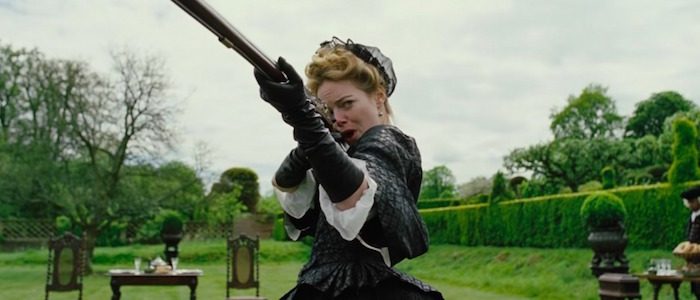
The movie wrestles with this in a perfunctory fashion, but it ultimately throws in the towel when it matters most.  For me, this was both disappointing and stupefying, and, beginning with the tire in the ring during training, I just don’t understand why Stallone let the script follow that path.  If the rifle is hanging on the wall in the opening act, it had better go off by the end of the film — if it doesn’t get fired, it shouldn’t be hanging there!  Is this really what young Adonis Creed was chosen to do?

On the plus side, there are actually a lot of things on the plus side.  Sylvester Stallone’s Rocky continues to be a great and emergent character, and Stallone himself continues to be a modern marvel of HGH.  I half expected him to get in the ring and spar a few rounds himself.  Even better, we have Michael B. Jordan being his great self, though his greatness is limited by the more cartoonish motivations given to him by the script.  He continues on his relationship with Bianca (Tessa Thompson), and her character and her music are both taken seriously.  The principal focus on Adonis and his family continues the rightful transition toward emphasizing African-American characters, as it is, of course, African Americans who continue to dominate the U.S. boxing scene.  Indeed, Jordan and Stallone have a great exchange on this point over baby names.

We also get to see Dolph Lundgren again, and he really has this strong, silent type thing nailed.  He isn’t given much to work with, but he is entirely believable.  I will also say I was pleased that the Brigitte Nielson character is satisfyingly predictable, and she manages to light up the movie without having to say a word.  With those two taking center stage, the young Drago — you know, that big muscly guy that almost gets run over by a Hummer a couple of times — isn’t given anything to work with.  Who is the villain here, anyway?

So while the plot is just too much tried and not enough true, there is probably enough to like here to rally this one above the $6 bar.  It has played to mostly positive reviews and we are undoubtedly headed to Creed III, so if you have seen the first seven in the series, there is probably enough here to warrant seeing the eighth.  The Achilles heel is not that the movie didn’t entertain, but that it could have rivaled the “original” with a bit more imagination and work on the script side.

Next time, I’ll manage my expectations better.  And I hope the Creed III folks will either fire that rifle or keep it out of sight.

The Front Runner

The-Front-Runner-YouTube-730x410.jpg

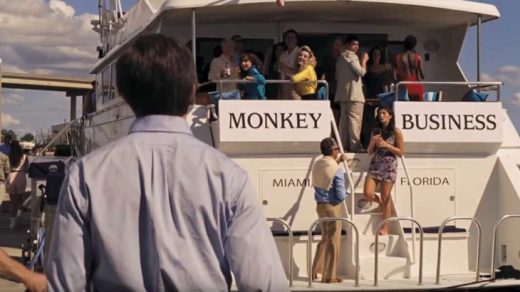
How could any film honestly dealing with the life of Gary Hart not be called Monkey Business? Even if there were already several other films about him titled Monkey Business, that would be no excuse. As Chappaquiddick is to Kennedy, Monkey Business is and always will be to Hart. 

That these filmmakers chose to call this movie The Front Runner set me up to viewing it skeptically. They must be Gary Hart apologists, I thought. And it does seem that way as the film bends credulity in trying to have you somehow sympathize with a man who after becoming the lead candidate for the Democratic presidential nomination in 1987, decided to charter a boat, Monkey Business, for a week long trip to Bimini. Here he openly has an affair with one Donna Rice. It comes at a point in American culture when suddenly the private lives of public figures like politicians were fair game for the traditional press. This could be due to the rise of cable TV, the 24 hour news cycle, the perception that the tabloid press was becoming more mainstream, all of the above and perhaps even other factors. The point being that Gary Hart flaunted his indiscretion and simply shrugged it off. 

After his affair is revealed, Hart doesn’t get the implications and completes several tone deaf moves like arguing with the editor of the paper that exposed him at the podium of what was ostensibly an economic forum and coming up flat in his response to a press conference question, “Have you ever cheated on your wife?” Defining moments for his candidacy. 

The film is especially annoying in that you are supposed to somehow feel that Hart is an anti-hero who is trying to protect all of our privacy rights. When in the end it is Hart who is calling for the spotlight on himself. At one point daring the press to follow him. So what did he expect and what are we left to think about him and his sense of judgement and character?

There is one great opening shot, a fantastic oner that floats around an on-location TV broadcast outside Hart’s hotel and captures the milieu around a presidential race. Otherwise, the film generally clunks along cinematically.  If you are a political wonk, or get into films where people take shots at each other while doing logistics and PR  around a table, some of this film might work for you. Or maybe you are a history buff and are simply curious about this episode in American political and pop culture. Okay, I can see that. But otherwise this film doesn’t do anyone justice and is the visual equivalent of stubbing your toe.

Even the casting is way off here as Gary Hart was never so buff and Hugh Jackman seems like he is about to sprout Wolverine’s metallic fangs at any moment and gouge a few reporters. Instead of maybe taking his foot off the protein powder pedal and transforming more into the actual physique of the character, Jackman doubles down including a moment where Gary Hart is doing push-ups at a meeting. It’s laughable, in the worst way.  Instead of watching Monkey Business, why not toss a few National Enquirer copies on the yule log this holiday and fire up Three Days of the Condor?

Widows

widows.jpg

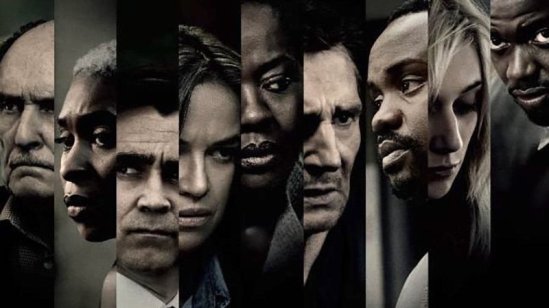
I wasn’t expecting much from Widows. File under: don’t judge a movie by its trailer. However the cast, particularly Viola Davis, Elizabeth Debicki and Cynthia Erivo —who also lit it up in Bad Times at the El Royale — where stellar. Even Liam Neeson does some acting, in a film where remarkably no one gets kidnapped. There are also strong supporting performances by the incomparable Robert Duvall who brings it as a potitical machine patriarch and Jacki Weaver as Debicki’s mom who does some serious Joan Crawford channeling. The musical score was handled deftly by Hans Zimmer who is to film scoring what Morgan Freeman is to narration. 

Widows has an interesting mix of being a heist movie and a love story all in one. And like the best heist movies, it has a certain humanistic gravitas. The theme of living with loss is heavily explored. Chicago politics and crime is constantly on the surface of this story without pulling the characters’ relationships under it. My favorite shot in the movie is an exterior car oner (a single shot, with no editing) where you never see the actors but hear their conversation. The dialouge is about being trapped in a golden cage and in the real time of this drive of about 4 minutes the entire neighborhood changes from poverty to wealth. Widows is no stranger to gory and shockingly violent moments—but it’s not more violent than the This is America music video. Plenty of violence is implied and one murder happens completely off screen as the volume is turned up on a TV set. But the film carries a slow simmering tension throughout which is punctuated by sparks of graphic violence being perpetrated by many of the main characters. No one is absolutely without guilt in this modern take on Robin Hood. The characters are complex and grounded with enough backstory that you care. Widows has the immediacy and realism that Ocean’s 8 could only wish for — Awkwafina aside. The stakes are epic and unlikely but also within the realm of believability given the circumstances of the story. 

There are moments where the pacing lagged for me. Moments where actors are staring at themselves in the mirror too long. However these were a mere annoyance in what is a beautifully shot and crafted film. There also happens to be a very good twist in Widows that I won’t reveal to you.  Regardless of story, the acting here is the real star. I would recommend Widows on the performance of Viola Davis alone.

Free Solo

freesolo.jpg

Free Solo is a movie that sneaks up on you. It’s a National Geographic documentary so you might at first be like, “Meh. How entertaining will this possibly be?” But it’s extremely entertaining and thought provoking. Suffice it to say that at an utter fraction of the budget of the next film we saw, Bohemian Rhapsody, Free Solo has enough raw intensity and emotion to make ten rock bio-pics. 

It actually took me a day or two to process everything I saw and experienced watching Free Solo.  I won’t say more because I don’t want to give anything away. There is one Achilles heel in the film for me and it’s the portrayal of the main characters’ girlfriend. There is a lot of drama built up around her, suggesting she is a bad influence or some type of bad luck that for me is unnecessary. Attempting the ultimate free solo, i.e. climbing the face of El Capitan in Yosemite without the aid of ropes, seems like more than enough of an obstacle for drama. She does however suitably relieve the intensity of the climb preparation in comical scenes where they contrast one another. For example, the scene where they buy a house in Las Vegas is pretty classic. You see Alex Honnold for the wild man he is, eating food out of a pot with a wooden spoon and talking about how he would be happy to sleep on the floor. 

If you take the time to watch this movie it’s something that will actually give back to you and enrich your life. There are not many movies you can say that about. And definitely catch it in the theater so you can truly appreciate the scale of this almost unimaginably epic undertaking.

Hunter Killer

hunter-killer-lg

Hunter Killer is nostalgic.   It’s nostalgic for some of the great submarine drama films like Das Boot and Hunt for Red October and Grey Lady Down (one of the first movies I can remember seeing in the theater; it gave me nightmares).   It’s nostalgic for a time when men were men and were at one with their careers.   And, it’s nostalgic for the time when people thought Hillary Clinton would win the presidency.   That’s a lot of nostalgia for just $5!

The movie stars Gerard Butler (no relation) as Joe Glass, a tough-as-nails, salt-of-the-earth, macho man first-time submarine captain — but not so heartless that he would put an arrow through a mama caribou out for a walk with all her little cariboos.  Joe takes the helm of a submarine en route to the icy waters of eastern Russia (or was it western Russia?), where he is to investigate the mysterious disappearance of another American submarine.   He explains to the crew that he is one of them, a career man, worked his way up from swabbing the deck and cleaning tubes and that he has saltwater in his veins.  This is a central point of the movie.

Glass’ counterpart on the Russian sub is also a career man who has dedicated his life to his underwater duties. This is clearly explained to us at least one point in the film, possibly four.  The Russian commander is decidedly shorter than Glass.

Meanwhile, back on terra firma, we have a team of rugged Navy SEAL-like characters, led by Toby Stevens, kicking ass and kicking more ass.  They are going to get  dropped into the s-h-you know what and things are going to get hot.  There is some great commando action for sure.  Stevens, it turns out, has also dedicated his life to the cause.

Back in Washington, we have Gary Oldham, who inexplicably shares top billing with Butler here.  This is not inexplicable because Oldham doesn’t have Butler’s acting chops; it is inexplicable because his character is so poorly written.  Oldham spends most of his time on screen pretty mad, possibly because he got cast in such a lousy role.  If you told me he was playing the role because he got drunk and lost a bet with Gerard Butler, that would make more sense than whatever actually happened to get him to waste his talent here.

Oldham is joined by, among others, Jayne Norquist (Linda Cardellini) in the military intelligence corner of the film.  Although Norquist is not in uniform, she does have a higher level of security clearance than her uniformed counterparts in the room.  But despite her elevated egghead standing, she has not dedicated her life to the cause, arriving at the crisis center war room straight from one of her kid’s school events.  The movie does not give you the sense that double duty as a mother is a mark in her favor.

Finally, in the fourth corner of the movie, we have some action taking place just off the icy waters of western Russia (or was it eastern Russia?) involving the Russian President (Alexander Diachenko) and assorted military personnel.   This is pretty interesting and not terribly generous to the Russians, perhaps explaining why the film distributor is having trouble releasing it in Russia and the Ukraine.   That’s probably a pretty interesting story in and of itself.  Google it and let me know.

Despite my objections to some of the cliches, the wooden story lines, and the pervasiveness of retrograde mentality, the story is compelling and the throwback action is generally fantastic.   If you long for a movie with some great scenery and lots of military tech on display, I’m guessing you will find a lot to like here.

As for the thematic elements, there is a guest appearance by a would-be Hillary Clinton-type presidential character (Caroline Gooodall), suggesting that production started prior to the 2016 election!  I suppose there is something interesting to be said about a movie that longs for days when men’s identities were at one with their careers would tacitly imagine a Clinton victory in 2016.   I’m just not sure what that is.

Overall, above the $5 bar for a fun story, good action in many “theaters,” a couple of compelling characters, and pretty awesome visuals along the way.  It won’t join the canon of awesome submarine thrillers, but the location scouting was magnificent, and this one should be enjoyed on a very large screen somewhere.

Bohemian Rhapsody

5B916A43-queen-new-scene-from-upcoming-bohemian-rhapsody-film-released-video-image

The key to enjoying a movie like Bohemian Rhapsody is managing expectations.   Months out, L didn’t seem terribly excited about the prospects of attending opening night, so we agreed we were probably not going to be breaking out the *Instant Classic* tag for this one.  But we had a good attitude and low expectations when we parked ourselves in the front middle seats and let ourselves recline into the sounds of one of some of the greatest pop / rock hits that ever graced AM radio.

L was right to be afraid:  the movie was not good.   I would describe it as a big budget Lifetime Movie Network production shot amidst a writers’ strike.   The back stories are weak. The main story lines are generally trite.  The emotional payoffs are minimal.  This sad state of affairs should be expected given the tumultuous nature of the film’s development, and I’m guessing the politics of this movie’s development were more interesting than what the movie reveals about the history of the band.

Even so, there are a number of big pluses.  Firstly, Rami Malek and his prosthetic teeth make for a convincing Freddy Mercury.  Second and thirdly, what they didn’t spend on writing they seem to have saved for wardrobe and production values.  And, finally, Mike Myers is barely recognizable and mostly fun as the red-headed curmudgeon.  Adding that all up, L&D left in a reasonably upbeat mood.  If you like Queen’s big hits, it isn’t a complete waste of time.

One note of caution, however, the more I read about the development of this film vis a vis the fact vs. fiction angle, the worse it gets.   So I quit reading.  But, suffice it to say, if you are a stickler for Queen history, it’s probably best to stay away from this one.

So, while we are happy we saw it, I don’t think we’re quite generous enough to brandish the *Not Terrible* tag, either.   I’m guessing that when this one hits TBS I will fire up the Greatest Hits album instead and give “Under Pressure” its due.

The Old Man & the Gun

MV5BOTk3NjU5MjIxM15BMl5BanBnXkFtZTgwNjU0OTU2NTM@._V1_.jpg

I wish more movies were made like this. The Old Man & the Gun is a simple story, told by a cast of superstar actors in the most understated yet intensely dramatic way.  

The cast alone is a joy to behold as they light up the screen. Sissy Spacek, Danny Glover, Tom Waits and Robert Redford in what is supposedly his last screen appearance  — we shall see. I actually worked on a movie with Danny Glover once called Supremacy. It was pretty cool being on set with him. He is a sweet dude. I can only imagine it was a kind of enchanted set with these greats just riffing away on some solid writing. 

There is a certain theme in TOM&TG which is, “Why are some people compelled to destructive behavior even in the face of their own eternal happiness?” Perhaps because your idea of eternal happiness is not theirs, even though they would like it to be…life would be much simpler and enjoyable for them that way. 

In the canon of heist films TOM&TG doesn’t tout the madness of Dog Day Afternoon, no chants of “At-ti-ca! / At-ti-ca!” here. Or the violence and naturalism of Hell or High Water. The crime itself isn’t the main point. It’s a fait accompli. Some of my favorite moments were things like the Tom Waits monologue about Christmas or Redford and Spacek’s first time sitting down for coffee, just shooting the breeze while we know he’s on the lam— and her calling him on his crap. It’s genuinely smart and amusing and real in its own right. It’s not Acting but acting and its great.

It’s interesting that as a period piece, TOM&TG is also filmed in the style of the period. In other words, it tells a story from the early 1980s with the same style or look films had in that general era. You almost feel like you are in a Three Days of the Condor fever dream. To that end, the film also comes through with some seriously laudable art direction.

So do yourself a favor and catch this one at some point when you want to watch a good film. 


Bad Times at the El Royale

BAD-TIMES-AT-THE-EL-ROYALE_POSTER-e1535472118923.jpg

You know you love the movies when you are able to watch the first few innings of your favorite baseball team in the MLB playoffs and figure well that’s that it’s movie night and I’ll find out who wins when I get out of the movies. Then, when the movie lets out you discover it’s the 11th inning and that the big and I mean enormous screen in the lobby of the movie theater is still paying the game. I was rooting for the Dodgers and everyone else was a Brewers fan, including one sweet old lady next to me who by the 12th inning, around 1:AM, was like, “Someone get a run I gotta go home and get some sleep.” All to say that it’s fun to have some extra community at the movies. One of the best things about baseball is going to the game and just being with people. I like to keep score at baseball games and there is always an oddball like me in every section to commiserate and compare notes with. I suppose you could say that I also like to keep score at the movies i.e., this blog. And as to the oddball I commiserate with, well…have you ever met D? 

Now how about Bad Times at the El Royale? We here at L & D are well known to rock our theater entrance perfectly after the trailers…since we can’t stand trailers. For this film in particular we were off and sadly saw various versions of trailers over the past several months. It certainly affected my experience. Are trailers before a movie passé, now that you can watch a trailer on demand on your smartphone?  

One thing that watching Bad Times at the El Royale sprung at us almost immediately were the similarities to an L & D all time favorite, Francis Ford Coppola’s undisputed masterpiece, The Conversation. If you have never seen The Conversation, please stop reading here. I will make a makeshift digital bookmark for you so that you know where to come back to once you have seen it. Okay here is the bookmark IIIIIIIIIIIIIIIIIIIIIIIIIIII ….So how was it? Pretty awesome, right? Now you see what the big stink is about Gene Hackman, right? So the first thing we noticed was the floorboards get torn up, just like the last scene in The Conversation. Then, a suitcase is opened with all the accouterments necessary for wiretapping, and many bugs are discovered in the room.  That’s two. Three, the suit which another character wears is a see-through rain jacket, exactly like the kind Hackman wears. Four, a confession to a priest occurs. There are more than likely other Conversation inspired aspects we didn’t pick up on in this viewing. When we checked with our confidential informant at the front desk, they did mention to us that the film had many Pulp Fiction like aspects. This must be a reference to the non-linear story. But the Tarantino film it reminded me more of was The Hateful Eight, with most of the action taking place in a remote mountain lodge. Of course, no suspense film would be without its Hitchcock references. Here most plainly to the Bates Motel in a rain storm in Psycho and to Rear Window with the voyeurism involved and even in the composition and literal framing of the inner workings of the El Royale.

The film can boast many positives, the acting is fantastic. Jeff Bridges is at his best. Cynthia Erivo drops a powerful, moving and at times jump out of your seat thrilling performance. The set design deserves an Oscar nomination and on down the line. The film is incredibly well-crafted and easy on the eyes. As I mentioned, the non-linear, at times repeating narrative certainly worked for me. As D openly rooted for the film at the start, the totally perfect set up needed to be continued. But after the untimely death of one of the main characters and then the addition of a not so believable character, the film flounders. Several people are killed in this film in a sort of so what type of way. But a lot of this blasé emotion is rescued by some biting dialogue and fierce acting.

Overall, I enjoyed Bad Times at the El Royale and though it may not reach the heights of the other films I referenced in this review, not many films do. At the same time it’s at least as good in terms of acting as The Hateful Eight so I would recommend it on that alone. Huzzah to Writer/Director Drew Goddard and DP Seamus McGarvey who also happened to shoot another favorite of mine, High Fidelity, which takes place in Chicago. D is Cubs fan. 

First Man

MTV-Moonman

L&D headed into the opening night of First Man expecting a high-energy film and a high-energy crowd:  we got neither.   Not only was the crowd in the single digits (even including the fabulous Anderson Brothers, who attended the show with us), the movie itself was a pretty mellow affair, with occasional bursts of excitement.  Kind of like the space travel itself, I suppose, which must be long stretches of nothing punctuated by hyper-intense, high-stakes moments.

The movie, of course, focuses on astronaut Neil Armstrong (Ryan Gosling) and his trajectory from young civilian pilot to the fore of the NASA program.  Overall, the action scenes — takeoffs, landings, dockings, bouncings off the atmosphere, etc… — were expositionally and technically impressive.   It turns out that pilots are often in very jittery situations.   First Man is worth seeing just on the back of that alone, and I might go back and see it again.

It’s the rest of the movie that is a little less impressive, particularly some of the choices about plot emphasis.  Gosling plays Armstrong as a cerebral, measured character, rewarded and promoted for his intelligence, his cool under pressure, his perseverance, and his luck of not being one of the several astronauts who was killed in action.   He’s a compelling character.   He is also willing to hold his tongue when he could potentially interject his opinion, and to call out others to keep their mouths’ shut, as well.   I liked this Armstrong.

But instead of shining a light on the trajectory of Armstrong’s career within the technical challenges and politics of NASA, the film instead puts its focus on his familial relationships, particularly with his wife (Claire Foy) and their young daughter.  Foy does a great job in her portrayal, a really great job, particularly with respect to her tenuous position as a woman whose husband might not come home.  And it isn’t entirely clear how she feels about her husband’s otherworldly accomplishments and celebrity status.  Indeed, I heard someone ask “Is she still mad at him?” as we adjourned from the theater.  But besides some great acting on both sides, this is decidedly not the most interesting aspect of the First Man story.

We also get a dose of gratuitous social commentary, with Kurt Vonnegut inexplicably getting tossed under the bus and an accurate but seemingly forced commentary on the status of 1960s US race relations as a temporary intermission of sorts before we get back to the main event.   I guess I am in the camp that this was probably unnecessary and didn’t work for me.

I would have probably voted for a more straight-up biopic, focusing on NASA machinations, NASA politics, and astronaut dish.   What was the deal between Aldrin and Armstrong anyway?  There was a hint that Aldrin was somewhat bumptious and rubbed Armstrong the wrong way.  What did these two do once they were down on the lunar surface — Aldrin looked like he was whooping it up there. What did they talk about when they got back in?  Where and how did they poop and how did they feel about that?  (I actually have a colleague who spent a great deal of time in space, and one of the few things I remember him sharing about space travel is that the men and women are “pretty ripe” when they get back home.)  And who was the third guy in the Apollo craft and what was he doing?  How did he feel about being left in space while his fellow men traipsed about the green cheese?  And what about Armstrong coming up with the “One small step for a man” line and his subsequent bungling of it?  He must have sweated that one out.  I liked the other scene where the NASA brass was writing press releases, and I think Armstrong wrestling with what to say when he crawled out would have worked a lot better than what we got. Instead, we get a decidedly narrow interpretation of Armstrong’s experience, one that was foreshadowed earlier, and, frankly, isn’t believable as the dominant aspect of his lunar experience.  Upon seeing this, the whole flag omission thing is definitely a non-issue for me — they didn’t show us much at all about the moontime, one of the more profound moments in human history, for sure.  Finally, I would have liked to see more about the tension of getting off the moon and re-docking with the mothership connection.

I won’t bother myself to figure out why the narrative arc went the way that it did, except to say that this isn’t a great film as a result. And, judging by the tepid attendance and audience reaction, it won’t be a blockbuster, either.  Even so, I think L&D would both endorse this on the big screen with the big speakers, so you can experience the Dolby SuperJitterCam from the comfort of your Marcus barcalounger.

And if you don’t, well, you’ll never know quite how L&D feel about that decision.

Venom

tom-hardy-battles-for-control-of-his-body-in-new-venom-scene-05-1

“Box Office Don’t Lie” is a favorite aphorism of my favorite movie review partner, and our feature this week appears to be a case where the 35 rating on Metacritic is perpendicular to the audience reaction.  Indeed, Marvel’s newest offering, Venom was the dominant offering over at the Marcus Cineplex the night we attended, and yet we sat in amidst a packed house to see last Tuesday night’s late screening.  To the extent that east central Wisconsin has its finger on the pulse of the box office, this one is headed to blockbuster status.

To those non-aficionados of the comic-book genre, Venom is an alien life form that instigates a symbiosis with a human carrier to elicit truly terrifying results.  That human is typically Peter Parker’s nemesis at The Daily Bugle, Eddie Brock, and we last saw the character in Spiderman 3, played by Topher Grace (and Parker himself also got venomized for a spell in that movie).  Spiderman 3 was a disaster of a movie that brought that particular story arc to a screeching halt (there there have been two more major studio arcs since, for those of you keeping score).  And, in the spirit of if at first you don’t succeed….

In this Venom incarnation, we don’t get any mention of Spidey, but we do get Eddie Brock, living in San Francisco having been chased out of Gotham some eastern city.  Brock finds himself as the investigative vlogger for the San Francisco paper / media concern, while living with his gorgeous lawyer girlfriend, Anne (Michelle Williams).  And it is Brock, played by Tom Hardy, that is pretty much the sole focus of the film — not as Hardy-centric as, say, Locke, but I would bet Hardy takes up over half of the screen time.  In contrast to the typical portrayal of Brock as a sniveling little weasel, Hardy plays it up more as a somewhat misguided urban hipster, lovable, but prone to bad judgement.  And once Brock and Venom become one, his back and forth with the alien symbiote push this one well over the $5 bar, even without the popcorn.  Indeed, I would argue that Hardy’s brilliant acting definitely undermines the credibility of the consensus panning of this one.

In fairness to the critics, there is plenty to complain about here.  First and foremost, the villain is weak.  If there is no Spidey to stop Venom, what exactly is going on in this movie?  And that is pretty much the rub.  The film trots out Riz Ahmed as the mad scientist, sort of an Elon Musk type who we also see loosely in Tony Stark and Norman Osborn and Lex Luthor, among others — the Big Brain, megalomaniac, world-conquerer type. Above the law and making his play to improve on the human condition.

Well, as we have remarked before, the villain / foil is really a key to a good action movie (e.g., Hans Gruber, the Joker, the Wicked Witch, Sam Gerard), and this movie doesn’t have it.  The best that can be said about the Ahmed character is his house on the banks of the Pacific just over the Golden Gate bridge is pretty cool, even if it does look remarkably like Tony Stark’s house further on down the coast in SoCal.  So, score one for the critical consensus on this front.

I suppose you could argue that Venom is Brock’s foil, and this relationship worked pretty well.  Kudos for that.  The audience repeatedly erupted in laughter from the alien commentary.   And, on that score, give it up for Tom Hardy.   His comedic, Men-in-Blackish portrayal of the alien’s host is good theater.  And, Hardy has now played two of the greatest comic book villains that DC and Marvel have offered up, Bane in The Dark Knight Rises and now Venom in Venom.   It is too bad the idiotic story lines in both of these efforts failed to keep pace with his considerable talents.

With all that said, it is no big surprise that this is one that audiences love and critics hate.  For this coming Tuesday’s showings, our local Marcus Theater is presenting 15 Venom showtimes, compared to 16 combined for Bad Times at the El Royale and First Man.  Box Office don’t lie, indeed.   I guess when you are sizing this one up you have to ask yourself:  if you had been newly endowed with superpowers, would you take a leap off a tall building, or would you take the elevator down?   L&D recommend that you take the leap on this one.