Our movie attendance continues to outpace our reviews, so day 59 of year 2026 seems like a reasonable time to square the accounts.
Good Luck, Have Fun, Don’t Die *** Caveat Spectator, this Sam Rockwell showcase about man back to alter the future starting at a Norm’s Diner in LA is seriously deranged. And not always in the fun deranged way. It cleared the $6.32 bar for L&D, but we forgive you if you give this one a hard pass. Or have a heart attack.
Crime 101***½ A homage to Robert Altman, Columbo, the City of Angels, and probably a lot of other things, too. Hemsworth, Berry, and Ruffalo, oh my! Lots of action, star power, the makings of a first-rate thriller. Possibly part of a concerted studio effort to showcase warm-weather settings in cold-weather months.
Melania *½ Why am I watching this, right? If you can live with the premise that President Trump is a benign presence, this has some interesting elements — Mrs. Trump spends *a lot* of time in motorcades, that’s for sure. I don’t have too much too add, except to say I would have liked this better without a lot less of her narrative and some more of the footage from her big gala.
Is This Thing On? ***½ I’ve been writing my review of this one for a month now, seems L got the drop on me. A very solid drama that takes adulthood seriously, with dozens of laugh-out-loud moments.
In retrospect, mabye we have been keeping up better than I thought! Here are a few more:
Marty Supreme *** Timothee Chalamet plays a table tennis phenom in post-WWII America. A lot of people I talked to loved this and encouraged me to see it. I would have liked this better if it hadn’t played out, for the better and the worse, as a very vivid fantasy (a view I shared with The Bergler).
Kill Bill: The Whole Bloody Affair **** If you have five hours to kill, you could do worse than to see this on the big screen. I found it interesting how much the tempo changed after the break. Tarantino has the capacity to be such a great story teller, and I find a lot of the stories within the story more interesting than the main story arc. Visually spectacular throughout, though not necessarily in my favorite sequence where the Uma Thurman character trains with Pai Mei, learning the Five Point Palm Exploding Heart Technique. We left the theater dazed and staggered directly into a public library — and the librarian was jealous! True story. The Whole Bloody Affair, indeed.
Christy *** Sydney Sweeney does a nice job portraying female boxing pioneer, Christy Martin, in the ascendancy of that sport during the early 1990s. Ben Foster is, of course, extremely convincing as her deranged, abusive, trainer and horror show of a husband. This is one of those films where you head to the internet to check the accuracy of things you saw in the film that couldn’t possibly be true. Incidentally, Don King (Chad L. Coleman) makes an appearance. I find that King is underrated as an American icon and is often caricatured in these affairs — easy enough to do. I appreciated that Christy takes the man seriously.
Wuthering Heights NR Despite obsessive requests from near and far for L&D to review a film adaptation of something resembling the Brontë classic, we did not manage to make it in the theater to see this one yet. Once Valentine’s Day passed, the point seemed moot.
Good Luck, Have Fun, Don’t Die *** Not for everybody is our big takeaway. You might say this is not even for most people. This cautionary tale has some fun elements, some really troubling attempts at black humor, and, above all, a lot of Sam Rockwell.
In the spirit of Back to the Future, Terminator, 12 Monkeys, Deadpool 2 and probably lots of others, Rockwell arrives from the future to try to change the historical trajectory. This year’s villain is the dual threats of human complacency and AI run amok, slouching toward Idiocracy, I suppose. The movie begins with Rockwell showing up at a Norm’s in LA to recruit a band of diner-goers to aid him in his quest.
I really like Sam Rockwell and he is great as far as these things go. We thought the supporting cast was also pretty solid in what were patently absurd roles, Michael Peha, Juno Temple, and Zazie Beetz. We especially liked Haley Lu Richardson as the enigmatic princess in black lace-up boots. That said, I could easily tell you five things about this movie that would make you not want to see it. Defintely cleared the $6.32 bar for us, but you are welcome to take a flyer or just walk out if school shooting jokes aren’t your thing.
Did Norm’s really go out of business? Perhaps the apocolypse is nigh.
When life isn’t fair, should you settle your score through some extralegal channel? And, if so, does that make you a bad person?
Questions Asked in Crime 101, a star-packed Amazon Theater release featuring the likes of Chris Hemsworth, Halle Berry, Mark Ruffalo, Monica Barbaro, Barry Keoghan, Jennifer Jason Leigh (!), and a guy who looks just like Nick Nolte.
In addition to the many Hollywood A-listers, the movie also features the city of Los Angeles itself, as we travel the city by car and by air, for better or worse, throughout the film. Indeed, the wide, panoramic overhead shots reminded me as much of as Midsommar (poor L) as the camera turned the city upside down–or at least pour something out of it. I’m guessing there is a metaphor there. Not exactly a love letter to the City of Angels, but not hate mail, either.
The movie definitely pays more than a little homage to Robert Altman, interweaving character arcs and story lines for Hemsworth, Berry, and Ruffalo. Hemsworth plays the master criminal with the heart-of-gold, targeting opportunities with minimal risk of violent confrontations. His character is written as the lost child longing to be normal. His non-violent proclivities don’t necessarily square with his enabler (that is Nick Nolte (!)).
Berry, meanwhile, works for a firm that provides personal risk insurance for the types of high-end clients that Hemsworth targets. Although she’s been at it for 11 years, her partnership is in the balance.
And then there’s Ruffalo, the rumpled detective with some strong theories and a low clearance rate, and his theory doesn’t seem to square with his commanding officer. His character arc brings the second major Question Asked — what if, instead of being an infallible homicide detective, Columbo was actually a 21st-century good-but-not-great cop on the LA bunco squad? The answers here are a more than a little unsettling — would he still bowl, or perhaps take up yoga? Would he be a cat person? How about his nephew, Andy Parma? L&D reveled in the Columbo parallels throughout. Ruffalo excels in the role, though I’ve seen him better.
The rest of the cast playing fairly straight-forward supporting roles. Except for Keoghan, who is perfectly cast as the smarmy blond nihlist dude. Unsettling, for sure.
All in all, two big ups from L&D. Probably won’t make the year’s best list, but closer to ***1/2 than **1/2 on the star chart.
LnD were fortunate to get out of the house a few times this year, and we bring you our Best Of list amongst the universe of movies we saw (mostly together). Here’s the faves out of that group:
Splitsville: This is the second phenomenol effort from Michael Angelo Covino and company, following up on the brilliant The Climb. If you are looking for hilarious adult dramas, I recommend you put these two on your watch list. It is #1 on our Best Of list and there is not a close second. Hilarious and poignant is a good combination.
Bugonia: Another provocative and wildly entertaining piece from our main man, Yorgos Lanthimos. Jesse Plemons is a great actor and turns in another intense performance in his role as a would-be lunatic. L&D readers certainly know we are huge fans of Emma Stone, and she also delivers in a challenging role. It is #2 on our list and there is not a close third.
One Battle After Another: I am a bigger fan of the Paul Thomas Anderson canon than my partner, but I didn’t think this was his best effort. This is a great action movie, for sure. Leonardo DiCaprio as the Lebowski terrorist is a solid running gag, and Benicio del Toro is blessed with another great role for him to dominate. That’s heavy metal, man. If the subject matter was right-wing terrorists, my guess is that the critics would be less sympathetic towards this one.
F1: The Movie: As a movie-length F1 advertisement, this works like a champ. Highly enjoyable. Very loud. Brad Pitt. A legitimately great summer movie.
Materialists: It’s possible that I liked After the Hunt more than I liked this one, but I did like this enough to recommend it to people. And I also saw it twice! Who would you pick as your life partner — Pedro Pascal or a Chris Evans? Decisions, decisions.
Honorable Mentions:
Sacramento: A very solid comedy from the land of fruits and nuts.
Eddington: I really liked this movie and had no idea where it was going an hour in. Then it went where it was going and I realized what it was actually about. Yeebus. We didn’t know it was Ari Aster until it flashed on the end credits. Of course it was Ari Aster! We laffed.
After the Hunt: Kind of a ridiculous set-up from my perspective of an academic insider, but some good characters and a lot to talk about. Julia Roberts is superior. And there’s Chris Evans again!
Nouvelle Vague and Blue Moon: Two solid efforts by Richard Linklater exploring the inner workings of great artists, Jean-Luc Godard and Lorenz Hart, respectively.
Dishonorable Mention:
The Amateur: Rami Malek dropped at least two spaces in my book from this one. Enough said.
Bride Hard: I was ready to get up and leave before the opening credits even wrapped up, but I figured it couldn’t get any worse. I was wrong.
More positives than negatives. Always fun to get out with L and Dr. B and our assorted cast of characters. See you next Tuesday!
Editors note (L): We had been talking about scrapping the actual writing of this blog and simply video recording our post-movie debrief —which occurs on our ride home. But I’ve been balking since I have enough video editing projects in my life. And I like writing the blog, even though it means, ultimately, that less of the movies we see will get reviewed. On this trip, we had help from GB who suggested that we audio record our rant. I took it a step further, wondering what if we put our 4 minute rant into Google Notebook LM (Language Model aka AI). It turned around a 9 minute podcast with hosts Jean and Raj in about 2 minutes…maybe less! Weirdly, or maybe not so weirdly or maybe just scarily, it understood the context of these comments without any explanation from us. It understood it was a car ride rant right after a movie and went off from there. D did a great job editing this down for time and readability. So enjoy our first ever L&D Report AI generated guest blog entry. Guest contributors always get an L&D Report t-shirt. What size do you think Jean and Raj wear?
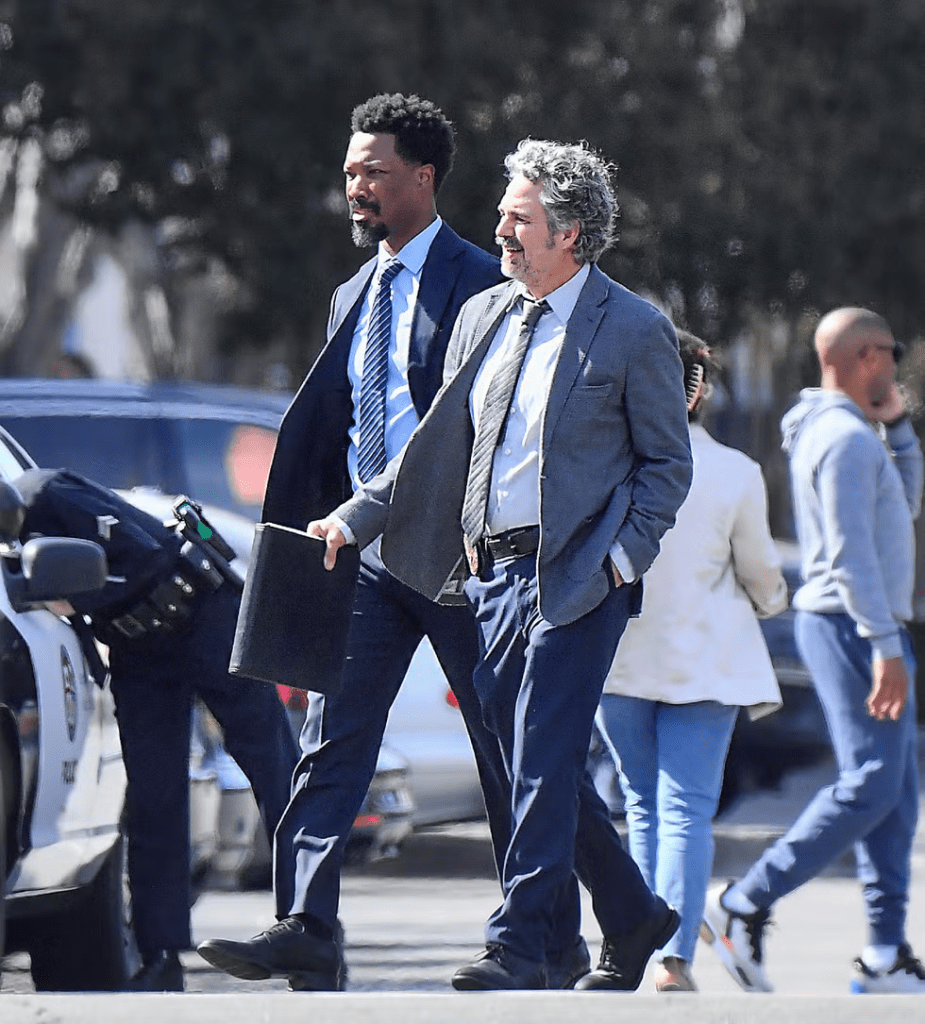
Editors note (D): …. starring Rami Malek, Laurence Fishburne, and probably some other people.
Jean: OK, so let’s talk about this idea. Like, how many times can a movie ask you to just ignore logic before you just throw your hands up and say, nope, I’m out?
Raj: Yeah, that’s a great question. And it seems like that’s exactly what happened with the listeners we’re focusing on today.
Jean: Right. We’ve got this really interesting source. It’s basically an informal audio recording. Some folks talking right after seeing a movie called Revenge of the Nerd (L&D had just screened The Amateur)
Raj: And just to be clear, not the 1984 comedy. This is apparently a very different film.
Jean: Oh, definitely. And our whole mission here is to kind of unpack their reactions, figure out why this specific movie just, well, failed to connect with them so badly.
Raj: It’s fascinating because it’s so raw, you know?
Jean: Yeah.
Raj: You’re getting their immediate thoughts unfiltered. It’s a really unique window into that audience experience.
Jean: Absolutely. And one of the first things that jumped out at me from their chat was this idea of a suspension of disbelief budget.
Raj: A budget, huh? Okay.
Jean: Yeah. You only grant a film so many moments where you have to consciously decide to ignore something unbelievable. And for them, with this movie, they felt that budget was just blown completely.
Raj: That makes a lot of sense. We all go into a movie willing to accept certain things, right? Fictional worlds have rules, but there’s a limit.
Jean: Exactly.
Raj: Too many breaks in that believability, too many wait, what, moments, and you just get fatigued. It pulls you right out.
Jean: Yeah, you stop being immersed. They even brought up what they called the Indiana Jones exception.
Raj: Oh, yeah.
Jean: The idea that some movies just seem to get a pass, you know? They can get away with way more unbelievable stuff. Why do you think that is?
Raj: Well, I think with something like Indiana Jones, the film signals its reality level right from the start. It’s heightened. It’s adventure with a capital A.
Jean: OK, so there’s an understanding up front.
Raj: Exactly. An unspoken agreement. Maybe Revenge of the Nerd, this one, either didn’t set its rules clearly or maybe it violated the internal logic it did try to set up. So the unbelievable moments felt jarring, not fun.
Jean: That tracks. Now, another big thing for them was predictability. They felt the plot was just completely obvious. Someone said, you already knew it was going to happen just from the revenge angle.
Raj: Hmm. Predictability. That can definitely be a drag on the experience, can’t it?
Jean: You think so. How much does that lack of surprise really matter?
Raj: Well, a lot of the fun of watching a movie is discovery, right? Finding out what happens next, if you feel like you’re always five steps ahead.
Jean: Yeah, it takes the wind out of its sails.
Raj: Right. You lose those potential aha moments they mentioned wanting. You become more of an observer than like an active participant in the story. It’s a real challenge, especially in genre films, to use familiar ideas but still make them feel fresh.
Jean: Keep you guessing somehow.
Raj: Exactly. You need that balance.
Jean: And speaking of not being invested, they really hammered the pacing, especially Act One. Act One took so long, someone said. Oof.
Raj: A slow start is tough. Yeah.
Jean: They even joked about getting confused, thinking maybe they were watching The Accountant instead at first. Which, I mean, that tells you how little it grabbed them early on.
Raj: Yeah, that first act is so crucial. It’s where the film’s supposed to, you know, set the tone, introduce who matters, what the stakes are, basically give you a reason to care.
Jean: To stick around.
Raj: Precisely. If it drags, you start checking your watch, you get restless, you lose that initial buy-in, even if things pick up later. It needs to build momentum, make a promise that the journey’s worth it.
Jean: And it sounds like, for these viewers, that promise felt pretty empty. They actually pointed to a specific moment where they felt it all just went downhill.
Raj: Oh, really? What was that?
Jean: It was when the main character, after blackmailing someone, apparently just decides, OK, now I’m going to go kill them myself.
Raj: Oh, OK. That’s a shift.
Jean: Yeah, their reaction was basically, that’s totally unbelievable. It’s amazing how one plot point can just shatter everything for a viewer.
Raj: It really speaks to character motivation, doesn’t it? And, like, logical progression. Even in a wild story, you expect characters to act in ways that make some kind of sense for them.
Jean: Right, based on who they are, what’s happening.
Raj: Yeah. And that sudden jump from blackmail to personal execution, it sounds like it felt completely unearned or illogical to them. And boom, there goes that fragile connection to the story’s reality.
Jean: Snapped just like that. They also seem to go in expecting something… Different, like maybe more of an action movie.
Raj: Ah, genre expectations.
Jean: Yeah, they felt this wasn’t really it. And the comparison they used was pretty brutal. A poor man’s Enemy of the State.
Raj: Ouch. OK, that’s telling. Enemy of the State suggests they were geared up for a certain kind of thriller, you know, tech, conspiracy, maybe some slick action.
Jean: Right.
Raj: And calling this a poor man’s version implies it just didn’t deliver on that level. Quality, pacing, maybe the thrills just weren’t there compared to what they expected. It really shows how important it is for a film’s marketing or even just its basic premise to line up with the actual movie.
Jean: Manage expectations, basically.
Raj: At least meet the expectations you set up.
Jean: Then there was, well, the ghost of the wife show, as they put it.
Raj: The what now?
Jean: Yeah. Apparently, a subplot involving the protagonist’s dead wife appearing. Their reaction was just universally negative. Pointless. Nobody bought it.
Raj: Oh dear. That sounds like a subplot that did not land.
Jean: Not even close, it seems. What happens when something like that, intended maybe for emotion, just falls flat?
Raj: It could be really detrimental. If a subplot feels forced or unbelievable or just unnecessary, it distracts from the main plot. Instead of adding depth, it just muddies the water.
Jean: Makes it feel cluttered.
Raj: Exactly. Or worse, unintentionally funny or just awkward. Sounds like this ghost wave thing felt like a total misstep that pulled them further out of the story.
Jean: Despite tearing it down pretty hard, they actually had ideas for how it could have been better.
Raj: Oh, like what?
Jean: Well, shorter runtime for one, maybe even cut most of Act One, a simpler plot, fewer bad guys maybe, and a more believable escape for the villains.
Raj: Okay, streamlining it.
Jean: Yeah, they specifically called out a very public kidnapping scene as being so unbelievable it sounds like they just wanted something tighter, more focused.
Raj: That makes sense. Taken together, their suggestions point towards wanting a story that was just more plausible within its own context. Faster pace, clearer conflict, and events that didn’t constantly strain credulity. That kidnapping scene sounds like a real breaking point for them.
Jean: A bridge too far. And maybe the biggest issue, which came up near the end of their chat, was the protagonist himself.
Raj: What about him?
Jean: They just couldn’t connect. Someone said flat out, you have to sympathize or empathize with the protagonist. And here, there was nothing really redeeming about him at all.
Raj: Wow. That’s tough for a film to overcome.
Jean: Isn’t it? How crucial is that connection, really? Do you have to like the main character?
Raj: I mean, not always.
Jean: Yeah.
Raj: But you need something to hold on to. Empathy, understanding, fascination, even. If you find the central character completely off-putting or unrelatable…
Jean: Why should you care what happens?
Raj: Exactly. It creates this huge emotional distance. It’s hard to get invested in the journey if you have no connection to the person taking it. I bet a lot of you listening have felt that, where you just can’t find anything to latch on to with the main character.
Jean: And it wasn’t just him. They pointed out they knew almost nothing about the wife he was supposedly avenging.
Raj: The ghost wife.
Jean: Well, the wife before she was a ghost, presumably. The only detail they could recall was that she goes to conferences for work.
Raj: Goes to conferences. That’s it.
Jean: Apparently, it just highlights how underdeveloped things felt. If even the core motivation, the wife’s significance, feels vague or underdeveloped.
Raj: It makes the stakes feel really low, doesn’t it? Why is he going through all this? If her character is just a cipher defined by professional conference attendance?
Jean: Yeah, it feels almost absurd.
Raj: It makes it hard to buy into the emotional core of the story. Those little details, or lack thereof, they add up.
Jean: So summing it all up, their final take was pretty scathing. Worst movie since Mother, one person said. Another thought it was definitely one of the worst of all time.
Raj: Pretty definitive judgments there.
Jean: Yeah. It really brings us back to where we started, doesn’t it? The whole deep dive was about why it failed, and it seems it was a failure on multiple levels for these viewers. Believability, pacing, plot logic, character connection.
Raj: And connecting this back for everyone listening, thinking about valuable insights, this conversation really highlights how vital that narrative contract is.
Jean: The unspoken agreement.
Raj: Exactly. Audiences need consistency. They need believable motivations, even in fiction. You push that too far, ask for too many leaps, make characters act nonsensically, you risk losing people completely, like these viewers were.
Raj: It’s a fragile thing, that suspension of disbelief.
Jean: Very fragile.
Raj: So maybe a final thought for you to chew on. What’s the movie that tested your limits the most? Was there one specific moment, one plot point, one character choice that just made you mentally check out and say, nope, not buying it?
Raj: And thinking about that, what does it tell us about that unspoken relationship, that delicate dance between the storyteller and the audience?
The Materialists *** I think you will enjoy going to this movie and talking about it with your friends. I don’t think this is a terribly good movie, but it does have a lot to say about life in the Big City, much of which is probably true. Lucy (Dakota Johnson) is a professional matchmaker for Manhattanite-types that can afford professional matchmaking services. Harry (Pedro Pascal) is a zillionaire “unicorn” (a perfect match for pretty much any female looking) and John (Chris Evans) is a bumbling idiot from Lucy’s past. There is a lot of “math” in this movie — for men the key addends are height and income, for women being young and rail thin (say, BMI < 20, not ≤ 20). The movie is billed as a rom-com, but I didn’t find it terribly funny (though there were several amusing sight gags). Does that make it a drama? There is definitely a meditation on how financial resources — or the lack thereof — shape life’s possibilities, especially in New York. There are some interesting exchanges and conversations throughout, but some baffling plot elements that are worth at least one * off.
The Phoenician Scheme ***Wes Anderson’s latest features Benicio del Toro as an industrialist and international man of mystery, Mia Threapleton as his daughter and would-be heir (or perhaps his heir and would-be daughter, tough to say), and with Michael Cera as the traveling secretary, Bjorn. The cast is also littered with supersars, Jeffrey Wright, Tom Hanks, Bryan Cranston, Scarlett Johansson, Benedict Cumberbatch, Willem Dafoe, F. Murray Abraham, and, of course, Bill Murray. Unfortunately, there aren’t many writers that can support that kind of cast, and this is no exception. I saw this a few weeks ago and couldn’t tell you the main takeaway from the movie, though I can recount a half dozen amusing moments and scenes. As per always, Anderson makes it clear who is directing with the set pieces and the props and the deliberate, sharp color schemes. If you are an Anderson fan, this one is a no brainer. If I was in the market to re-watch an Anderson movie, this one would be at least five or six deep in the queue.
Bride Hard ½* Ostensibly a Die Hard spoof set at a ritzy wedding, this one falls flatter than Hans Gruber from the top floor of the Nakatomi Plaza. Within the first minute of watching I sensed I was in for a long evening. Rebel Wilson in the lead has a couple of moments (using curling irons as nunchucks gave us a moment), but what appears to be a pretty talented cast (Wilson, Anna Chumsky, Da’Vine Joy Randolph) wasn’t enough to overcome a bad script and lazy writing. L liked it quite a bit more than I did, and my estimated rating for him is *½.
F1 ***, ***½ if you see it on the big, big screen. This is a summer action film, big stars (Brad Pitt, Javier Bardem), loud music, rumbling cars, some reasonably strong plot lines. Not that strong, though. Mostly, but not entirely, predictable. If you are looking for two hours of extraordinary film production from Daytona to Budapest to Belgium to Abu Dhabi and back again to Baja, then this one is a good choice.
Listen to me. Everything we see that is ugly- stupid, cruel, and ugly. Everything is your fault…
But especially the ugly.
That is the best punch line of The Brutalist, Director Brady Corbet’s epic exploration of the Affluent Society. It is also, arguably, the thesis of the film.
I loved watching this film on the very big Marcus screen. People often say this about movies shot in Montana or Australia, big landscapes, blue skies, astonishing weather fronts, that sort of thing. Remarkably in The Brutalist, many of these landscape views are scratchy stock film from the ’50s heralding the post-WWII industrial boom. The stock film is often co-narrated by the guy from the school movies of your childhood, and backed by the gasp of an accordion, or some pulsing, syncopated beats.
Meanwhile, much of the main action is shot with what is — gosh, I don’t know, where is L when you need him? — maybe a hand-held camera? The effect is this disorienting and sometimes suffocating intimacy that pervades the movie. There were times where I swear I could see two sets of eyes on characters bouncing up and down in their cars. But it seems like it wouldn’t work as well on a television.
Anyhow, this is a very long movie, clocking in at over 200 minutes, so hunker down. About 15 minutes in, the cacophony of visual and aural and intellectual stimulation was so overwhelming that I knew I wasn’t going to be able to process and put it all together in real time. So the four-hour theater experience, including a 15-minute intermission, was not one of your relax-at-the-movie experiences.
And the film takes on the Big, Big issues, the Holocaust, the camps (the main characters are survivors), remorseless capitalism, immigration, assimilation, covert and overt anti-Semitism, and, perhaps least of all, the place of art and architecture in the emergent industrial age.
The main character, protagonist, possible hero, and subject of the movie is László Tóth (Adrien Brody), the brutalist himself. His journey is Brady Corbet’s characterization of America.
Tóth makes it to America in the opening scene and the first outdoor American shot in the film is an upside-down Statue of Liberty. (Could this possibly be a metaphor of some sort?). His first stop is the City of Brotherly Love to live with and work for his cousin, Atilla (Alessandro Nivola). Atilla is the proprietor of a small furniture business and has reimagined himself as an American Catholic named Miller! More foreshadowing here as the cousins converse about what is expected in America, what it takes to be accepted in America.
Tóth isn’t impressed. He doesn’t seem like the compromising type, and certainly not one to compromise his vision for the sake of bean counters or pencil pushers. Yet, he is also pragragmatic about some of the ends to get to his means, particularly with respect to the use of abundant and inexpensive concrete! And so away we go.
Much of the movie involves Tóth’s relationship with his new patron, Harrison Lee Van Buren (Guy Pearce). These patron-artist relationships are always a dicey and touchy area for the artist. Who is paying and what exactly are they paying for? What if they want you to comprimise? What if they delegate oversight to some penny-pinching philistine? But Van Buren’s real role is that of the industrialist archetype. He represents the post-war economic and construction boom that’s helping Pennsylvania and the United States into the modern age.
Van Buren’s son, Harry Lee (Joe Alwyn), also features prominently for plot-related reasons, but ultimately he represents the financiers. At one point László asks him, “how does that work exactly? The company paying themselves to finance?”
As it says on our masthead, to ask the question is to answer it.
So the politics of the movie aren’t altogether complicated, but László’s relationships with his wife and niece certainly are. Right off the bus in Philadelphia, Cousin Miller tells László that he has received word that they are alive! So throughout the first few hours of the movie there are repeeated voiceovers back-and-forths between László and Erzsébet in an attempt to get her to the states. I must admit that I don’t watch trailers, so I wasn’t entirely sure that she would ever really make it.
But, spoiler alert, the intermission credits provide a decisive wedding picture that helps secure her immigration visa, so Erzsébet (Felicity Jones) and their niece Zsófia (Raffey Cassidy) make their way over to join László at the Van Buren estate. There is a lot going on here in terms of the state of their marriage, the state of their Jewish faith, their places in America, to name a few. There is no easy way to characterize Erzsébet, she understands ambition and ambitions, but she also is reflective and shows gratitude in spots where I’m not sure you would expect it. She is definitely an interesting add and a welcome riposte to Corbet’s otherwise simplistic American caricature.
The other main and recurring character is Gordon (Isaach De Bankolé), who László meets in a food line early on in the movie. Gordon’s role seems to be to provide opportunities for the script to explore László’s character and humanity. He often shows up right as László is responding to a new plot development.
And what of the Brutalism? Huh. I guess I will continue to reflect on that question as I continue to process all of this. My big takeaway is that the movie is a commentary on the economic and cultural response to World War II coming to a close.
I think the acting is splendid, Brody really is great. I’m not sure who else might have pulled this off. Felicity Jones earns her money, too. I also loved Salvatore Sansone as Orazio in the Italy scene –– “dangerous work.” The entire sequence in Italy is just remarkable. There is so much to like.
The verdict. I thought this was a great movie to watch, though it isn’t a great movie. I do recommend you head to see it on the big, big screen if you can. It was loud in there, too! Make a day of it.
A shout out to Dr. B for braving this one with me. He didn’t get up and leave or doze off, so I think he liked it, too.
The Odyssey. Odysseus. Ten years away at the Trojan war, ten years to get back. Past the Cicones, the Lotus Eaters, the Cyclops (“Nobody” tricked him!), the Wind God, Circe’s Island, to Hades and back, the singing Sirens, through Scylla and Charybdis, on to the Isle of the Sun God and to Caylpso’s Island. What a trip!
Ithaca. Queen Penelope raising the son, Telemachus, keeping the many suitors at bay. Famously weaving a funeral shroud by day, covertly undoing it at night. For 20 years! The suitors weren’t the sharpest group.
Setting the stage for the return. Just not setting the stage for The Return.
While Penelope was unwinding, Odysseus found his way to Phaeacia, where he recounts his tales to King Alcinous and the Phaeacians — I actually wrote a college term paper on how this penultimate stop served as a transition from the fantastic back to the more mundane toil of life in Ithaca (not exactly an original thesis, I know). It was the sea-smart Phaeacians that help Odysseus find his way back to Ithaca.
None of this makes it into The Return, unfortunately, especially the part about Odysseus talking a lot. Instead, The Return focuses solely on Odysseus (Ralph Fiennes) back in Ithaca to (presumably) reunite with Penelope (Julia Binoche). I say presumably here because Odysseus of The Return is a troubled, broken shell of a man, and not at all in a talking mood. He has misgivings about his time as a warrior and his heroics in the Trojan War. He can’t muster up the courage to confront the suitors and reunite with Penelope. He is seemingly all alone — there is no sign of the goddess, Athena, who has been his #1 fan and protector over the past 20 years. The entire movie, in fact, is a godless affair, and not in a good way!
The movie does capture Odysseus’ renuion with his loyal dog, Argos. My recollection is that Odysseus passes by on his way back to the palace and Argos looks up from the dung heap, notes his master’s presence, wags his tail, and passes on from this life. The Return doesn’t let him off that easy, instead extending into several minutes of pointlessness before finally letting Argos go. Even so, on behalf of L&D, I will say we wish we would have checked out of the theater when Argos passed on.
Revisionist Odyssey didn’t work for us. If you are looking for action, drama, intrigue, tension, emotion, suspense, you best look elsewhere. This is one of the worst viewing experiences in the L&D canon.
Did you notice the title has the Roman numeral II in the middle of it? Indeed, that is about the most subtle part of the Gladiator remake. This is the second Ridley Scott project in recent memory — Napoleon being the other one — where it seems like it would have worked better as an eight-to-ten part Max or Netflix series. But instead we get sloppy storytelling that sets up a variety of spectacular visual sequences.
If you are familiar with Gladiator, you can see where this movie is going from the length of the Roman empire away. The charasmatic warrior Lucius (Paul Mescal) is captured by legions led by General Acacius (Pedro Pascal) and then sold into gladiatorial servitude to the enigmatic Macrinus (Denzel Washington himself!). Lucius turns out to be exceptional at killing man and beast and makes his way to the Colloseum. General Acacius and Macrinus have sketchier motives, I guess we’ll have to see about all of that. And we are introduced to the decadent emporer tandem, Geta and Caracalla. Lucilla (Connie Nielson) shows up and seems concerned about the fate of Rome. Contrived drama. Big finish.
With Gladiator, we all knew Maximus (an in-shape Russell Crowe) was pals with Marcus Aurelius and had been unjustly railroaded. He reluctantly did his killing to get his chance for vengeance, “in this lifetime or the next.” The big difference here is that there is some mystery surrounding who the actual protagonist is — is it the gladiator? General Acacius? Denzel? Lucilla? The fratelli imperatori?
The bad news is that if you haven’t seen Gladiator, it might be a little difficult to follow along. The good news is that it doesn’t really matter. This movie is the battlefield and the Roman Circus. Ridley Scott gives us a naval assault and a great siege to open the movie. He gives us a gladiator mounted on great rhinosoraus (hat tip to a classic Bugs Bunny short for the rhino’s fate). He turns the colleseum to a great, shark-infested naval theater. This is definitely one of those “see it in the theater” type movies because they spent a lot of money making this look spectacular.
There are two things L&D want you to know about Yorgos Lanthimos’ Poor Things, out in theaters just in time to disrupt your holiday season.
First off, it is a masterpiece.
Second, it is not for everybody.
In fact, it might not be for most people. It is full of sordid characters, blasphemy, torture, maiming, dismemberment, houses of ill repute, objectionable animal husbandry, live-action surgery, graphic sex, and a lot of things that could be dealbreakers for you that possibly didn’t even register for me. And in many cases what is implied in the script is even worse than what we actually see on the screen. I admit to some squirming throughout and covering my eyes and wincing at least twice. It is probably not a great holiday movie choice for you and the kids.
On the other hand, the production values are extraordinary, at least three movie stars are at their best (or better), and the story is cerebral in more ways than you can count on one hand.
The movie begins with an in-color shot of Emma Stone taking a nosedive off a bridge and into the drink. What follows is not a flashback, but does initially revert to black-and-white with Stone awkwardly walking, playing, eating, urinating, etc… in a cognitively primitive state. She is within the confines of the home of a heroically patient yet grotesquely disfigured Dr. Godwin Baxter, played by Appletonian Willem Dafoe (!). “God”, as his inner circle immodestly addresses him, is a pure empiricist — a surgeon or a man-of-science of some sort.
L&D were huge fans of Emma Stone’s performance in The Favourite, another Lanthimos film, so we were expecting good things. But five minutes into this one I was pretty confused as to what was going on, and thought to myself that there is no way Stone’s character can carry this movie. Boy was I way off in that initial assessment. I was also not expecting Mark Ruffalo to show up and attempt to steal the show with a bravado performance. But a bravado performance it is, with his portrayal of the the rakish Duncan Wedderburn.
And then there is Dafoe. For a horribly disfigured guy who is on the front-end of surgical innovation, it is a pretty understated performance. But as we were leaving the theater, we were debating whether this was the best performance of his career. Although the movie does not reveal the backstory on the heavy scars covering his face, we have enough clues to put together the likely source. It becomes more and more heartbreaking as the movie goes along.
So to sum up, a crazy feminist science fiction steampunk storyline, an abundance of edgy content, several great performances, a number of big laughs, and a visually challenging yet gorgeous backdrop.
In short, a masterpiece.
L&D were duped into paying full price for this one, but it was still way over the bar. I wouldn’t be surprised if we catch this one again before it leaves the theaters.






 L&D Report