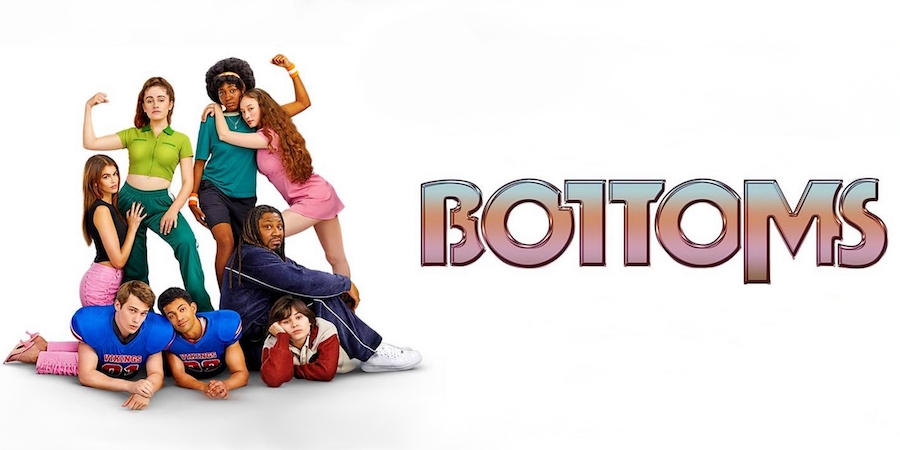
Bottoms had me laughing pretty much all the way through. However, as D noted, a lot of the laughs were asynchronous. It happens. When two hapless lesbian high schoolers, PJ (Rachel Sennott) and Josie (Ayo Edebiri), try to hook up with cheerleaders by starting a school sanctioned fight club, things go sideways, quickly. First of all, what faculty member in their right mind would sign on to advise such a group? Maybe someone like Mr. G, played convincingly by former NFL star Marshawn Lynch, who’s going through a divorce and phoning it in. In one memorable scene, Mr. G has the class reenact the Treaty of Versailles while he sits back to enjoy the Big Booty Babes edition of Divorced & Happy magazine.
As the poster says, Bottoms, is produced by Elizabeth Banks, who also Directed Cocaine Bear. (We actually both wrote Cocaine Bear reviews.) And this film certainly has that same zaniness, irreverence, great casting and a touch of gore, but nothing too over the top. Just enough to make you audibly groan and then laugh. The dialogue reminded me of His Girl Friday, with plenty of repartee that kept things moving right along.
I also learned a few things. In a dramatic mic drop moment, one black fight club member says, “This is the Second Wave all over again!”, a reference to the exclusion of women of color in the narratives of Second-wave feminism. This zinger, set up by a Mr. G multiple choice question, possibly in a “History of Murdered Women” class, had people laughing out loud in the theater.
Bottoms creates an absurd yet believable universe. It is certainly silly but the comedy belies a cutting social critique. What better way to heal what ails us, than to serve it up with a smile. Or an uppercut to the jaw. A side kick to the groin. A broadsword through the chest. …Mistimed explosives.
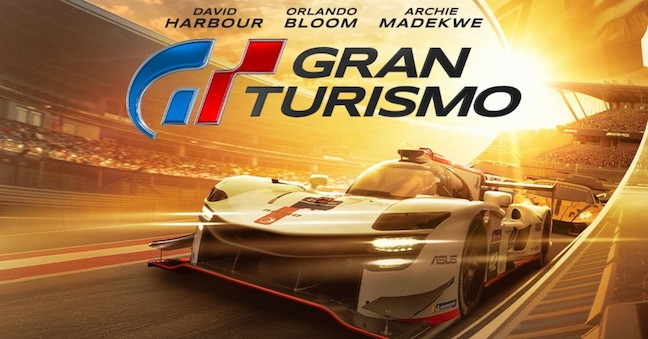
According to the National Association of Collegiate Esports there are currently 5,000 esports student-athletes and $16 million in scholarships awarded in the U.S. annually. Stats like these illustrate the blurring of what has traditionally been considered sports. Gran Turismo considers the relationship of gaming in the virtual world with that of a high stakes sport in the physical world.
Based on the true story of Jann Mardenborough, a young man who lost himself in the simulated world of auto racing in the game Gran Turismo, only to find himself in the real-world GT Academy. A driving school where the winners of a seemingly half-baked marketing idea learn what it takes to race behind the actual wheel.
The film is extremely formulaic in terms of the Joseph Campbell hero’s journey. Right down to a “use the force” moment in ACT III. Not surprisingly, it fails the Bechdel test. Though it had the opportunity to pass when racer Leah Vega (Emelia Hartford) meets love interest Audrey (Maeve Courtier-Lilley) at Le Mans. There were also two women competing at the GT Academy, another missed opportunity. In fact, the entire Audrey girlfriend storyline is crowbarred into the narrative and is simply an awkward attempt to normalize a character who has an extraordinary talent. I’m sorry but Jann Mardenborough (Archie Madekwe) is anything but typical. He has big dreams that he is unafraid to pursue. And he’s laser focused.
All of the impressive computer generated graphics and all the other actors are completely upstaged by the great David Harbour. He reprises his role as sage protector from Stranger Things and it totally works. You don’t doubt his sincerity or vulnerability for a moment. There were also other strong performances by Orlando Bloom, Geri Halliwell and Dijon Hounsou.
Gran Turismo is a fun, globetrottting affair. It celebrates Japanese design and western showmanship. It certainly hits on the well worn tropes of the racing film genre. Yet, the story is told in a such a fast-paced way, with such cool effects and good acting, that the audience is still surprised by the twists. If nothing else, Gran Turismo is effective.
The greatest strength of Gran Turismo is Director Neill Blomkamp. His first feature was the instant classic and box office smash District 9. A haunting combination of science fiction and social commentary from his homeland, South Africa. He is a master of weaving special effects with live action. A perfect choice to navigate this subject matter, which lives in both places simultaneously. Even though our hero Jann is constantly told by every person in authority that life is not a game, the only way he can feel calm and conquer the so-called real world is, besides blasting Kenny G at unholy levels, reminding himself that, “It’s only a game.”
There is always a movie from India playing at the Marcus Hollywood cinema here in Appleton, Wisconsin. They are screened in the Hindi, Telugu or Tamil languages. Sometimes a film will have various language versions during the same theatrical run. Out of curiosity, we snuck into one of these films, halfway through, a few years back. It was loud, very loud, but also seemed like something we’d like to try for real down the line.
This week, we finally made it back to the Indian screening, with all-star LnD contributor, G., for a film called Unstoppable (Unlimited Fun). Going to one of these screenings is a unique experience. Right off the bat, I can’t think of another film that has parenthesis in the title. …I’ll wait. … No, right? …Then, I forgot to bring earplugs. This is not an exaggeration. Unstoppable (Unlimited Fun) is an all out full throttled assault on your senses and the theaters’ surround sound system. It makesEverything, Everywhere All at Oncelook like a French alpine picnic, including baguettes and brie. There is a wall of sound & color. You can feel the full energy and power of the Indian sub-continent. By the way, India is now the most populated country on earth with 1.4 billion people and you can think of U(UF) as a blaring public address announcement for you.
To enjoy U(UF) just order a side of suspend your disbelief with your popcorn. It’s a rollicking whirlwind, an absurd ride, that breaks into elaborate and large song and dance numbers. One dance scene takes place in a Hollywood themed amusement park. The protagonists end up sitting in front of a statue of Laurel and Hardy for a moment. There are also funny but poignant critiques of the way we do things in the West. In particular the obese child of one of the main heels who seemingly would be able to find the floor of a bottomless bucket of KFC — and demand more like a golden ticket winner in the Wonka factory.
Another note on sound. The film had a comic book sound design that surprised my sensibilities. Akin to the original TV Batman series, the effects accentuated each character, gag and zinger. There was no shame in this. And it made sense in a universe that was so completely over-the-top. As far as the volume, I’m not saying this facetiously, to be cute or racist…bring your damn earplugs. Why are these Indian films so loud? I can’t tell you why. I don’t know if this is the volume that they are normally played at in India and is what people expect or if this is an anomaly. I suppose we could have had the staff turn it down. We were after all the only people in the theater, but that wouldn’t seem right in principle. This must be the way it was intended to be heard. Another thing is that the Indian films which play at Marcus Hollywood are long. At two and a half hours, U(UF) is a shorty. Most are at least three hours. I asked a friend who immigrated to the US from India about this and without missing a beat he said that, “L., there is no air-conditioning in India.” Maybe so. I know that in most places in the world people use the movies to escape muggy, hot weather. This leads me to wonder if movies are going to get longer due to global warming? I’ll leave this question to box office experts and climate scientists. Ironically, it was kind of stuffy in the Marcus Hollywood Cinema in Appleton.
The plot of the film, which you can easily understand without reading a word of subtitles, follows two YouTube celebrity film critics, Kohinoor Kalyan (VJ Sunny) and Jilani Ramdas (Saptagiri) as they get into some hot water before a big wedding. Their quest has them come up against a really bad hombre and his henchmen. Our crew is aided by Ramdas’ girlfriend Apple aka Bandar (Aqsa Khan) and also an internet influencer and Kalyan’s love interest named Time Table Tulasi (Nakshatra) who really needs this to end so she can make a reel for her friends. She has a lot of followers! An Uber driver named Tyre (Bithiri Sathi) who is only into “super interesting” stories and experiences basically steals the movie. Overall, as an experience, I enjoyed Unstoppable (Unlimited Fun). I would have enjoyed it more with ear protection but that’s my own damn fault. I judge this film not on the usual standards I would apply to story structure and reality but to how well it brings energy —and this film really brings it. In the words of Tyre, the cracked out Uber driver, “It’s SUPER INTERESTING, bro!”
Dr. Ken Jeong screaming over and over “I am somebody! I am somebody!” as he is floating atop a mosh pit of security guards who are about to 86 him from the Downtown LA Standard Hotel is a highlight in Fool’s Paradise. Sadly, the highlights are few and far between. There were other stand out moments, like the scenes with Adrian Brody, especially drunk driving at night and shooting out the La La Land streetlight from his supped up Mustang on Mulholland Drive. And every time he said, “I’m coming for you!” right before a scene in the movie within a movie, Billy the Kid, was about to start. And there were a few fun moments with the inimitable Drew Droege who I had the good fortune of working with when I was the Cinematographer on the Ringo Le’s feature, Big Gay Love. Drew lit up the screen in Fool’s Paradise. He’s a natural in front of the camera.
To look at Fool’s Paradise on paper, from the talent-side alone, you’d think there is no way this will miss. But you’d think wrong. At the heart of the film is a parable in the vein of Charlie Chaplin. The protagonist doesn’t speak, wears a bowler, walks and runs with the same gait as the master. However, a cursory glance at the works of Chaplin like Modern Times, The Great Dictator, City Lights and The Kid reveal a character who was active in the world. He wanted things. He wanted to be gainfully employed. He wanted to be in love …and would fall in love. Even watching the last scene of City Lights simply puts Fool’s Paradise to shame. There is so much power in movie making that this film never explores and has left on the table. It only somewhat hints at the magic of cinema once. A shot where a lamp in Echo Park, a movie location since 1910, starts to flutter. Instead we have a protagonist who is blank slate. A mirror to the insanity around him. But he’s helpless. What he wants most is to sleep on a park bench. And we want him to. We don’t want him to succeed in Hollywood. We just want him to be left alone.
It was disconcerting to me how bad this film unraveled. It doesn’t help to overanalyze it. As D said, the jokes were flat.
I’d like to start this review by pointing to the great craftsmanship in this film. Sometimes it even feels slightly overproduced. For example, a street sign in a part of town that is supposed to be downtrodden looks like it was just created and polished in the prop shop. But in general the film is well made and impressive from a technical point of view. It’s a big movie for a big guy.
However, it’s not a great movie. There is just so much about George Foreman. His will and his achievements are almost incomprehensible. How could you focus on just one aspect, one moment? To the detriment of the story, the filmmakers didn’t even try. Alternately, let’s look at the 2018 Ruth Bader Ginsburg film, On the Basis of Sex (I break down how the film works in the penultimate paragraph of this essay, Power). It didn’t focus on her illustrious career. It honed in on her very first case. It was so effective in that telling, that we could understand her thought process and extrapolate from there. If given this situation, RBG is going to handle it like this. This is what she’s like.
In Big George, we come to similar epiphanies but go on an epic roller coaster ride. During the end credits we are told that the George Forman® Grill rights were sold by George for 137 million dollars. The grill was only mentioned once, in passing, during the entire movie. That story alone could have taken an hour and a half to tell. Maybe it’ll be the sequel? To be fair, there were a lot of interesting things I didn’t know. How Forman won the Olympic Gold Medal in ’68. How Foreman became world champ not once, but twice…20 years apart! And a lot about his deep faith and how he came to it. Over the course of his life, George Foreman’s spirituality and intellect rose to match his raw power and athletic talent.
This is an epic film. It’s a long film and it feels that way…but I still enjoyed it. As D pointed out, it plays more like a filmed graphic novel. I rejoined that if it were a Bob Ross painting, it would be painted using only his famously wide two inch brush. To quote the most prolific painter the world has ever known, “There are no mistakes. Just happy accidents.” Big George Foreman does have a lot of heart and gives you plenty to think about. It’s a good movie that’s worth watching.
Polite Society begins with a very cool montage of London. D. leaned over and said, “Where is this?” And I replied in a little louder than a whisper, “She just rode her bike into Shepard’s Bush Market.”
I was walking the streets of London last Summer and there is an instant nostalgia at every turn. You feel as though if you just stand still long enough the buildings will invite you to tea and start regaling you with stories from Mozart to Lady Di.
One thing about Polite Society is that it’s a movie which Quentin Tarantino would approve of (both D. and I have added his great book, Cinema Speculation, to our collections). Polite Society is vibrant. Crackling with energy. It’s exuberant. It’s fun. In a world of simply staid movies it stands out.
A Pakistani-British fairy tale, it’s absurd in some aspects. Hyper-real, literary, graphical — all those things — but what keeps it tied to the audience is a fantastically grounded performance by Priya Kansara as aspiring stuntwoman Ria Khan. At one point, I felt such joy watching this performance and also of the fight in this characters’ arc that it made me recall why I got into making films in the first place. To tell meaningful stories in an entertaining way. To bring characters to life. I enjoyed this film to no end.
Plot-wise however, it got off to a slow start. Then, it pursued a story-line we have seen time and again. Most recently in Sorry to Bother You —another strong film with a serious twist. However, Polite Society for me was about great casting and performances. And the soundtrack is straight to the top and off the damn charts. Right up there withBaby Driver and The Big Sick. If you want to see a kung-fu, kick-ass, coming of age story, I highly recommend Polite Society. It’s anything but.
Something we haven’t written about in a while is expectations and film going. It boils down to this, keep your expectations low and you won’t be disappointed…at least not too bad. This was a difficult lesson to learn. Not to beat a dead Sully but I’m still shaking my head there. What made me think that would be God’s gift to celluloid. Meanwhile I had zero expectations of Free Solo. I was even wondering what we were doing there at first. I think we may have been the only people in the theater. And that film went on to blow everyone’s mind and win the Best Documentary Academy Award. So there.
Another thing about expectations is that we, LnD, are opposed to trailers. We actually have our routine timed in such a way that we can saunter into the cinema —amuse the managers, grind the ticket counter person, goof around with the concession staff— and mosey on into the movie as the opening frames start flashing.
Which brings me to Somewhere in Queens. Frankly, I wasn’t expecting much. Ray Romano was, maybe still is, a household name. He had a hit TV show for 9 seasons, 210 episodes from 1996 to 2005. Of course, I have never seen it. I may have watched it once. Maybe twice. I know his dad was grumpy and his brother was tall. The point is, I didn’t have any Ray Romano baggage going into this film. When D leaned over to say at the beginning of the film, “Is this a Ray Romano is sad movie?” I just shrugged. I am supposing that Ray Romano wasn’t sad on his TV show. Romano, co-wrote, produced, directs and stars in Somewhere in Queens. His character isn’t sad. He’s complicated. He’s like a weathered ship in a storm. A guy who needs a shave so badly, but when will he find the time? His wife is a cancer survivor who hasn’t psychologically overcome the disease. His son, who probably should have been diagnosed with something by now, is reclusive, introverted. Romano works for an indifferent father and insensitive brother. He does have a few good buddies he works with. There is at least that. But it’s shaky. Everything is slightly shaky for this Ray Romano character. He lives vicariously through the exploits of his son on the high school basketball court. And from here the twists and turns of the narrative and great references to Rocky begin. It turns out that Rocky Balboa is Romano’s philosophical standard-bearer.
There are a lot of laugh out loud moments in this film. There are also a lot of awkward, cringy by design moments. Something was off though. The pacing? I’m not sure. Somewhere in Queens doesn’t knock you off your feet like say, CODA. It’s almost too relatable for that. There is nothing special and yet everything is special about this family. It’s like a mirror of a film. There won’t be shootouts, or car crashes, or witticisms. Just moments…that will make you laugh, or hurt…that you can relate to. It actually blew away my expectations in that it told a very solid story, with strong performances and charming vignettes along the way.
Some people might get offended and say the film plays on stereotypes of Italian-American families. But at least from my own experience in a big Italian-American family, it’s pretty spot on. Apologies all around. But that’s what the dinner table is like. Please deal with it. I found it to be authentic in its stereotyping and not exploitive. How about that? There are reasons that stereotypes exist. And that was actually my biggest fear. I did break the rule, don’t watch the trailers! And watched the trailer to About My Father. That film stars De Niro and Maniscalco and it is truly a cringeworthy trailer. All the stereotypes there seem completely forced. Like, the film is a vehicle to exploit stereotypes, that’s why it exists. The laughs will be cheap and on the surface. That’s the opposite of what’s going on here. Maniscalco actually plays Ray Romano’s brother in Somewhere in Queens. Unlike his over the top, physical standup, which I enjoy, his performance was measured and poignant. He stayed true to his character and even seemed to have a little arc at the very end of the film.
So, as someone who was actually born in Flushing, Queens. Home of the Amazin’ Mets of 1969. I say Somewhere in Queens is a worthwhile, earnest exploration of the things that scare us and the ways we can face them.
The first thing to know about Air is that you already know the ending. …Or do you? You know that Nike makes kicks called Air Jordan. But did you know that the sneaker behemoth was once, before Air Jordan, a hair’s-breadth from dismantling its entire fledgling basketball division? Nike was predominantly known as a running shoe company in 1985.
The other thing you know going into Air is that any film with Ben Affleck and Matt Damon as the main talent, as the producers and directors aka above the line, is going to be good. And Air is good. It doesn’t hurt when you cast the great Viola Davis either. Or this other actor you may have heard of, Jason Bateman. And the film lets these talents get right to it, lets them show off their range.
It easily answers the question, can you make an interesting movie if the audience already knows the outcome? Yes you can. The movie is also a love letter to 1985 and all the products that went along with it. The montages of TV spots, the costumes and art direction were on point.
The film also flips the script on your traditional white savior story trope. In this movie, the savior is a 6’-6” African-American with an incredibly silky jumper, ice in his veins and a mom with a savvy business sense. It reminded me of TheFounder, the story of Ray Kroc and McDonalds, in some ways. As D pointed out of the comparison, Damon’s character, Sonny Vaccaro, becomes obsessed with a singular mission. Not to be cast aside, the character of CEO Phil Knight is played with hilarity and pathos by Affleck. But we are left to wonder about the means of production. Who makes these ethereal, leather bound beauties, that allow a man to defy gravity? That part of the story, besides a passing line by Bateman’s Marketing VP Strasser, never gets the spotlight. The film isn’t about a few folks reaping billions from the work of below minimum wage off-shore laborers, forced labor, child laborers in sweatshops. That’s a different movie. This one is about the tenacity and vision of someone who risked it all, thinking outside the box and who ultimately championed athletes. …Though that other question is left to float like the iconic Air Jordan logo.
The epilogue of the film, the little montage you often see of, “Where Are They Now” is simply jaw-dropping. And I didn’t wonder, as I had before the movie started, why Damon and Affleck chose this particular story to tell.
Am I going to reference Cocaine Bearin this John Wick: Chapter 4 review? You bet I am!
Now, I have said my piece regarding John Wick in a March 11, 2017 essay (6 years ago people!) here on this very blog. Let’s just say it is filed under an undignified LnD category labelled: “Terrible”. Regardless, I am coming around to John Wick. Mostly for the amazing locations and art direction. In terms of its filmic reality, it’s still an absolutely absurd video game, with only the special effect of spawning (when your player kind of electronically buzzes back to life) missing. However (here it is!) unlike Cocaine Bear, the violence in John Wick is essentially abstract. Poofs of blood-like mist emanate from people shot at close range. And the fighting…it’s choreographed like a fantastic dance. Actually, I think it would be cool if they just turned John Wick: Chapter 5 into a musical. Sure, a violent musical, but a musical nevertheless.
There was a great nod to the famous shots of a match being blown out cutting to a sunrise in Lawrence of Arabia. And the car chase scene around the Arc de Triomphe rivals anything that screeched in the French Connection. So if you are a fan of this series, you will certainly have plenty to cheer about in this installment.
In the not too distant past, L&D headed off to the late Marcus Tuesday screening to take in what was certain to be a memorable event, however it went, and it went exceedingly well.
“How good could a movie called Cocaine Bear be?” you ask.
Well, the L&D mantra of late is “To ask the question is to answer it.” Cocaine Bear is exactly as good as it can be, it’s hard to imagine that it could have been any better. It’s ridiculous, it’s funny, it’s thrilling, it’s gross, it’s surprising, it has star power, it’s remarkable across the board.
To say the movie is based on “true events” is akin to saying The Wizard of Oz is based on true events — indeed, a young woman got caught in a storm and hit her head once. As for the rest, well.
The intertwining plotlines fall somewhere between serviceable and solid. Keri Russell gets top billing as the mom tracking down her cheerfully truant explorer daughter and pal (Matthew Rhys sneaks in, as well). Isiah Whitlock, Jr. has cop buddy detail, he’s the one chasing down the big lead. Margo Martindale puts on a tub of lipstick as the lonely ranger setting a honey trap. There is a smattering of young park thugs who get more than they bargained for in the affair. And it’s Ray Liotta himself as the exasperated crime figure in what was his last major role.
There are a number of laugh out loud moments, though laughter did not seem uniform throughout the theater. The opening scene with the drug runner gleefully tossing bricks of coke out of the plane is surprisingly hilarious. The entire EMT sequence is surprisingly inspired . And the finale featuring Liotta shows some surprising intestinal fortitude.
So big ups from L&D, if you think you might like Cocaine Bear, you should head out and see Cocaine Bear.