Winter Viewing

Here’s what I’ve been watching on DVD and what I thought of it. 

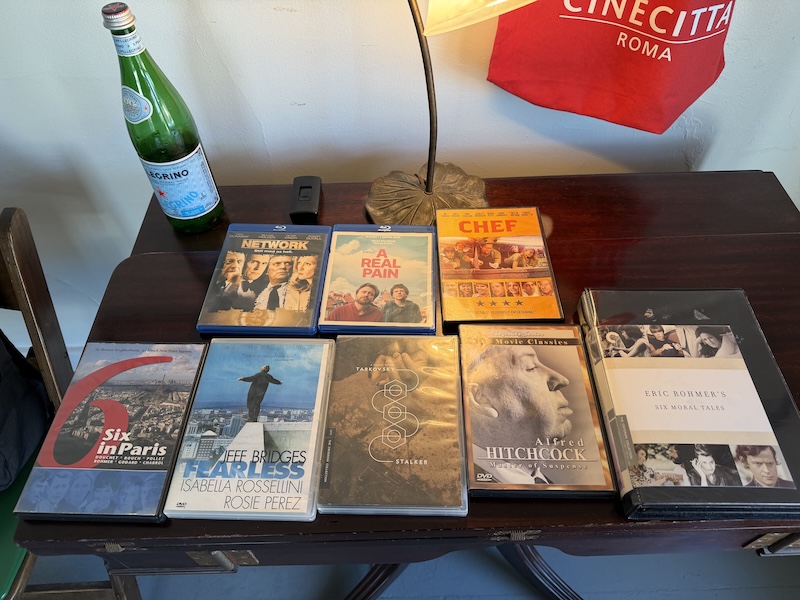
Network (1976) – “I’m mad as hell and I’m not going to take it anymore.” Ned Beatty won an Academy Award for his performance in one incredible scene. This is a portrait of power, the overly ambitious and greed. I watched it with the Sydney Lumet commentary on as well. He gives a lot of credit to Paddy Chayefsky, the writer, whose life story and career is almost as interesting as the movie.

A Real Pain (2024) – I watched this one and then a BTS video. It’s a powerful film. A Jesse Eisenberg vanity film about anything but vanity. Kieran Culkin controls his characters’ mercurial nature so it’s as sharp as a knife. And his performance is reason alone to check this one out.  However, there is a visit to a WWII Polish concentration camp, Majdanek, that will leave you with a lump in your throat, at least.

 Three Short Films by Werner Herzog – Featuring The Dark Glow of the Mountains (2008)  I’d like to teach a college course on the early documentaries of Werner Herzog. Seriously. What impresses me is how he is unafraid to ask the most direct questions. Like, “What was your mothers’ reaction when you told her your brother was dead?”  Herzog means serious business. In Ballad of the Little Soldier (1984), he gets caught in a fire fight between Nicaraguan rebels and counter-revolutionaries along the Honduran border. Most people would be packing their bags but Herzog is just digging in.

Chef (2014) Jon Favreau inspires in this feel good movie about the pain and pleasure of making cuisine. I listened to the commentary on this film, which included the thoughts of celebrity Chef and co-producer Roy Choi. I loved the Latino-centric vibe of the film which also stars John Leguizamo and Sofia Vergara. And I enjoyed how it becomes a road movie, traveling to some of my favorite foodie places like Austin, New Orleans and LA. 

Stalker (1979) This Andrey Tarkovsky film is based off of the sci-fi novel Roadside Picnic which involves an alien invasion and a room that will bring your single most desired wish to life. Sounds like a good deal except that the room has penchant for killing people. The eponymous Stalker refers to the guide who smuggles daring folks into this heavily guarded zone. This allegorical and philosophical film is difficult and I had to break it up into two viewings. It’s a slow slow burn. Characters disappear and appear in unlikely locations. Characters sleep. But at least for me, the payoff was worth it. So I’d say if you are a total film nerd or love a deeply intellectual and even absurdist film, it’s a must and well worth the effort. Stalker is also prescient in its dystopian imagery of the towers of a nuclear power plant, only a few years before the Chernobyl disaster. 

Six in Paris (1965) – I was looking forward to this collection of 6 films from famous New Wave directors. Ultimately it was rough and amateurish. Disappointing and not memorable. If you’d like an anthology of films about Paris I’d recommend Paris, Je t’aime (2006). Olivier Assayas’ segment is titled “Quartier des Enfants Rouges”, stars Maggie Gyllenhaal and is one of my favorite films ever, long or short. It’s a perfect moral tale, which leads to my next viewing. 

Eric Rohmer’s Six Moral Tales (2020). All of these films are interesting on their own merits. And this Criterion box set includes other cool short films, a documentary and several TV shows from the 1970s with the actors, producers and Rohmer himself. It also includes a book from which these films are based on. If that’s not the definition of literary film, I can’t imagine what is. What absolutely stopped me in my tracks is a film called “My Night At Maud’s”. There are long scenes in this film of people talking about philosophy and religion and relationships. It’s amazing. I have to say it blew my mind to watch people talking at length in a movie. I didn’t think it was possible. But here before my eyes Rohmer proved it’s more than possible and if the characters are interesting and have something to say, it’s mesmerizing, enlightening and inspiring. The other noteworthy film for me in the series is La collectionneuse, shot by Néstor Almendros, who would go on to win an Academy Award for Days of Heaven. There is a similar all natural aesthetic here, in the beautiful countryside around Saint-Tropez. La collectionneuse has to be in the top ten bougie films of all time and is great viewing for a cold, dark winter’s night, as the song says. 

Fearless (1993) – Directed by the great Australian, Peter Weir, this film stars Rosie Perez, who was nominated for an Oscar for her role, Jeff Bridges, Isabella Rossellini, John Turturro and the Bay Area. The strangest thing about this film for me is that I didn’t recall ever watching it until a powerful scene with Perez and Bridges toward the end of the movie. That scene jarred my memory. I must have watched this film 30 years ago! So that was a strange phenomenon. It’s a heavy film, dealing with post-traumatic stress from a plane crash. And is based on the stories of survivors from the crash of United Airlines Flight 232 in Sioux City Iowa in 1989. It’s a solid film that I think has been overshadowed by Weir’s more popular works.

Brazil (1985)- This is peak-Gilliam in my humble opinion. It’s wrapped in all of his visual mastery, Monty Pythonesque humor, his steampunk sensibility and an absolutely sick supporting turn by Robert De Niro. Jonathan Pryce stars in this film and as I’ve watched it three times this year, I’ve come to appreciate his physical comedy. There is a moment early on where the Marx Brothers’ Duck Soup, another one of the great political satires of all time, is playing on a tv monitor. It’s an apt homage as Brazil is another film in that great tradition. Shameless plug, if you are in the Appleton, Wisconsin area, or want to be, I’ll be screening Gilliam’s Time Bandits and The Fisher King in February and March of 2026, respectively, at the 9th Annual 602 Club Winter Film Series. Join us! 

Have a Happy New Year and a Happy Winter. — L

Shogun

A guest review by music writer and performer Mr. Ian Moore, who by his own admission is, “prolly banned”.

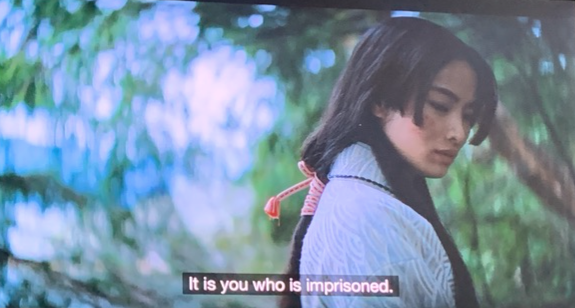
A powerful woman bows before a home shrine, the mood reverent and gentle.  A samurai enters and meticulously prepares his estranged wife a small matcha tea, which she drinks and ceremonially compliments his performance before refusing his offer of reconciliation.  Such are the illustrative vignettes created in “Shogun,” the Sengoku period Japanese epic now streaming on Hulu. Meditative, rainy landscapes, rituals, and trials form the main action of the plot; but not to worry, plenty of heads get chopped off and the occasional ship race, battle, or wreck erupts in high-budget glory, courtesy of the James Clavell novel that “Shogun” is based on. 

The two main characters are struggling against the Osaka council’s takeover when a mysterious British naval pilot is captured attempting to open up trade with Japan, now monopolized by the Portuguese.  Lady Mariko and Toranaga are trying to save Japan from tyranny and are constantly on the run back to Edo, a smaller fishing village, keeping them in sight of the British ship and the warlord who graphically boiled alive one of the British crew, though now he’s ready to enjoy some of the good saké while plotting to make Toranaga the Shogun, the military leader of Japan. The marooned Blackthorne has an uncertain mission but quickly makes himself indispensable to Toranaga as leverage against the council while developing a relationship with Mariko, who interprets for him having been taught Portuguese by the scheming Catholic priests.  The depiction of women in “Shogun” reflects a deeply repressive society with a rigid role-based hierarchy but subverts this system occasionally with female power moves and notably when a madame eloquently uses a bartered moment with the leader to request that he set aside a large district in his capital city for retired courtesans.  More unexpected business filled some episodes: a conniving small town warlord is shown to be pretty kinky and the plot often revolves around not violence, but Toranaga or Mariko gaming the complex political world to outwit the council in unpredictable ways.

Throughout the ten hour series, the mise en scene is almost another character, we’re forever coming upon the samurai staring out into the rain like moody teens – it’s heavy when the fate of the empire is on your gorgeously robed shoulders. Each character wore iridescent fabrics with geometric, jacquard knots – even in the remote village where dry cleaning must be outrageous! If someone happens upon a noble warrior in such a moment, then it’s time for impromptu Haiku. Characters would go back and forth composing a poem together until one is overcome by the elegance of the others’ imagery and submits. Or, as another friend said, “that show is boring,” but I like a good poetry slam and the soundtrack is just perfect – composed by half of the Grammy-winning duo that scored ‘The Social Network.’ I just loved how complicated the characters were, often double-crossing each other and employing tricks of etiquette to wrongfoot their opponents. It’s a war movie, so that might not be your thing, cannon blasts and swordplay are maybe 1/5 of the film. Also: tons of subtitled talk of keeping your third heart hidden and building an eightfold fence in your mind; but the sex was really sexy and the blood spurty, so there’s something for the whole family!

A Wenders Journey — Essay

As the 1960s dragged on in divided Germany, conventional movies, American imports and porn were the only products you could find to watch in the cinemas of the West. Many movie theaters simply shut down. To the rescue of this sad state of affairs came a group of young independent filmmakers whose movement became known as New German Cinema. Its manifesto reads, “The old film is dead. We believe in the new one.” 

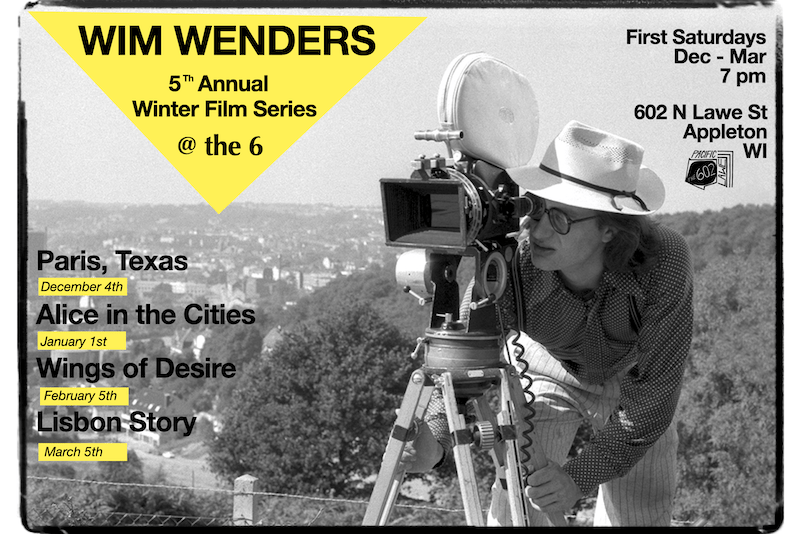
The two most famous and internationally successful Directors to come from this movement are Werner Herzog and Wim Wenders.  With Wenders, it’s not so much that his worldview is borderless but rather that he absorbs and elevates each country he is filming in. He holds these diverse cultures and peoples to be equal. In these times of over the top nationalist sentiment, it’s a powerful message. But it’s not overtly political. His cinema is one of travel and discovery. Of movement above all. Trains, planes, automobiles, cable cars, boats…whatever it takes to keep the characters literally moving. And if they are not moving, they are sleeping, restlessly, somewhere on the road. Or trying to kill a mosquito in the night or actually killing a TV set in a hotel room.

Which brings me to another aspect of Wenders’ cinema. A respect for and acknowledgment of making the images themselves. Whether Polaroid, Hi8 video or using a Bolex. Telling stories cinematically is what matters most to him. A recurring theme is the cultural importance of image making. “You lose touch when you lose your sense of identity. That’s why you always need proof, proof that you still exist. And that’s why you keep taking those photos.” — From Alice in the Cities

When a Wim Wenders film starts, there is a sort of transportation that also happens within me. Wherever he is going, the intention of a Wenders film is to take us all along for the journey. 

A special treat for the cinephile are the many Director’s commentaries that can be found on Wenders’ DVDs. These commentaries were made often 20 years after production, during the release of restored versions of his films. You can really feel the depth of his desire to use movies as not just a form of expression for himself but as a way to bring us all out of our shells and into the entire world with him. 

— If you’d like to get out of your shell in Appleton, Wisconsin, the next (and final!) installment of The 602 Club Wenders Series is Saturday, March 5th. I’ll be screening 1994’s Lisbon Story, which I mail-ordered from Korea, with a proper glass of port. 

Rafiki

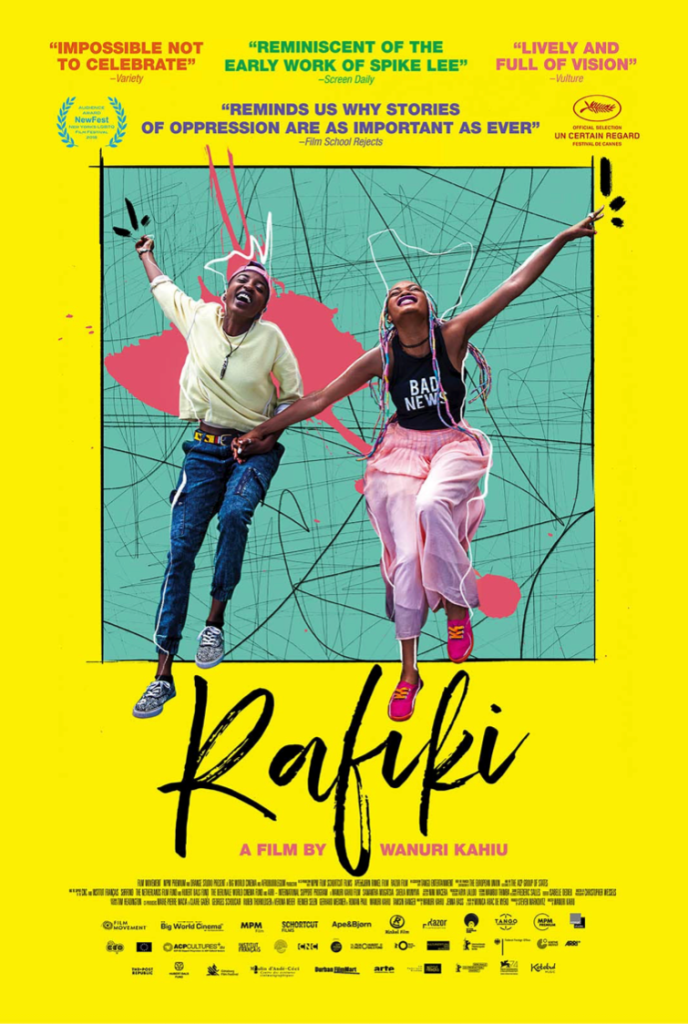
This is a great film, originally banned in Kenya and only released after my UCLA Film School friend, and Director of this film, Wanuri Kahiu sued the Kenyan government. According to Wikipedia, “On 21 September 2018, the Kenyan High Court lifted the ban on the film.” I was able to check this out at my local library here in Appleton, Wisconsin. It’s also available on Amazon Prime, Hulu and Showtime. It’s a great story, with Capulet and Montague overtones and a scene reminiscent of a film that recently blew me away, David Lean’s, Ryan’s Daughter. There is a truly indelible, good natured human spirit that runs through this film and I highly recommend it to you.

Mank

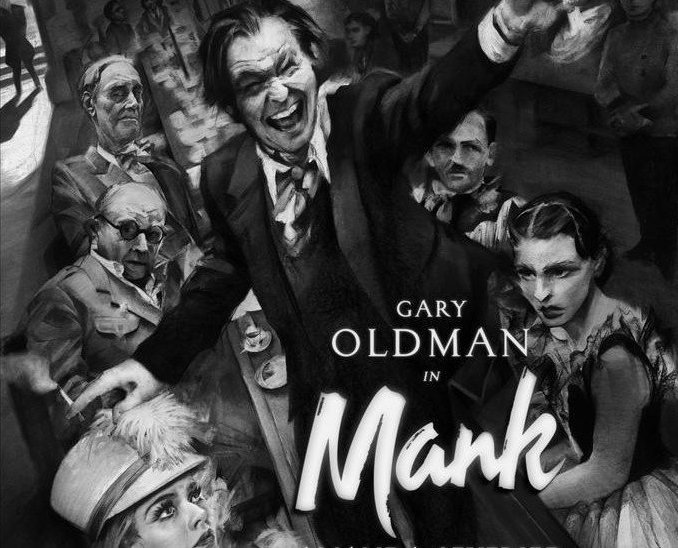
With a David Fincher movie, you know you are going to see a well crafted work of art at the highest standards of the cinematic craft. Fincher himself championed (the rumor was part-owned) one of the first cinema grade digital cameras, the Viper, which was groundbreaking back in the aughts. With Mank, I’d also congratulate Cinematographer Erik Messerschmidt on some exquisite and indelible images. If you’ve ever been up to Hearst Castle for a visit and imagined what the grounds must have been like back in the days when Chaplin was a regular house guest and tickling the ivories after dinner, this film will give you some idea. Famously, newspaper mogul W.R. Hearst kept a menagerie including escaped zebras that still roam San Simeon to this day. In short, it’s really a beautiful movie. 

Gary Oldman is transcendent in the role. He becomes Mank in a way that we will forever associate with someone who we hadn’t really thought that deeply about before. It’s a profound performance in its subtlety. He takes on a character under all kinds of pressure and brings levity and in turn empathy from the audience. Gary Oldman is someone else who merits our high expectations.

Perhaps oddly, Citizen Kane, the film that this one revolves around, though drummed into my brain in the countless film classes I’ve taken — and the subsequent passing on of such drumming to my own film students — has never really spoken to me. I’d rather curl up to say, It’s a Wonderful Life or Strangers on a Train. If I’m supposed to go crazy for deep focus shots, there is always Ozu (Master Japanese Director, not Greek alcohol, though I’m sure there’s an argument that can be made.)

What does strike me about Mank and Kane are the close-ups. As was done with great precision and emotional effect by Director Neil Butler in this years’ fabulous short, “Herzog & Morris”, the extreme close-up can work like a  punctuation mark on an island all its own. Editorially, it doesn’t have to graphically match on action, it doesn’t have to flow seamlessly from the previous or following shot. It can just be there saying, check me out.! Just like that.

The genius here is the threading of these purely cinematic punctuations within the great theatre that, in this case Gary Oldman, brings to the role of Herman J. Mankiewicz. Mank, a mensch who saved an entire town from the Nazi’s but is himself drowning from the bottle. In real life, he would die the year after writing the script for Citizen Kane. The film also gets into his battles with Meyer, his employer and unscrupulous if not downright evil head of MGM. Though Meyer, Wells and Hearst for that matter, are painted in caricature in order to focus more on the relationship between Mank and Hearst’s mistress, the Brooklyn actress and future philanthropist, Marion Davies, played convincingly by Amanda Seyfried.

The film also takes a stab at the sociopolitical milieu and the crushing hand of the studio and dominant political class. These sub-plots work in the sense that we can get to know Mank better in relief; as a man with a conscience, a backbone, a gift for storytelling and ultimately a disease that he couldn’t escape. 

If you have Netflix, I highly recommend this adventure and if you don’t, I’m sure that this title will find its way to your library’s shelves or streaming service soon enough.

The Forty-Year-Old Version

A special guest review to the LnD Report by Joana Kosowsky Dane

After reading half a sentence about the film “40-Year-Old Version,” I knew I needed to see it.  

Radha Blank plays herself, missing her dead mother, unable to return her brother’s phone calls. She is chronically late to the after-school theatre class she teaches where one of the girls, frustrated with Miss B’s indifference to her heartfelt spoken word, calls her washed up, a fake. It stings more than the girl knows.  Radha had higher expectations for her art, no doubt.  Her name is on the 30 Under 30 Playwright’s Award that sits among the clutter on her dresser.  But now she’s 40, with that all-too-familiar reality facing aging artists: What do I have to show for this life I’ve lived?

Filmed in black and white, we follow Radha on a journey through New York – Harlem and the Bronx and a brief foray on Broadway – the camera in close, capturing all the details of her pain and her comedy.  She glances at the camera and we know exactly how she’s feeling about D, the guy who lays down beats for anyone willing to bring him a bag of weed; or about J. Whitman, a famous producer who is willing to give Radha a big break but only if she compromises the integrity of her play by turning the characters into racial stereotypes.  

What’s an aging artist to do?  

Interspersed are color photographs explaining years of back story in a single flash (like the one of Radha and her gay agent, dancing together at her high school prom); and postcard sized snippets of interviews with characters from the neighborhood giving blunt and hilarious commentary on Radha’s middle-aged life.  

She’s down, but not so far down that she can’t grasp inspiration when it strikes, rapping one afternoon about all the ailments that come with being 40.  “Why my ass always horny? Why I always gotta pee? Why a young boy on the bus offer his seat to me? Why my skin so dry? Why am I yawning right now?  Why them AARP niggers sending shit to my house?” She catches the ear of the elusive D who invites her to perform her piece Poverty Porn at his next showcase.  She fails hard.  But we see what the past 10 years have taught her, a resilience that comes when an artist keeps creating despite being crushed and ignored.  

D takes her on a long drive, to a Queen of the Ring competition where 4 women battle with their rhymes in a stark boxing ring.  Radha is awed by their raw power and their courage.  They show her how it’s done, and in turn, she shows us.  Keep doing, stay brave. 

Radha goes to see her brother.  Trying to figure out what to do with one of their mom’s numerous paintings that neither have room for, her brother says it will just have to go into storage.  “Wow. You come here with a dream, and your work ends up in storage,” says Radha, a pitiful conclusion to an artist’s life.  Her brother sees it differently.  “She did what she wanted. She was a teacher, a curator.  She chanted, she traveled, she did some art.  She lived a life.”  Her children, their mother always said, were her greatest creation.

Radha realizes the reward is not in the big production, but in the much smaller daily task of staying true to her art.  And when she does, she wins the admiration of her theatre students, though she won the viewers’ admiration long before that.  

Watchable Westerns that I have Watched

Question:  My boy and I are on a Western film kick that started with Ballad of Buster Scruggs (way underrated).  From there we hit The Searchers, Man Who Shot Liberty Valence, and Hondo.  Last night we watched Butch Cassidy, which, while exceptional at times, felt dated and longer than its run time.

What else should be on the list?

Answer (D):  The key to answering this question is to know that there are lots of Best Westerns, and then there are the Best Westerns, and then there are the best Westerns, but these are some of my best Westerns, at least the ones I can remember:

Can’t Miss

  • Tombstone
  • Lonesome Dove series (!)

For pure, wholesome, family-like entertainment, it’s hard to go astray with these two.   The apex of Val Kilmer.

The Spaghetti Trinity, plus one and then plus another one

  • Fistful of Dollars
  • For a Few Dollars More
  • The Good, the Bad, and the Ugly
  • Once Upon a Time in the West
  • Unforgiven

I recommend seeing at least one of the first two two before diving into Il Buono and friends.    Then wait a year and watch Unforgiven (spoiler alert: he aint like that no more).

Once Upon a Time is not the fastest-moving movie, but it is exceptional.

Top Ten in my Favorite Movies

  • There Will Be Blood

There is not a greater movie about American capitalism than There Will Be Blood.

I Really Enjoyed These Movies

  • True Grit
  • A River Runs through It (!)

I am partial to the Coen version!, though you might have to watch it with closed captions.  And, who doesn’t like movies about would-be professors and their exceptionally good-looking brothers? I also enjoyed Ballad of Buster Scruggs, especially the Liam Neeson one. 

And Franco, of course.

Modern Westerns 

  • No Country for Old Men
  • Hell or High Water 
  • Lone Star
  • Gold

No Country is exceptional, but too violent for sharing with anyone not accustomed to violent movies.  Hell or High Water was a little preachy upon rewatching, but was one of our L&D Picks for 2016.  Also violent.   Gold is definitely underrated. McConnaughey in tighty whiteys that are neither tight nor white.

 Possibly too Violent, but mostly great

  • Hateful Eight

Tarantino kept the tension high for a while, but then it devolves into Kill Bill.  Isn’t that just like him?

Way too Violent, but completely great

  • The Wild Bunch

Way Too Violent and Disturbing and Under No Circumstances Share this with Your Kid, but Great and, hey, Nick Cave!

  • The Proposition

I was so excited about this movie and I was loving watching this movie and there are so many things right about this movie and, wait, what just happened?!

I Want to Live in a World With These

  • McCabe and Mrs. Miller
  • Dead Man

Altman and Jarmusch weigh in, wow.  How this missed the Jarmusch Film Festival, I’ll never know.

More from the Classics

  • Treasure of the Sierra Madre (more western mining!)
  • The Ox-Bow Incident (yikes!)
  • Shane (I want to live forever!)

More Good Stuff

  • The Long Riders
  • Pat Garrett and Billy the Kid
  • The Assassination of Jesse James…

That’s Entertainment

  • Pale Rider
  • 3:10 to Yuma

Does anyone besides me remember The Magnolias version of “Pale Horse, Pale Rider”?  To paraphrase a colleague, “The Magnolias don’t even remember playing that song.”

I really liked the remake of 3:10 to Yuma right up until near the end, and then…. Russel Crowe is very good.  Gretchen Mol is even better.  

So, that’s a hundred hours of entertainment, and you might even learn something along the way.   Hit me up if you are planning to see any of these on the big screen.

Except for The Proposition.  I can’t handle that again.

HBO in August

8579e766cd07d431-600x338


I recently re-upped my HBO subscription and have been scrolling through several L&D reviews of some of their upcoming marquee movie offerings.

The Favourite, August 3  (An L&D favourite.)

Aquaman, August 10 (Horrible, even by DC standards.)

The Mule, August 17

Can You Ever Forgive Me, August 31 (An even bigger L&D favourite.)

And if I had done this for July it would have looked like this:

Bohemian Rhapsody, July 6  (“Nice pants!”)

First Man, July 20  (“Is she still mad at him?”)

Widows, July 27  (“Even Liam Neeson does some acting, in a film where remarkably no one gets kidnapped.”)

Aside from Aquaman, these are all solid fare or better.

If I get around to it, I might weigh in on the five-part Chernobyl series, which was pretty good, though ultimately too action movie-ie to characterize the real thing.   I can’t decide if I’m looking forward to The Watchmen or not.