Phantom Thread

sniffer
“I smell the blood of an English mum”


We were about 45 minutes into this latest Paul Thomas Anderson piece when I realized I was completely transfixed by a movie about an uptight dressmaker who lived with his very measured sister and was making a lot of dresses for a young waitress.  Not exactly Thor for a plot line or for action.  I also realized I was pretty excited because I had no idea where this was headed.

The movie is set in 1950s London, and focuses a lot on gender roles and who gets what in a relationship.  The central tension is between the dressmaker, Reynolds Woodcock (Daniel Day-Lewis), and his love interest / model / protege / partner, Alma (Vicki Krieps).  The other major player is is Woodcock’s sister, Cyril (Lesley Manville), who is subtly managing the board to keep her brother on the straight and narrow.  In the deeper background is Woodcock’s mother, Woodcock is a mama’s boy, and the questions of matrimony and maternity are paramount throughout, even if the movie doesn’t ever come right out and say it.

So what do you need to know here?  First off, the movie is ostensibly about an insufferable male tyrant type, the type of guy who simply cannot start the day with a confrontation because he has no time for confrontations — if he has a bad breakfast, he may never recover.  The one who commends his own “gallantry” for eating asparagus that is not prepared the way he likes it.  Were you sent here to ruin his evening?

Second off, the movie is actually about the women around him. One set is predominantly populated with the Woodcock label’s army of skilled seamstresses, who spend their days watching Woodcock eye up his dresses, and then work their magic with the needles and thread.  This group is skilled but lacks agency.  Cyril lets them know when to come and she lets them know when they can go.

There is another group of women with various levels of authority based on either their wealth or their social status — indeed, the Woodcock empire is built on draping wealthy women with unimaginably beautiful clothing.  These women purchase Woodcock’s attention.

The third group is Woodcock’s love interests, including Alma, and there is some dissection of how a woman can move into a different social strata based either on her position or her money or on Woodcock’s interest.  There is some fluidity here between groups, and in the clumsiest exposition in the film, a competitor for Woodcock’s attentions dutifully (and annoyingly) attempts to undermine Alma’s claim on Woodcock’s affections.

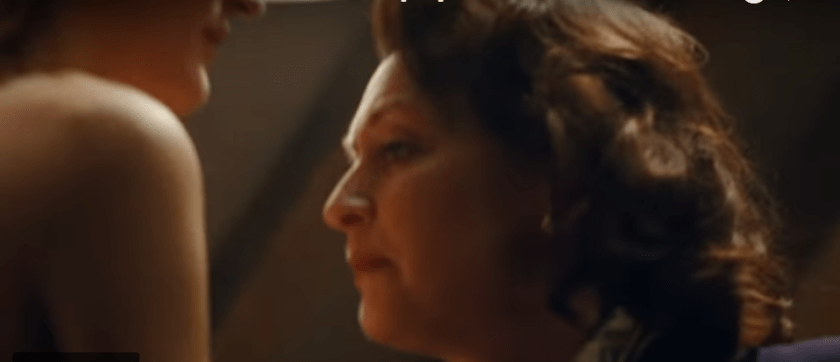
And, finally, we have his sister, Cyril, who represents the meritocratic & perhaps nepotistic element.  It is Cyril who enables, encourages, Reynolds’ single-mindedness and surliness, and one suspects that without her machinations, Reynolds may well have gone the route of Bartleby the Scrivener. Cyril evaluates her brother’s potential companions like the second in command looking out for the alpha dog.  Indeed, when Cyril first encounters Alma, there is a prolonged scene where she sniffs her, up close like, and susses out why Alma smells the way she does, and then the Woodcock siblings literally take to sizing her up.  It is ridiculous and unsettling and evidently as normal as can be in the land of Woodcock.  I’m pretty sure I could make the case that she is playing the role of a protective mother, though I think there is something else going on here.  At any rate, Lesley Manville is both beautiful and marvelous in this role.

The bottom line is that you can take the movie at face value and you will find it beautiful and possibly that it has a lot to say about cut-throat competition in human interactions.  The dresses are certainly astonishing.  I’m no fashionista — I leave that to my colleague —  yet I enjoyed the sartorial splendor for the women and for the men. Krieps, Manville, and Day-Lewis are all phenomenal.  It is straight up quite the show.

But I would urge you to have an open mind about this being a comedy, because the movie is seriously hilarious.  After all, the main character’s name is Reynolds Woodcock, a name with tremendous comedic potential. If you don’t agree, I mean, what is wrong with you? Reynolds Woodcock?!?  That’s not an accident.  Consider this:  this is the same filmmaker that brought us Tom Cruise saying unspeakably filthy things, gave us Boogie Nights and all that entailed, and built an entire movie around Adam Sandler arbitraging coupons off of pudding cups.  We also have the sniffing scene, Daniel Day-Lewis ordering breakfast like he was expecting a table full of lumberjacks, Daniel Day-Lewis wearing purple pajamas and a tweed sport coat, and a running joke about how annoying  toast butterers can be. And then there is the wedding dress for the princess.  If you are watching this as a comedy, you are laughing at this dress.  Indeed, L&D laffed out loud throughout, and there was audible cackling from all corners the theater. Overall, I can pretty much guarantee that there are more laugh out loud moments in this than you will find in the film actually called Mr. Woodcock.

I encourage you to check it out because it is beautiful, awesome, hilarious, and may well be Daniel Day-Lewis’ last role.  As a P.T. Anderson junkie, this is way over the $5 bar for me.  L wasn’t completely sold on it, but I don’t think he had buyer’s remorse over his $5.  I can see his point and will admit that I was a bit disappointed in the final half hour and don’t think it was tied together as a masterpiece (like, say, There Will Be Blood), but it was certainly thought provoking — we had a good discussion about the differences between Wes Andersen and P. T. Anderson, the parallels to Mother! and The Beguiled (and here) and a bunch of other stuff.  I bet L would even put this over the $6 Thursday bar.

The Shape of Water (D)

L&D headed out for The Shape of Water Thursday night and boy are we glad that we did.   It’s Beauty and the Beast for the Cold War set, only with a lot more egg imagery and masturbation.    The protagonist is a solitaire, semi-beautiful mute woman, Elisa (Sally Hawkins), who lives in an apartment above the movie theater next to her neighbor (Richard Jenkins), an erstwhile commercial artist, closeted lonely guy, cat lover.  They watch a lot of movies and spend their time being lonely together.  Elisa takes the bus to her work at a top-secret government site, where she works on the cleaning staff alongside Zelda (Octavia Spencer),  who provides a running stream-of-consciousness one-way dialog throughout the day.  The site is supervised by Richard Strickland (Michael Shannon), a candy-chomping shitheel who was responsible for transporting an amphibious creature up to Baltimore, and is now in charge of securing the creature for whatever it is the US military and/or its Soviet rivals are going to do with it.

That’s the basic setup, but the movie really isn’t about the story, it’s about a lot of other things.  It’s shot beautifully, with a really cool color scheme.   The acting is brilliant — it’s hard to imagine Hawkins, Spencer, Jenkins or Shannon being better cast or providing better performances.   It has some great writing and some memorable lines (“There is no profit in last week’s fish”).  It is laugh-out-loud funny in spots.   It is uncomfortable and disturbing in others.  It has scenes so excruciatingly painful that I had to cover my eyes, and scenes so beautiful that I forgot how ridiculous the whole thing was.  It reminds me of The Purple Rose of Cairo with its running homage to the great movies, and a main character who can’t help but find herself lost in them.

So, this should be on our top movies list for the year, but that ship has sailed.  I’m pretty sure it’s not for everybody, but for us it was over the $6 bar for sure.   I might even see if the misses wants to check it out.  I’m better looking than the leading man for a change.

Star Wars: The Last Jedi (D)

BenicioL&D attended a special preview of The Last Jedi Thursday evening, and – we aren’t making this up – they waited for us to show up before starting the movie!   We entered to a packed house and a blank screen, and when we sat down they got things going.  Our charmed lives continue.

The movie is actually more of a movie than a commercial and cultural obligation that we often see, with a plot about a zillion times better than the galactic trade tariff squabble nonsense that stupefied an entire generation of fans.  There is also a brazen effort to beef up the moral ambiguities that pervade warfare that involves large-scale killing of the other side and its people.  There are moments where the film heads toward moral nihilism, though it generally puts on the brakes before it gets there.

The action is pretty good, but there is no drama to it.  There isn’t much left to be done with the star fighter dogfight that we didn’t see in the first eight movies, but it’d be hard to have a Star Wars movie without these scenes.  The film makers seem to acknowledge this by opening with a comedic twist and somewhat unconventional blasting away, though it quickly devolves into a full-scale dog fight that looks increasingly awesome, but has all the suspense of watching a dog eat a bowl of food in the morning. The film is replete with Star Warsian Boilerplate:  The pod race is now a horsie chase.  The bar scene is a casino scene (has anyone ever written on the pervasiveness of gambling in the Star Wars universe?). The walkers are back, not nearly as deadly, but with some sort of big cannon thingie with them (where do those bad guys store all this hardware? Damn).

The action isn’t great, but we do get some drama.  The big story here, is that maybe, just maybe, the Jedi aren’t such good guys after all.  This has been a rather obvious dissenting view for some time now (even among us non-Straussians) but the dissent in Episode VIII comes from none other than Luke Skywalker questioning the whole Jedi order.  It wouldn’t take much to forward some “what about” hypotheticals that are far worse than what is purportedly bothering Luke, but that’s probably unfair, since at least 15 years of the series was all about trying to sell action figures to pre-teenage boys.  I liked the Rashoman sequences, which explored the idea that heroes aren’t without their flaws.  Well, I liked the idea better than the execution, but it was still a big plus here.

The main plot pairs intertwining stories concerning the Rey character (Daisy Ridley), who we last saw tracking down Luke Skywalker and get him to rejoin the rebellion.  With Mark Hamill back as Luke this line of the story certainly pays homage to the great western, Unforgiven.  The other part of that story is the weird interface of Daisey with Kylo Ren, and this one seems to have the legs that will carry us through Episode IX.  Ridley is pretty great in her role and the movie would pretty much suck if she hadn’t been.

My biggest beef is that the villains are weak, and the writers just dropped the ball here. The enormous head of Snoke is bigger and wrinklier than the now-deposed Emperor, but his motives are as transparent as they are uninteresting.   His masked red henchmen lack the intrigue of, say, Darth Maul (the most grotesquely underutilized asset in the history of the series), though the Reds do have these cool, bendy light sabers that are seen but not heard, really.  Indeed, the whole Snoke angle is so underdeveloped that you wonder why they bothered. Oh, man, is that guy evil!  That leaves Kylo Ren to take up the mantle of this generation’s Darth Vader, but Kylo Ren is no Darth Vader (then again, who is?).

A couple of other notes:

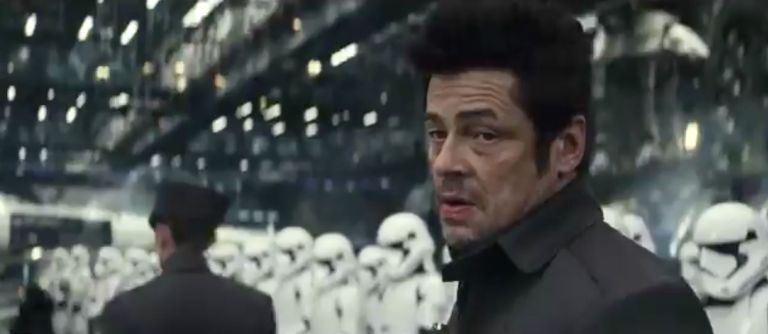
  • Benicio del Toro gets to play an unrepentant mercenary, and he is exactly as good as his script allows.  The film makers would be fools to leave him out of the series finale.
  • Wait, isn’t Carrie Fisher dead?  You wouldn’t know it from watching this film.  There is definitely something weird going on with that.
  • Laura Dern is dashing and decisive as the next in command, though she didn’t get the best the script had to offer (although she did use the term “cockpit”, emphasis on the first syllable, to malign testosterone-fueled bravado).  The yin to her yang is the Poe Dameron (Oscar Isaac) character, and this plays out tolerably.
  • The story line involving Finn and Rose was disposable, and the would-be bromance between Finn and Poe Dameron will have to wait if it is to blossom.  Finn was the big loser as far as the script goes.
  • The days of non-humans as principal characters has mercifully come to an end.  There are smatterings of non-humans, but mostly they are relegated to the more traditional status as non-humans.   Chewie is the big exception and he is a very bit player here.
  • And, keeping up the great westerns, there is even a homage to the final scene Butch Cassidy and the Sundance Kid.  
  • This is probably the funniest Star Wars yet.  Not a high bar, but still

The verdict is good, but not great (see L’s review for the same verdict).  If you see it you will probably enjoy most of it, though it’s at least 20 minutes too long.  Maybe 30 minutes too long.  Maybe more.  It’s way too long.  The story winds up pretty much exactly where you think it will, but not quite in the way that you are expecting.   There are also a couple surprises a long the way that will cause even the most hardened among us to crack a smile and shed a tear.

Well, maybe not, but it’s still pretty good.

Three Billboards Outside Ebbing, Missouri

Frances McDormand and Peter Dinklage

The people responsible for Three Billboards Outside Ebbing, Missouri made some great choices, but they did not make a great film.  The plot centers around the aftermath of a rape and murder of a young woman in Ebbing, whose mother, Mildred, (Frances McDormand) puts up billboards calling out Police Chief Willoughby (Woody Harrelson) to make some headway in the case.  Chief Willoughby says he doesn’t have much to go on, and it’s no wonder: his right-hand man is a dipshit racist (Jason Dixon played mostly brilliantly by Sam Rockwell), and the rest of the gang is a bunch of brazenly white guys that don’t seem to be doing too much in the way of police work.  On top of that, Willoughby has his own problems. Indeed, everyone in this movie is damaged goods in one way or another, and the film does a really good job of conveying the complicated emotions for all involved.

Despite these emotions, the story is told with this sort of a screwball comedy vibe, and this tension in the production never gets resolved.  On the way out of the theater, L wondered aloud how he didn’t like the movie even though it was a good movie.  I think the answer is that the film makers didn’t want to go  completely Altman and let it be built on character pieces, and they didn’t have the stomach to cut the good material they were working with in order to tighten it up to make it a great drama. The former is tough to do (and probably tough to sell in Hollywood), and the latter would have required cutting out some great acting and dialog.  So what we are left with is something that is sort of a mush of some of the best and the worst of the likes of Twin Peaks, Fargo and Mystic River.  This will go down as a movie where people remember some great scenes and amusing dialog, but will scratch their heads at some of the plot holes and other peculiarities.

The positives include the cast and characters, and the casting is brilliant top to bottom:  Red (Caleb Landry Jones) is the semi-principled ad exec, Robbie (Lucas Hedges) is Mildred’s son who has to deal with the blowback from his mother’s antics, and Charlie (John Hawkes) is Mildred’s ex-husband, a wife beater now living with the unreasonably good looking “19-year old” Penelope (Samara Weaving).  On the negative side, Penelope is caricatured as a ditz, though she works as an animal trainer and reads about horses in her spare time.  Even more unfortunately, although the movie takes some stabs at race issues, the several African American characters are not developed at all.  Even Chief Abercrombie (Clarke Peters), who is eventually sent in (by whom?) to replace Willoughby, is just a place holder, not a character.  There is possibly a metaphor I am missing here.

Another positive is that there are some lucid scenes, including a a “date” between Mildred and the alcoholic used car salesman and midget, Peter Dinklage. The meal takes place for what passes for an upscale restaurant in Ebbing, and the ex-husband arrives with his young girlfriend about midway through.  This allows Dinklage to rattle off a brief monologue that lays bare life’s prospects for the likes of these folks, and there is probably a thesis of the movie in there somewhere.  We all play the hand we were dealt.  Other scenes, particularly the one where Mildred dresses down the Catholic priest, aim high and miss the mark.

Finally, at the risk of introducing spoilers, during the end of the film I was reminded of one of the great and mysterious lines of the 1993 movie, Tombstone, where the Val Kilmer Doc Holliday character says of Wyatt Earp:

“Oh, make no mistake, it’s not revenge he’s after; it’s a reckoning.”

A reckoning is a resolution and an ending, but that is not really what these characters are after.  And even if it were, a reckoning isn’t attainable, is it?  Finding the girl’s killer might offer some clarity along some margin, but it doesn’t change much of anything else.  So there will be no revenge, no resolution, no reckoning, and ultimately no justice.  That’s just the way it goes in Ebbing, Missouri.

So this makes its way over the $6 bar for some compelling characters and some good scenes. But, too many question marks and not enough Woody limit its upside.  So despite the gaudy critical acclaim elsewhere, this one won’t be filling space in the Best of L&D for 2017, which is coming sooner than you probably think!

Justice League

cvjhk3hbdisxm6vsdgukI find I have a lot to say about Justice League, though I will admit to having slept through a pretty good chunk of what was undoubtedly a CGI-tastic battle action extravaganza.  I did wake up in time to find out who won and to see the two end-credit bits, which were two of the best parts of the evening for sure.
I’ll start with what I liked best about the movie, and that will pretty much tell you what’s wrong with it.  First off, The Flash is great.  He has some really funny lines and he physically plays the role conceived for him brilliantly.  He really feeds well off the other characters and there are a half dozen memorable moments there.  I am pretty certain that the success of this character will lead us to a stand-alone movie, and maybe we’ll get to see what’s happening in his super-cool studio!  The big downside here is that his back story rushed and confused and not particularly interesting — contrived is the word I’m looking for.  Aside from that, big ups to the Flash.

Second up, the Aquaman character isn’t too bad, either. Jason Momoa is all tatted up and hip and is the big sexy male in this one (when Ben Affleck isn’t strutting around in his $1000 suit pants, that is), and they also feed him some great lines — one monologue in particular —  that set him as more than an appendage to the big three.  The Aquaman component of the story isn’t bad, though his back story is even more contrived than Flash’s.  At any rate, his charisma is such that there is definitely a marine-based superhero film in our future (and probably more “you talk to fish” jokes, as well).

And that’s pretty much the deal with the movie – the best parts are peripheral elements.  The Justice League is about Batman and Superman and Wonder Woman, and what they bring just isn’t that compelling.  What’s worse, the main villain, Steppenwolf [insert Born to Be Wild joke here] is terrible.  Here’s the thumbnail sketch:  he’s really big wrinkly dude, he wears a viking helmet and wields a big battle axe, and he’s a mama’s boy.  His interests include jumping city blocks in a single bound and ruling with absolute power, and his biggest turn on is watching Nordic television adaptations of Oedipus Rex.  Or something like that.  The best part of the Steppenwolf angle is that there is a partial answer to the question of whether vikings wore helmets with horns.

In terms of action, I would compare it to an average James Bond movie franchise on that front, particularly in terms of the forgettable villain.  There was certainly some enjoyable action, like the “pissy Superman” sequence and Batman frying one of those bug things, so, yeah.  Gal Gadot is really the best of the big three here and my guess is that the Wonder Woman franchise will thrive as long as she wants it to and so far as the powers that be don’t overdo action at expense of letting her act.  Henry Cavill as Superman is meh and Ben Affleck as Batman just makes you shake your head and wonder what could have been with him in that role.

The main story was ok enough.  It was certainly the most successful as a playful and funny DC film that I can remember.  I was also kind of feeling it with J.K. Simmons as Commissioner Gordon.  On the other hand, poor Amy Adams and Diane Lane, big stars trotted out for pretty much nothing, and Jeremy Irons is also pretty much worthless.  In terms of acting, it was like watching a pre-season game where the people with established acting chops are sitting on the bench and we get to watch to see if the new guys can get it done (that might not be a bad metaphor for the entire project).  Maybe these stars will come out to shine in one of the many future movies that are evidently planned.

So there it is from the L&D, watchable, pretty enjoyable, funny in spots, and more than enough to make you go out and buy a Flash t-shirt. On the other hand, it was loaded with underdeveloped and mostly contrived backstories to set up future movies (though probably not for the Cyborg character, oh brother) and a worthless villain.  My guess is they will follow Marvel’s lead with having some of the League in supporting roles, such as the Iron Man presence in Spiderman: Homecoming or the Hulk in the latest Thor incarnation.

Overall, enough to get L&D’s coveted “not terrible” tag.  But it’s not great, either.  Justice League has all the drama of watching a breakout star dominate a pre-season football game: the action is there, the established players are hanging around mostly watching, and nobody really cares about the opponent or who wins.  In other words, we’re really just passing the time until Lex Luthor shows up for when they play the game for real.

————————————————————————————————————————————

Market Madness:  It’s not clear how much buzz there is about this movie.  We were in a 9:50 showing with about six people total, including one guy we continue to see and is either a kindred spirit or an L&D stalker.  We will keep you posted as more information becomes available. Recent opening nights for Thor and Spiderman played to packed houses.   Just sayin.


Edge of Seventeen

This is a previously unreleased review of Edge of Seventeen, at the request of one of our long-time readers….

A Thursday night special midnight feature here at The Report, with the world premiere of The Edge of Seventeen, the latest high-end portrayal of teen angst, in the spirit of Election, Juno, Me & Earl & the Dying Girl, and probably a half dozen others that escape me at the moment.

Without giving too much away, let me just sat that it is like watching a slow-motion nervous breakdown of the main character, portrayed by Hailee Steinfeld. Steinfeld brilliantly reprises her role from True Grit as the surly teen down one parent, only this time it’s her unreasonably good-looking brother looking after the family, while Steinfeld inflicts misery and discomfort on those around her and on the audience. The lesson of this particular film, it seems, is that some young people might have stellar reasons for being miserable and depressed (aside from just being teenagers), and yet still not give us any cause to like them.  L&D favorite, Woody Harrelson, is solid but unspectacular in a limited role as the wise adult character. And friend of The Report, Hayden Szeto, is very convincing in his portrayal of an insecure, wealthy Korean-American kid. Though he kind of got shorted on the character complexity front, they did reward him with a couple of good moments….

Some other tidbits, we learned that the new James Franco vehicle (Why Him?) might be a bit funnier than originally thought, as E17 featured an R-rated trailer that featured some spectacular swearing and a Moosey teabag. Also, we feel Ed Norton probably hasn’t seen a decent script come across his desk for some time, possibly since Fight Club. Finally, there was no mention of curling, either in the previews or the main feature.

Blade Runner 2049 (D)

RobotVictim

The Running Man, Running Scared, the other Running Scared, Cool Runnings, Cannonball Run, even Chicken Run.  These are movies where run in the title, often the gerund form of the word, means that the action moves along at a running-like pace.  So, if you are looking for a fast-paced action movie, you might be excused if you think Blade Runner 2049 will fit that mold. But, I am here to tell you that that is not the case, and the pace of the movie is more like that of metal rusting.  Many critics have mistakenly cited 2049 as the year when the story takes place, when it is actually the approximate running time…

It’s not that there isn’t any action.  Indeed, the title character, “K” (Ryan Gosling), travels from a farm outside of L.A., back to the inner city, to a dump back out yonder, and even off to Sin City, getting his head beaten in at every stop.  But the movie sure takes its sweet time between stops.  In this sense — and probably in more senses I’m willing to admit — the movie is reminiscent of another sequel from earlier this year, War for the Planet of the Apes, where the technical aspects were overwhelmingly awesome, but we spent a lot of time watching the actors emote rather than actually do anything.  Instead of people in ape costumes pretending to be human, we have humans pretending to be robots trying to be human.  On the other hand, if your idea of a good time is watching Ryan Gosling lay down and take a nap in a snowstorm, then you are in for a real treat.

Aside from my objections about the pacing, I loved it.  The Blade Runner this time is indubitably one of these very humany “replicant” robots, so much so that he doesn’t really even have a name: “K” is short for KD9-3.7, his model number or somesuch.  This is a change from the original, where it doesn’t even seem to be a question as to whether the title character, Deckard, (Harrison Ford) is a human or a replicant.  Then that question sort of insinuates itself into your consciousness and all of a sudden it’s like, holy crap, what did Edward J. Olmos just do?  What he did was drop a truth bomb that makes it rather obvious that Deckard himself is a replicant (though L remains in denial on this point), and you are left sitting in a stupor as the ending credits roll.  But, if you didn’t believe it coming out of the first movie, this movie is unlikely to clear things up for you.

What is certain is that the world is hurtling towards an apocalypse.  Blade Runner 2049 finds us in some sort of post-apocalyptic state stemming from a 10-year blackout.  Whatever happened left cities empty and laid ecosystems to waste, leaving us without any flowers or trees or things that grow, farming worms for protein.  The movie alternates between foggy mist and various shades of rust, and I don’t remember seeing the sun once.  The settings weren’t as convincing as they were disturbing, and the movie reveals more than enough to be disturbed about.

This all seems bad enough, but the movie’s real thesis is that the apocalypse will take another form, with technology and robots and artificial intelligence insinuating themselves in such a way that pushes the human race towards irrelevance and, ultimately, obsolescence. One endpoint, for example, is that we have a ridiculously good looking robot (Gosling) hanging out with a ridiculously good looking hologram of a young woman.  In this case that hologram is a young “product” aptly named Joi (Ana de Armas), who is tasked with keeping K company and sporting whatever fashion captures the replicant’s fancy these days.  At some point, technology will be able to replicate and exceed the best (and worst) humankind has to offer, and how are we mere mortals supposed to compete with that?

The movie actually provides something of an answer to this question.  It’s not that humans are worthless, far from it.  Human ingenuity is the straw that stirs the drink here, at least for the time being.  Modern technology can take the best of what we have to over, bringing the greats back to life – Elvis, Sinatra, Carrie Fisher – now and whenever.  The only thing modern technology can’t do is bring back the nature that is so dearly missed.  And, like in the first film, the replicants soak up as much rain and snow and trees and flowers as they possibly can, because feeling the rain and snow on your face is pretty awesome, even if watching someone else do it gets a little tedious.

The great irony here is that the main human character is a police lieutenant (Robin Wright) who sees it as her purpose to “maintain order.” The irony is that the order of the day is the slow march to human extinction at the hands of its own creations.  We saw this story not too long ago in Alien: Covenant, with Guy Pearce playing god in that one, and the notion of a creator was no small part of the original Blade Runner.  This theme simmers throughout the movie, as after Wright and Olmos, I am not sure how many characters are in the definitely human category.   The upshot is that this movie is not so much about what it means to be human as it is about what happens when technology methodically pushes humans to the brink of extinction.  If you are on the human side of this one, “maintaining order” seems like the wrong choice.

The movie had a lot of other cool stuff going on, the visual awesomeness being the most obvious.  Talk about setting the tone.  We watched the 3D reel and it was beautiful and pretty seamless.   And there really were some interesting characters and some reasonable action when they got around to showing it. The big story is that Harrison Ford returns as Deckard, and once again he shows why he is our greatest American movie icon.  He, too, takes his turn kicking the crap out of K and then gives his dog some booze. Incredible.  It is also not clear whether the dog is a robot or not, and, once again, it doesn’t really matter.  I will go back just to see that part of the story arc.  Sean Young also returns from the original, and she hasn’t aged a day.

We also get some new characters, of course.  Jared Leto is appropriately creepy and objectionable as the creator of the new class of  replicant.  He makes Tyrell from the first movie seem like St. Francis of Assisi.  One of Leto’s creations is his love interest, Luv (Sylvia Hoeks), who is exceedingly convincing in her role as the evil robot bagman, making Leto of secondary interest.  We also get to see a rather unusual sex scene involving K, Joi, and Mariette (Mackenzie Davis), possibly the most original thing in the entire movie.  Upon reflection, I don’t think it makes one bit of difference to the story line if Mariette is a human or a replicant.  I am guessing she’s human, but she certainly bears more than a passing resemblance to the spectacular Daryl Hannah replicant character from the first movie. So, who  knows? And, ultimately, who cares?

And so it goes with this one.  More questions than answers as far as the details go, but the big picture is clear enough.  It’s only a matter of time before the robots take over;  we will just have to wait to see whether it’s the good or the bad ones in charge when all that orange dust finally settles.

Atomic Blonde

atomic-blonde-post-credits-scene

Atomic Blonde is the latest in a series of movie-length music videos, this one featuring the synthy sounds and backbeats of the late 1980s.  The movie’s action is set in East Berlin right at the cusp of the fall of the Berlin Wall, and the script is that of a low-grade Cold War espionage thriller.

The movie features Charlize Theron in the role of “Blonde, James Blonde,” a female incarnation of the invincible British secret agent, only Theron drinks Stoli on ice, no vermouth.  We first find her soaking in a tub of ice water with a body full of bumps and bruises and cuts and lacerations (but, remarkably, no broken bones, no limp, no discernible handicap), and then the movie proceeds to show us how she got that way. The film isn’t shy about showing Theron in the buff, beginning with an extended scene of her checking her beaten up body out in the mirror, but also featuring a couple of gratuitous lesbian exchanges.

If you don’t think about it terribly hard, the plot itself is pretty straightforward.  Theron sits down in an interview room with her “superior” (Toby James, that round-faced dude from Tinker, Tailor, Soldier, Spy) and American CIA agent (John Goodman). There is also an even more superior boss man watching through the glass that probably signifies something important here, though not important enough for me to try to figure out. Theron then details how she was sent to East Berlin to meet up with a British agent embedded in the terrain (David MacAvoy) and recover some sort of important list that seems to be contained inside some guy’s watch.  Meanwhile, a young French agent (Sofia Boutella) is following Theron around taking pictures about as inconspicuously as a fashion model in a skin-tight leather suit riding around on a motorcycle in Communist Eastern Europe could back in those days.  Then there are a bunch of Russians and local thugs, and, well, you’ll figure it out.

But, who needs a plot when we’ve got action?  And there is plenty of action to go around. Theron survives at least three major car crashes and is in a couple of extended hand-to-hand melees reminiscent of early Apollo Creed-Rocky Balboa bouts (at one point L shouted: “Stay down, kid, stay down”).  Indeed, one of those fisticuffs was about three minutes too long, so it turned from drama to comedy as the kids in the back of the theater began to laugh, but it segued into a terrific car chase scene that probably constituted the best few minutes of the movie.

Then again, I’m not sure this movie was even an action movie.  It might be better described as a vehicle for Charlize Theron to show off her super awesome self in some super awesome clothing, with her duds even matching the lampshade at one point according to my more fashion-sensitive companion.  This was partly utilitarian, as she beat at least one person to death with her shoe.  But I was concerned from a narrative standpoint about how she fit an entire wardrobe into such a tiny suitcase.  Perhaps she went shopping?   But where do you get a screaming red dress in East Berlin in 1989?  The questions pile up quickly in this one.

It is also possible that the movie is Theron’s response to getting passed over for the Wonder Woman role — she is definitely gorgeous and she definitely shows her chops as an action hero, even grabbing a bright yellow lasso of justice (a staple in most urban eastern bloc households, for sure) and beating the crap out of a bunch of Commie henchmen at one point. I guess you’d have to ask her.

Overall, over the $5 bar for its excellent music video qualities, but that’s kind of assuming you’ve seen the many high-quality action movies already out this summer – Wonder Woman, Spider Man, Baby Driver, Dunkirk.   It also assumes you sit in the theater with the good sound system (e.g., the Marcus SuperScreen DLX) for you to get your 99 Luftballoons on.

When writing this up I learned that this was directed by the guy who got his directorial start with John Wick, and, there it is, I buried the lede.   Evidently, he is also directing the second Deadpool movie, so here’s hoping that one goes a little better.

War for the Planet of the Apes

If you are ready for some top-flight man on monkey violence, then War for the Planet of the Apes is the movie for you.   But it is so much more than that.   It is a nuanced exploration of racism, sexism, compassion, and possibly the greatest cinematic meditation on existential philosophy since The Seventh Seal.

Nah, I’m just kidding. It really just amounts to some good only man on monkey violence.  It’s not that the movie doesn’t try to do the things listed above, it just doesn’t do them very well.  The apes are generally set up in the “good camp” and the humans in the “bad camp” in this one, and we spend probably an hour of the movie literally watching the apes ape various stages of grief and angst and heartbreak while we wait around for the film to get to Woody Harrelson.

But, get to them they finally do, featuring one spectacular, borderline insane expository monologue that nearly saves the film along a number of fronts.  By the time they got around to the monologue, I had almost completely checked from the story, but he introduced enough material to bring the story back in play.  He is also able to almost — almost — blur the “good ape, bad man” line with his historic account, enough to give us a little sympathy for the human side.  Like the greats, he makes those around him better, so things that had been annoying me to that point got a little less annoying. But, alas, even the Hestonesque charismatic burst doesn’t save the film, and what we are left with is a few great pieces of film making in a movie that is pretty stupid and at least an hour too long (but do check out L’s review for a pro’s perspective on some of the legitimate cinematic achievements).

There are a couple of big plusses here.  Some of the action is great, including a super awesome wrinkle in the climactic scene.  Although I am kind of bashing on the movie here, even haters like me will take the drama seriously enough to enjoy the action in the context of the dramatic narrative, unlike action for action’s sake in, say, the Transformers or Alien v. Predator movies.  It’s probably worth mentioning again that Woody is must-see tv.  And, finally, this is one of the few movies where you can feel license to enjoy the fabulous Marcus 128 oz soda specials, because there are plenty of spaces between the pauses here to take a pit stop or two.

Over the $5 bar for some great action and for Woody, but I would have been willing to pay more for less for this one.

Spider Man: Homecoming

Spider Man: Homecoming is really a special piece of film making, melding the chase-the- bad-guys-and-blow-stuff up action movie with the poignant teen adolescent drama to make for a really enjoyable experience.  We went in with high expectations, and we did not leave disappointed.  This is the sixth Spider Man movie in recent memory, and I will put it neck-and-neck with Spider Man 2 (the Doc Oc one) as the best of the lot.  Judging by the packed house and the generally enthusiastic audience response, this movie is going to make like a zillion dollars.

I was really feeling the adult-adolescent nexus portrayals here and, despite not being a superhero myself, found the Tony Stark grooming his protege angle quite compelling. At one point I leaned over to L and said, “I am really identifying with the authority figures here.”  In the front end of the movie, the adults generally didn’t know what was going on with the younger set, and mostly didn’t care, either.  Rather than Scooby Doo the whole thing, the plot suggests that this cuts both ways — in some cases the adults should be listening, but in others the kids really are meddling when they should be minding their own business.  Jon Favreau is occasionally funny as the mostly inept intermediary for the Spidey-Tony relationship.   Then, remarkably, the story spins this to illustrate that in many cases the kids don’t know what’s going on with the adults, either.  This makes for some excellent dramatic narrative and a couple genuine surprises, not something that is characteristic of superhero genre.

The adults here included many of the usual suspects, with Tony Stark and Iron Man being central characters throughout.  This is the first Spidey movie set squarely in the Marvel Universe on the heels of the Captain America: Civil War story trajectory.  One consequence of this is that the plot line involves Michael Keaton building a criminal enterprise on the back of repurposing alien technology left behind in that affair.   Keaton eventually shows himself as the Vulture, more than possibly a hat tip to his role in Birdman or (The Unexpected Virtue of Ignorance), which is amusing for a number of reasons.  The Vulture isn’t particularly interesting, but the plot built around him is.  The story sets up and mostly moves along at a good clip, without pausing too much to show off.  A second consequence is that Spidey has access to a suit equipped with Stark technology, so the high-tech elements of the Iron Man series are pervasive within this new universe.   I had mixed feelings about the high-tech Spider Man, as most of it was done really well and is consistent with the technology frontiers in these other movies. On the other hand, c’mon, man!

Mostly for better, this movie does not begin with the genesis story and does not dwell on the guilt over Uncle Ben’s death that is so central to the other two Spider Man movie incarnations (and the comic books I remember from my youth).  As Fenwick would probably say, it’s been done.  The movie also strips Peter Parker of his solely internal struggles, as he inadvertently reveals to his buddy that he is Spider Man, so much of the movie involves the interplay with these two rather than Peter going it alone.  This revelation is probably one of the reasons why the writers were able to develop the adolescent characters and setting so well.  There is plenty to say about that, too, so the movie leaves us with a lot to chew on.

A couple other things, Marisa Tomei as Aunt May worked well, and she got at least one great line in (or most of it, at least).  Tyne Daly (Cagney or Lacey) shows up as a government security bigwig, which is nice, though her role is perfunctory.  And Michael Mando of Breaking Bad fame is evidently being groomed as the next super villain, and what’s not to like about that?

Overall, well above the $5 bar.  I found myself laughing out loud, including several times when I was the only one in the theater doing so.  At other points, the theater laughed whilst I nodded or maybe grinned.  There is definitely something for most of us.   I’m guessing I will see it again (and again and again on TNT).