Winter Viewing

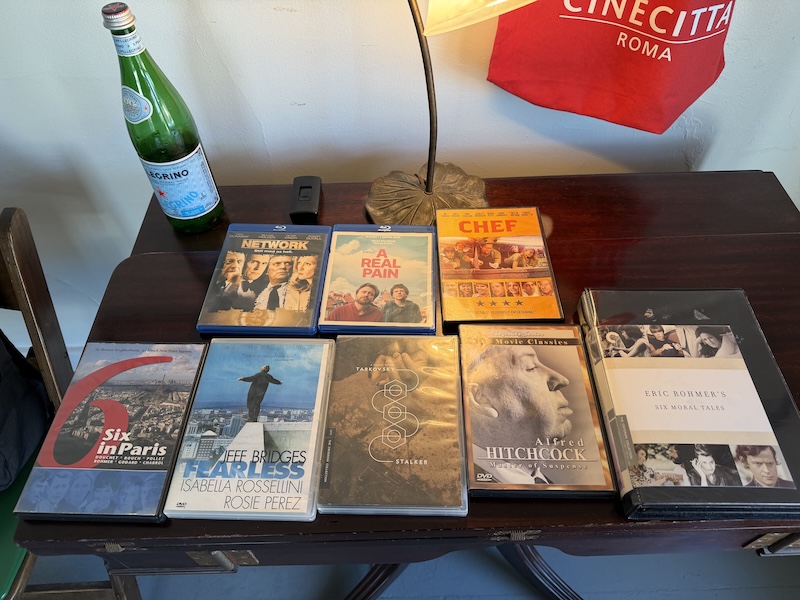
Here’s what I’ve been watching on DVD and what I thought of it. 

Network (1976) – “I’m mad as hell and I’m not going to take it anymore.” Ned Beatty won an Academy Award for his performance in one incredible scene. This is a portrait of power, the overly ambitious and greed. I watched it with the Sydney Lumet commentary on as well. He gives a lot of credit to Paddy Chayefsky, the writer, whose life story and career is almost as interesting as the movie.

A Real Pain (2024) – I watched this one and then a BTS video. It’s a powerful film. A Jesse Eisenberg vanity film about anything but vanity. Kieran Culkin controls his characters’ mercurial nature so it’s as sharp as a knife. And his performance is reason alone to check this one out.  However, there is a visit to a WWII Polish concentration camp, Majdanek, that will leave you with a lump in your throat, at least.

 Three Short Films by Werner Herzog – Featuring The Dark Glow of the Mountains (2008)  I’d like to teach a college course on the early documentaries of Werner Herzog. Seriously. What impresses me is how he is unafraid to ask the most direct questions. Like, “What was your mothers’ reaction when you told her your brother was dead?”  Herzog means serious business. In Ballad of the Little Soldier (1984), he gets caught in a fire fight between Nicaraguan rebels and counter-revolutionaries along the Honduran border. Most people would be packing their bags but Herzog is just digging in.

Chef (2014) Jon Favreau inspires in this feel good movie about the pain and pleasure of making cuisine. I listened to the commentary on this film, which included the thoughts of celebrity Chef and co-producer Roy Choi. I loved the Latino-centric vibe of the film which also stars John Leguizamo and Sofia Vergara. And I enjoyed how it becomes a road movie, traveling to some of my favorite foodie places like Austin, New Orleans and LA. 

Stalker (1979) This Andrey Tarkovsky film is based off of the sci-fi novel Roadside Picnic which involves an alien invasion and a room that will bring your single most desired wish to life. Sounds like a good deal except that the room has penchant for killing people. The eponymous Stalker refers to the guide who smuggles daring folks into this heavily guarded zone. This allegorical and philosophical film is difficult and I had to break it up into two viewings. It’s a slow slow burn. Characters disappear and appear in unlikely locations. Characters sleep. But at least for me, the payoff was worth it. So I’d say if you are a total film nerd or love a deeply intellectual and even absurdist film, it’s a must and well worth the effort. Stalker is also prescient in its dystopian imagery of the towers of a nuclear power plant, only a few years before the Chernobyl disaster. 

Six in Paris (1965) – I was looking forward to this collection of 6 films from famous New Wave directors. Ultimately it was rough and amateurish. Disappointing and not memorable. If you’d like an anthology of films about Paris I’d recommend Paris, Je t’aime (2006). Olivier Assayas’ segment is titled “Quartier des Enfants Rouges”, stars Maggie Gyllenhaal and is one of my favorite films ever, long or short. It’s a perfect moral tale, which leads to my next viewing. 

Eric Rohmer’s Six Moral Tales (2020). All of these films are interesting on their own merits. And this Criterion box set includes other cool short films, a documentary and several TV shows from the 1970s with the actors, producers and Rohmer himself. It also includes a book from which these films are based on. If that’s not the definition of literary film, I can’t imagine what is. What absolutely stopped me in my tracks is a film called “My Night At Maud’s”. There are long scenes in this film of people talking about philosophy and religion and relationships. It’s amazing. I have to say it blew my mind to watch people talking at length in a movie. I didn’t think it was possible. But here before my eyes Rohmer proved it’s more than possible and if the characters are interesting and have something to say, it’s mesmerizing, enlightening and inspiring. The other noteworthy film for me in the series is La collectionneuse, shot by Néstor Almendros, who would go on to win an Academy Award for Days of Heaven. There is a similar all natural aesthetic here, in the beautiful countryside around Saint-Tropez. La collectionneuse has to be in the top ten bougie films of all time and is great viewing for a cold, dark winter’s night, as the song says. 

Fearless (1993) – Directed by the great Australian, Peter Weir, this film stars Rosie Perez, who was nominated for an Oscar for her role, Jeff Bridges, Isabella Rossellini, John Turturro and the Bay Area. The strangest thing about this film for me is that I didn’t recall ever watching it until a powerful scene with Perez and Bridges toward the end of the movie. That scene jarred my memory. I must have watched this film 30 years ago! So that was a strange phenomenon. It’s a heavy film, dealing with post-traumatic stress from a plane crash. And is based on the stories of survivors from the crash of United Airlines Flight 232 in Sioux City Iowa in 1989. It’s a solid film that I think has been overshadowed by Weir’s more popular works.

Brazil (1985)- This is peak-Gilliam in my humble opinion. It’s wrapped in all of his visual mastery, Monty Pythonesque humor, his steampunk sensibility and an absolutely sick supporting turn by Robert De Niro. Jonathan Pryce stars in this film and as I’ve watched it three times this year, I’ve come to appreciate his physical comedy. There is a moment early on where the Marx Brothers’ Duck Soup, another one of the great political satires of all time, is playing on a tv monitor. It’s an apt homage as Brazil is another film in that great tradition. Shameless plug, if you are in the Appleton, Wisconsin area, or want to be, I’ll be screening Gilliam’s Time Bandits and The Fisher King in February and March of 2026, respectively, at the 9th Annual 602 Club Winter Film Series. Join us! 

Have a Happy New Year and a Happy Winter. — L
I Fellini — Essay

271771.jpg

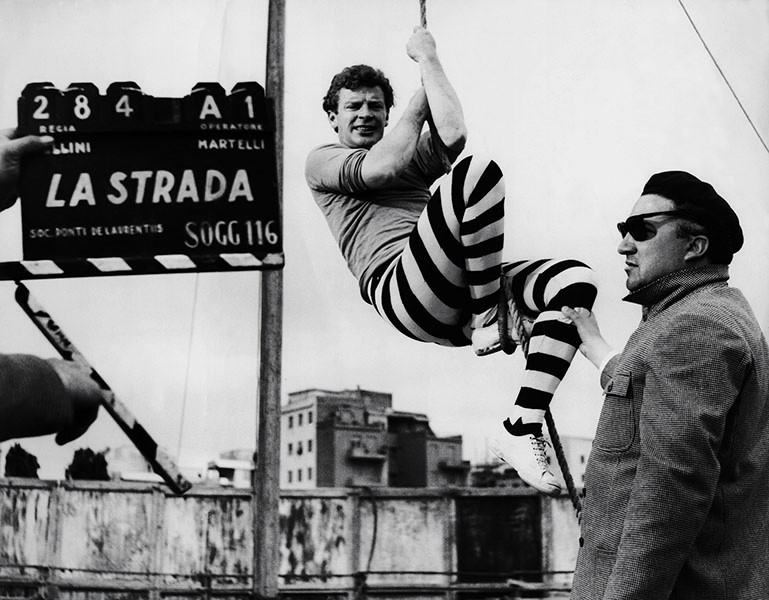
Federico Fellini’s I Vitelloni and Amarcord are often called autobiographical films but that is only partially true. They are inspired by actual events but those are merely the jumping off points for his creations. Take Rimini, a 4 hour drive to the Northeast of Rome on the Adriatic Sea. Fellini’s hometown. But he never shot a single frame of film there. He would return only at night and for brief periods. He didn’t want a flood of emotions to take over his imaginings. 

A Fellini character is not present in I Vitelloni. The characters depicted in the film are in their late 20’s. Fellini himself left Rimini at age 19. But he would have seen the vitelloni hanging out all night in the cafe. He would have personally known a few, even if just in passing. He would have heard their stories and legends.

He does share a similarity with one of the characters —the one who leaves. Otherwise, I Vitelloni can be considered a snapshot in time. It’s similar to the buddy movies that would come along later, Levinson’s Diner, Linklater’s Slacker, Noah Baumbach’s Kicking and Screaming, Ben Stiller’s Reality Bites. People, frozen in time and place, making due with their dreams and the best they can to reach them. Even if the rest of the world looks at their efforts and finds it not much.

If the world of Fellini were represented in a Dadaist connect the dots, the numbers to connect would be 1, 24, -52, 19, -8, 107 and then the images: a cross, a woman’s tush in a tight dress, a lonely soul walking in the night, a race car driver tearing through a town square, an exasperated, screaming adult, a naive newlywed, a little person, a strong man, an alluring acrobat, a circus clown and finally dots in a shape to make the face of Fellini himself, the ringmaster of dreams. 


Women on the Verge of a Nervous Breakdown — Essay

WOTVOANB

Thanks to you film fans, including D!, who came out to the Almodóvar Series opener Women on the Verge of a Nervous Breakdown at the 602 Club here in Appleton, Wisconsin. It was a cool evening paired with another 6 oh 2 event, Noche de Español. We ate well to say the least and even the “despacito” sign wasn’t enough to stop the sangria from spilling. Oh well.

The version of Women on the Verge that I screened was a pristine Criterion Collection copy, a remastered version with wonderful liner notes from Elvira Lindo which I picked up at the equally wonderful Appleton Public Library. They do have a top notch collection that I find difficult to stump, which is saying something. And the APL is also great at digging up more obscure titles for me. Doing research for my little pre-screening spiel I discovered that a lot of early Almodóvar came about from something called La Movida Madrileña. A time after the death of ironclad dictator Francisco Franco’s 40 year rule of dogmatic, machiavellian inspired Roman Catholicism. Franco himself died only in 1975. It shocked me to realize that the rapid societal attitude changes toward individual freedom that have happened in Spain occurred during my lifetime. It made me consider how I take a lot of the freedoms we have here in the West for granted. So what happened in Spain? As I mentioned in my little film intro, people went ballistic with this new found freedom in a kind of non-gendered “Ding-Dong! The Witch is Dead” kind of way. Maybe it’s a similar feeling a first year college student has in the dorms after deciding they are not fit for religious vows of chastity after all—“Sorry mom and dad!…and hey! Stop bogarting the bong!” And it was within this zeitgeist of personal freedom, art, music, fashion and yes filmmaking, La Movida, that the person — the film auteur— we know as Almodóvar was truly born.

We shouldn’t take our freedoms lightly. I don’t necessarily think we do but I think that there is nothing like a threat to shake us from our complacency. One thing I love about film is its ability to illuminate history like this and light us along in our path to being fully human, warts and all and respecting one another. Now if you can do this with bright primary colors, amazingly painted on fake eyelashes and totally barbiturate spiked gazpacho, as in the world of Almodóvar and Women on the Verge of a Nervous Breakdown, better still.

— The next installment in The 602 Club Almodóvar Series is Saturday January 6th, 2017 at 9:PM, when I’ll screen, All About My Mother. Preceded by a Noche de Español event. Save the date and leave room for tapas.

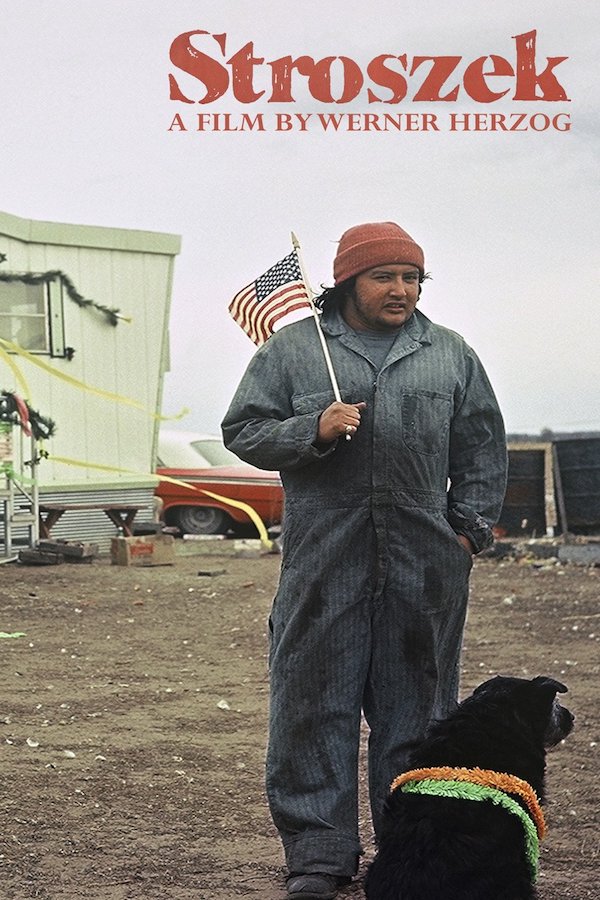
Strosczek

stroszek-herzog

Last night was the 2nd installment of the Werner Herzog Film Series at The 602 Club in Appleton. The event was in reasonable doubt earlier in the week as an unscrupulous individual was hanging on to the Appleton Public Library’s copy of Strosczek way past its due date. But luckily for the L and D, the D was able to get a hold of the title at the Lawrence University Library. He even showed up and gave tips on cooking brats as the L was making pork brats and chorizo. Cheese curds were also served. The menu also included chips, dip, New Glarus and Beaujolais.

A slight technical snafu at the start of the film, namely the Director’s commentary would not turn off, was figured out by one of the guests, who suggested hitting the audio button during playback, which worked! Once that bullet was dodged and as the final stragglers scuttled in we were all able to sit back and enjoy Strosczek. It had been decades since I last saw this film and like our offering last month, Burden of Dreams, this film from 1975 has stood the test of time. It tells the tale of Berliners: Bruno, Eva and their eccentric upstairs neighbor, Scheitz. Scheitz has a nephew in Wisconsin who writes to invite his Uncle to move. Trying times at home and looking to get rich quick in the promised land has the trio flying to NYC, buying a station wagon for $450 and moving onward to Wisco. It’s a touching story, at times extremely humorous, at times heartbreaking, at times absurdist but always compelling and beautiful. Definitely worth watching if you are in the market for a solid foreign film, that also takes place in the United States. …Next month we will follow up this narrative with the documentary “Little Deiter Needs to Fly”.  About a boy who grows up in post-war Germany and eventually becomes a pilot for the U.S. Navy during the Vietnam War. He is shot down over Laos and becomes a POW.