EPiC is an acronym for Elvis Presley in Concert. That’s pretty cool Baz Luhrmann! Now you may recall that Baz Luhrmann directed an eponymous narrative film, Elvis, in 2022. As for me, it was forgettable. However EPiC will not face that same fate. Maybe it takes an Aussie director, or simply anyone from any other country, to tell us something that we all can’t see clearly: Elvis was great.
Some people may always have known this, but to a lot of us, it’s a revelation. And EPiC is really a celebration of someone who wanted more and gave absolutely everything to be himself and to entertain. What I learned most from this film was that Elvis was a funny person, with a real sense of humor. And maybe in an ironic way, he was probably most naturally himself when performing on stage.
The film is peppered with several hard hitting interviews. And it’s telling because Elvis reveals things to these reporters that expresses a desire to be taken seriously, almost an anguish or a hope. It’s mind-boggling that someone so successful could feel that he had so much more to prove. But it’s obvious that he felt that he did.
Ultimately, no matter what you may think of Elvis falls by the wayside once he starts singing and dancing. It’s almost trancelike for him and the audience. And I think it’s right there in the music where Elvis is able to knock down the boundaries and really connect with people. He’s not the King of Rock ’n’ Roll for nothing.
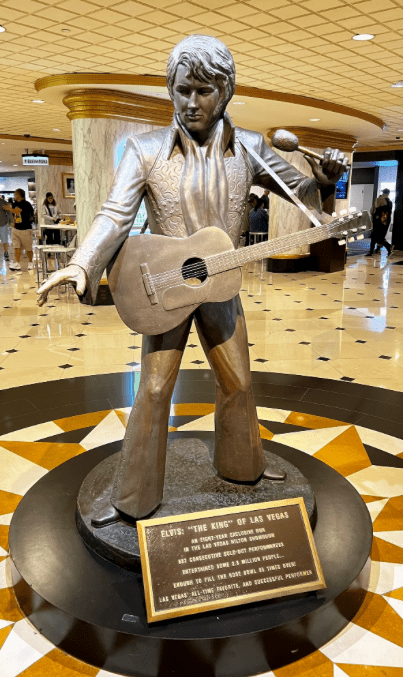
EPiC covers Elvis’ 1970s residency at the Las Vegas International Hotel. He played 636 consecutive shows there over a seven year period. Today the hotel is called the Westgate Resort. There’s an iconic statue to Elvis in the lobby that I enjoy visiting any time I stay there or am in the neighborhood. It’s not just fun for a selfie I can send to D — which I do! — but it sort of encapsulates that moment in time when Vegas was that wild rollicking place. EPiC captures parts of that moment as well.
Good Luck, Have Fun, Don’t Die *** Not for everybody is our big takeaway. You might say this is not even for most people. This cautionary tale has some fun elements, some really troubling attempts at black humor, and, above all, a lot of Sam Rockwell.
In the spirit of Back to the Future, Terminator, 12 Monkeys, Deadpool 2 and probably lots of others, Rockwell arrives from the future to try to change the historical trajectory. This year’s villain is the dual threats of human complacency and AI run amok, slouching toward Idiocracy, I suppose. The movie begins with Rockwell showing up at a Norm’s in LA to recruit a band of diner-goers to aid him in his quest.
I really like Sam Rockwell and he is great as far as these things go. We thought the supporting cast was also pretty solid in what were patently absurd roles, Michael Peha, Juno Temple, and Zazie Beetz. We especially liked Haley Lu Richardson as the enigmatic princess in black lace-up boots. That said, I could easily tell you five things about this movie that would make you not want to see it. Defintely cleared the $6.32 bar for us, but you are welcome to take a flyer or just walk out if school shooting jokes aren’t your thing.
Did Norm’s really go out of business? Perhaps the apocolypse is nigh.
When life isn’t fair, should you settle your score through some extralegal channel? And, if so, does that make you a bad person?
Questions Asked in Crime 101, a star-packed Amazon Theater release featuring the likes of Chris Hemsworth, Halle Berry, Mark Ruffalo, Monica Barbaro, Barry Keoghan, Jennifer Jason Leigh (!), and a guy who looks just like Nick Nolte.
In addition to the many Hollywood A-listers, the movie also features the city of Los Angeles itself, as we travel the city by car and by air, for better or worse, throughout the film. Indeed, the wide, panoramic overhead shots reminded me as much of as Midsommar (poor L) as the camera turned the city upside down–or at least pour something out of it. I’m guessing there is a metaphor there. Not exactly a love letter to the City of Angels, but not hate mail, either.
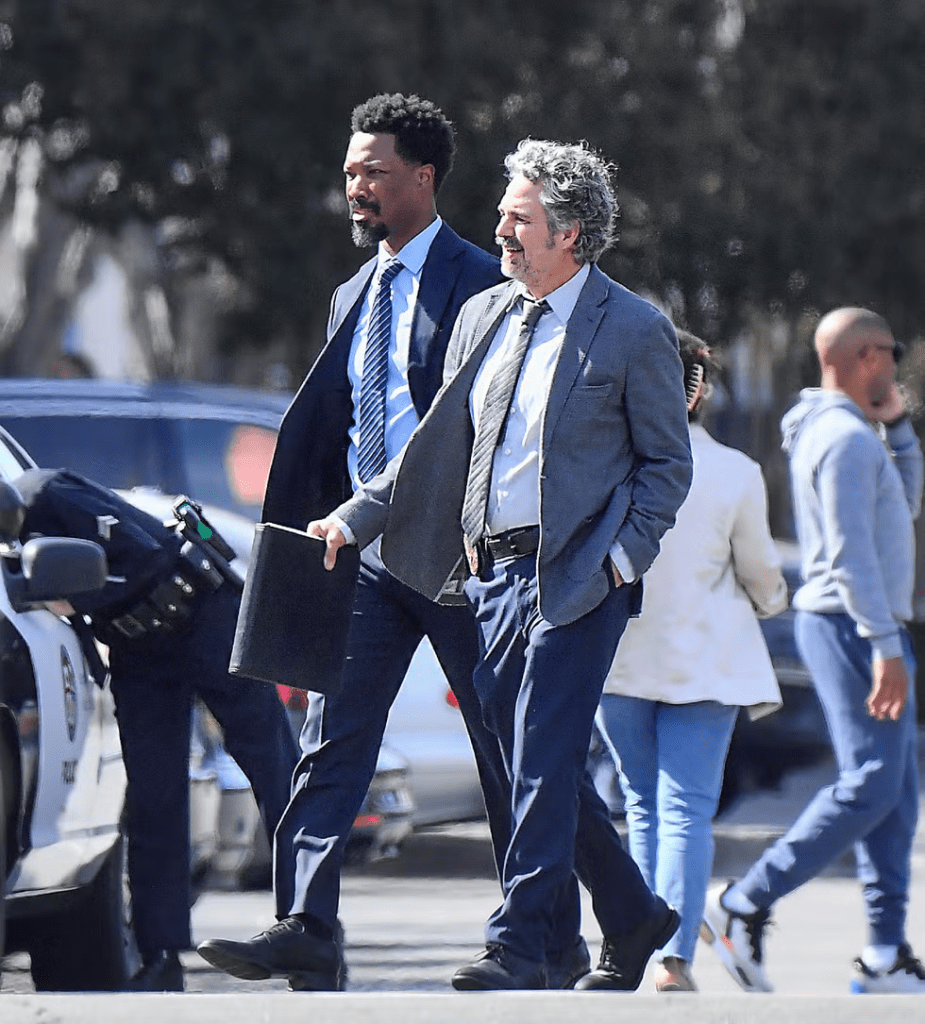
The movie definitely pays more than a little homage to Robert Altman, interweaving character arcs and story lines for Hemsworth, Berry, and Ruffalo. Hemsworth plays the master criminal with the heart-of-gold, targeting opportunities with minimal risk of violent confrontations. His character is written as the lost child longing to be normal. His non-violent proclivities don’t necessarily square with his enabler (that is Nick Nolte (!)).
Berry, meanwhile, works for a firm that provides personal risk insurance for the types of high-end clients that Hemsworth targets. Although she’s been at it for 11 years, her partnership is in the balance.
And then there’s Ruffalo, the rumpled detective with some strong theories and a low clearance rate, and his theory doesn’t seem to square with his commanding officer. His character arc brings the second major Question Asked — what if, instead of being an infallible homicide detective, Columbo was actually a 21st-century good-but-not-great cop on the LA bunco squad? The answers here are a more than a little unsettling — would he still bowl, or perhaps take up yoga? Would he be a cat person? How about his nephew, Andy Parma? L&D reveled in the Columbo parallels throughout. Ruffalo excels in the role, though I’ve seen him better.
The rest of the cast playing fairly straight-forward supporting roles. Except for Keoghan, who is perfectly cast as the smarmy blond nihlist dude. Unsettling, for sure.
All in all, two big ups from L&D. Probably won’t make the year’s best list, but closer to ***1/2 than **1/2 on the star chart.
This film is what’s known as a “vanity” piece because it’s funded by the same person who stars in it. In this case, the First Lady of the United States of America, Mrs. Melania Trump. Now I’ll stop right there to steal a line from Melanie McDonah, who opines in The Standard, and I paraphrase, “If you don’t like Donald Trump to the point where seeing some of him is actually a neuralgic thing, this may not be for you.” That is some classic movie reviewing right there and probably better than anything I’m going to come up with.
However, if you’re a political wonk, I’m not sure how you could miss it. A few things about this movie you may already know. It boasts one of the highest acquisitions ever for a documentary. We can thank our Amazon Prime accounts for that. Mr. Jeff Bezos found it expedient to expend 40 million for distribution rights and 35 million for global marketing. He also has a cameo in the movie sitting at the President and Melania’s table during the 2025 inaugural gala dinner. An event that ties together the entire narrative. Another element to note is that the director of this film is Brett Ratner, you may be familiar with his work in the Epstein Files.
I noted that there were many interesting things in this film. And D noted that many interesting things does not make an interesting film. There are a few things we learn along the way. For example D leaned over to ask me where Melania was from? I knew the answer was not Queens. I shrugged in the dark. …Slovenia! Our first lady is an immigrant from Slovenia. Also, she uses an Apple computer when Zooming with world leaders like Brigitte Macron, who you may know from her work slapping her husband in the face.
It feels like the entire first third of the film includes more dress fittings than anything before or after Phantom Thread. And there are more motorcades in an hour and 44 minutes than in all 4 seasons of Succession combined. We learn that Melania’s mother died on January 9th, 2024. Exactly one year later, Melania decides to light a candle for her at a church. If you’re Melania Trump, this requires police cars, the Secret Service, a limo, the closure of Saint Patrick’s Cathedral to the public and a personal blessing from the clergy. As she walks out, a crowd has formed on 5Th Avenue. No one boos, no one cheers, no one takes pictures. Melania is an enigma. And this film doesn’t do much to dispel that hard plastic feeling that you sense from her aura.
There is one scene where she meets with Aviva Siegel who was held hostage by Hamas for 51 days. At the time of the meeting, her husband Keith is also being held hostage. There was a lot of humanity in that scene. Aviva says, “There is too much hate in the world. Too much hate.” An important message. I don’t doubt Melania believes this as well. However, she is so detached from reality, I’m not sure how much it matters. It’s her film, though, so it’s her message.
I find a movie like this interesting for the Rashomon effect moments. More than one person sees the exact same event but interprets it in totally different ways. Traditionally, the incoming President and first lady spend the night before the inauguration at Blair House. In the morning, they are asked to take a photo with about 20 household staff members on their way to the ceremony. Melania, in her black dress and infamous, D would say Hamburgler style, massively brimmed hat is so incongruous with this group. Dental work is easier to sit through than watching this upstairs downstairs collision. And yet, if you’re a Melania fan, you don’t see the cringe, you simply see your heroine being cool with the staff…or however they might characterize this. Again, it’s a vanity piece, and I’m certain that this scene made the final cut because depicting empathy is the intention.
The film ends with on screen text listing Melania’s accomplishments and, as she would say, initiatives. And these deal with helping foster kids and supporting legislation against using AI deep fakes unethically, as in revenge porn. Who could really argue with this? Melania also touts her 2020 Rose Garden renovation. Of course the President paved over the grassy area she installed with a stone patio in 2025. And let’s not even talk about what he did with her office (hint, it was in the East Wing). But Melania truly doesn’t seem to be phased at all by these changes. In one genuinely brilliant scene, she is on the phone with “Mr. President” and he is asking her if she has seen the final election results. You can tell she is busy with so many other things, isn’t interested and can’t wait to get off the phone. “I’ll watch it later, dear.” It’s great comedy and probably the only scene that organically grows from real life. Melania has other pressing initiatives on her mind. Other state dinners to organize featuring gold leafed eggs stuffed with caviar. Her Style to maintain in exacting detail.
One thing D mentioned in passing which I can’t stop thinking about is how this film would play without the constant voiceover from the first lady. She’s a #1 NYT best selling author, after all, so I’m sure she can’t help herself. But if this film only featured found sounds, diegetic sounds, like a classic cinéma vérité Frederick Wiseman film, it would truly be elevated. Instead, this slice of life has more akin with an IMAX nature documentary than anything a person can really relate to.
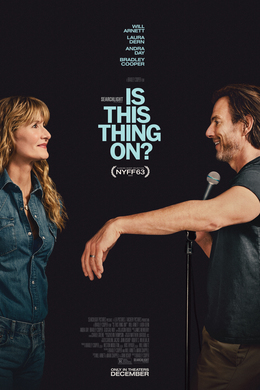
This will be a particularly subjective review of Is This Thing On? starring Will Arnett because I’m a Smartless devotee. That is the podcast that features Arnett, Sean Hayes and Jason Bateman. It’s my go to pod for snow shoveling. And also was my go to for flying before I was turned on to The Rest is History (The Abraham Lincoln two parter. So good. You. Have. Got. To. Be. Kidding. Me.) If you have never listened to Smartless, start with the interview of José Andrés, the celebrity chef and humanitarian. It’s inspiring and enlightening.
The strange thing is that since I listen to Arnett often, I almost didn’t want to watch this movie. If I’m into a podcast and don’t know what the hosts look like, I enjoy my imaginary idea of how they look. Do you do that? And so I thought, well this may be weird to see this person on the screen with the voice of Will Arnett. But I’m here to report that no such phenomenon happened. I was able to watch and enjoy this film without thinking about the podcast. Will Arnett did a great job creating the character of Alex Novak, a guy who’s down on his luck and finds salvation in stand-up.
That said, there were times when the real Will Arnett poked through. The football (Liverpool) chant in the restroom, for example. This would be a non sequitur if you didn’t know Arnett’s fandom. Though later, he wears a Liverpool T-shirt as he emerges from his bed. In these cases, the nod to Liverpool took me out of the story. Not because I dated a girl who was a Liverpool fan, I did, but because there is no reason given, no indication why Alex Novak would be a fan. Also, where does Alex Novak work? He is in finance we are told. That’s convenient but does he work from home? These ideas are tied because there is no backstory, if you will, no history for Alex, or life for him outside his pain and drama. Does this guy have a job? Is he a real person? Is he simply self-inflicting wounds and self-centered? For the audience, it’s tough because his marital separation is just as murky. The whys threaten to creep in and overwhelm the story. And if they did, the film would die in its tracks. Because we the audience would feel that at any point, Alex Novak, the trust fund kid and Liverpool fan, could simply fly himself to Saint Martin, or Sint Maarten for that matter, when things start to fall apart.
But these filmmakers are too savvy for that. Perhaps starting and ending with Director, Actor and Co-Producer Bradley Cooper. He knows how to keep an audience interested in a story and empathetic to the main character. Even one who gets on stage at the comedy club, sets his drink down on a table in the front row and says, “Don’t roofie me. …No actually roofie me. I would love to be roofied.” Frankly, I thought the depth of darkness in that line was genuinely funny. It gives profound insight into the loneliness of the character. And yet, someone who is reaching out to others. And it’s a reason I enjoy stand-up. A sphere where everyone agrees ahead of time, we’re all grown ups here. We are gonna vent and laugh, be vulnerable together in a way that may be acceptable in few other places outside of this club.
Laura Dern also drops in a heartfelt performance, filled with nuance. She and Arnett have a strong chemistry together that’s sometimes even stronger when they are at odds.
As a fan of stand-up, I enjoyed Is This Thing On? It felt like a great balance between the art of telling a story and the art of learning a craft like making strangers laugh.
Listen to me. Everything we see that is ugly- stupid, cruel, and ugly. Everything is your fault…
But especially the ugly.
That is the best punch line of The Brutalist, Director Brady Corbet’s epic exploration of the Affluent Society. It is also, arguably, the thesis of the film.
I loved watching this film on the very big Marcus screen. People often say this about movies shot in Montana or Australia, big landscapes, blue skies, astonishing weather fronts, that sort of thing. Remarkably in The Brutalist, many of these landscape views are scratchy stock film from the ’50s heralding the post-WWII industrial boom. The stock film is often co-narrated by the guy from the school movies of your childhood, and backed by the gasp of an accordion, or some pulsing, syncopated beats.
Meanwhile, much of the main action is shot with what is — gosh, I don’t know, where is L when you need him? — maybe a hand-held camera? The effect is this disorienting and sometimes suffocating intimacy that pervades the movie. There were times where I swear I could see two sets of eyes on characters bouncing up and down in their cars. But it seems like it wouldn’t work as well on a television.
Anyhow, this is a very long movie, clocking in at over 200 minutes, so hunker down. About 15 minutes in, the cacophony of visual and aural and intellectual stimulation was so overwhelming that I knew I wasn’t going to be able to process and put it all together in real time. So the four-hour theater experience, including a 15-minute intermission, was not one of your relax-at-the-movie experiences.
And the film takes on the Big, Big issues, the Holocaust, the camps (the main characters are survivors), remorseless capitalism, immigration, assimilation, covert and overt anti-Semitism, and, perhaps least of all, the place of art and architecture in the emergent industrial age.
The main character, protagonist, possible hero, and subject of the movie is László Tóth (Adrien Brody), the brutalist himself. His journey is Brady Corbet’s characterization of America.
Tóth makes it to America in the opening scene and the first outdoor American shot in the film is an upside-down Statue of Liberty. (Could this possibly be a metaphor of some sort?). His first stop is the City of Brotherly Love to live with and work for his cousin, Atilla (Alessandro Nivola). Atilla is the proprietor of a small furniture business and has reimagined himself as an American Catholic named Miller! More foreshadowing here as the cousins converse about what is expected in America, what it takes to be accepted in America.
Tóth isn’t impressed. He doesn’t seem like the compromising type, and certainly not one to compromise his vision for the sake of bean counters or pencil pushers. Yet, he is also pragragmatic about some of the ends to get to his means, particularly with respect to the use of abundant and inexpensive concrete! And so away we go.
Much of the movie involves Tóth’s relationship with his new patron, Harrison Lee Van Buren (Guy Pearce). These patron-artist relationships are always a dicey and touchy area for the artist. Who is paying and what exactly are they paying for? What if they want you to comprimise? What if they delegate oversight to some penny-pinching philistine? But Van Buren’s real role is that of the industrialist archetype. He represents the post-war economic and construction boom that’s helping Pennsylvania and the United States into the modern age.
Van Buren’s son, Harry Lee (Joe Alwyn), also features prominently for plot-related reasons, but ultimately he represents the financiers. At one point László asks him, “how does that work exactly? The company paying themselves to finance?”
As it says on our masthead, to ask the question is to answer it.
So the politics of the movie aren’t altogether complicated, but László’s relationships with his wife and niece certainly are. Right off the bus in Philadelphia, Cousin Miller tells László that he has received word that they are alive! So throughout the first few hours of the movie there are repeeated voiceovers back-and-forths between László and Erzsébet in an attempt to get her to the states. I must admit that I don’t watch trailers, so I wasn’t entirely sure that she would ever really make it.
But, spoiler alert, the intermission credits provide a decisive wedding picture that helps secure her immigration visa, so Erzsébet (Felicity Jones) and their niece Zsófia (Raffey Cassidy) make their way over to join László at the Van Buren estate. There is a lot going on here in terms of the state of their marriage, the state of their Jewish faith, their places in America, to name a few. There is no easy way to characterize Erzsébet, she understands ambition and ambitions, but she also is reflective and shows gratitude in spots where I’m not sure you would expect it. She is definitely an interesting add and a welcome riposte to Corbet’s otherwise simplistic American caricature.
The other main and recurring character is Gordon (Isaach De Bankolé), who László meets in a food line early on in the movie. Gordon’s role seems to be to provide opportunities for the script to explore László’s character and humanity. He often shows up right as László is responding to a new plot development.
And what of the Brutalism? Huh. I guess I will continue to reflect on that question as I continue to process all of this. My big takeaway is that the movie is a commentary on the economic and cultural response to World War II coming to a close.
I think the acting is splendid, Brody really is great. I’m not sure who else might have pulled this off. Felicity Jones earns her money, too. I also loved Salvatore Sansone as Orazio in the Italy scene –– “dangerous work.” The entire sequence in Italy is just remarkable. There is so much to like.
The verdict. I thought this was a great movie to watch, though it isn’t a great movie. I do recommend you head to see it on the big, big screen if you can. It was loud in there, too! Make a day of it.
A shout out to Dr. B for braving this one with me. He didn’t get up and leave or doze off, so I think he liked it, too.
If the opening scene of Anora doesn’t get your blood moving one way or another, I have terrible news for you. You have died. … The silver lining is of course that even as a dead person, you’re still able to watch movies and read movie reviews. That opening shot, tracking across a line of guys getting lap dances, drops you right into the world of eponymous heroine, Anora, with no apologies. It’s made apparent quickly enough that for these working women, it’s just another day at the office. Except that in this career there is no 401(k), health insurance or paid time off. This is the world of men. If you don’t like it, there’s the door.
It’s within this milieu that Anora, who shares an apartment with her sister and brother-in-law, takes on escort work. Back at Headquarters strip club, as a Russian speaker, she’s assigned to entertain the son of a wealthy oligarch, who asks if he can see her outside of work. Here the so-called fun and games of the story ensue. And they do ensue, extending Act I almost uncomfortably. Has the director lost control of this story? — Or what you realize later. You’ve been wonderfully set up.
Act II takes you into the realm of comedy but with the real threat of violence underpinning every moment. It’s unnerving but you settle into it. The strength of Anora is that it simultaneously holds what could be an absurd Eastern European folktale within the bounds of a tangible New York City universe. Here, broken noses are felt. As our friend B., who’s an M.D., leaned over to give us a real-time diagnosis of one of the characters. The prognosis wasn’t good. The severity of the mounting symptoms meant that the other characters needed to rush the injured one to the ER. STAT.
And broken dreams are deeply felt as well. Disappointment is the millstone that’s anchored around every neck in Anora. And one apparent theme is that just because you wish something to be real, doesn’t mean it is.
There are a few outrageous and memorable scenes in Anora. The Coney Island tow truck scene stays with you. And the haunting final scene reveals the depth and complexities of the characters. Cutting to a silent credit sequence gives you no reprieve and invites reflection. A perfect antithesis to the chaotic euphoria of the opening shot.
It doesn’t surprise me that Director, Sean Baker, a kid from New Jersey, walked away with the Palm d’Or at Cannes for Anora. He has a track record of fearless filmmaking, expressing himself by any means at his disposal. In the character of Anora he found a kindred spirit.
The Odyssey. Odysseus. Ten years away at the Trojan war, ten years to get back. Past the Cicones, the Lotus Eaters, the Cyclops (“Nobody” tricked him!), the Wind God, Circe’s Island, to Hades and back, the singing Sirens, through Scylla and Charybdis, on to the Isle of the Sun God and to Caylpso’s Island. What a trip!
Ithaca. Queen Penelope raising the son, Telemachus, keeping the many suitors at bay. Famously weaving a funeral shroud by day, covertly undoing it at night. For 20 years! The suitors weren’t the sharpest group.
Setting the stage for the return. Just not setting the stage for The Return.
While Penelope was unwinding, Odysseus found his way to Phaeacia, where he recounts his tales to King Alcinous and the Phaeacians — I actually wrote a college term paper on how this penultimate stop served as a transition from the fantastic back to the more mundane toil of life in Ithaca (not exactly an original thesis, I know). It was the sea-smart Phaeacians that help Odysseus find his way back to Ithaca.
None of this makes it into The Return, unfortunately, especially the part about Odysseus talking a lot. Instead, The Return focuses solely on Odysseus (Ralph Fiennes) back in Ithaca to (presumably) reunite with Penelope (Julia Binoche). I say presumably here because Odysseus of The Return is a troubled, broken shell of a man, and not at all in a talking mood. He has misgivings about his time as a warrior and his heroics in the Trojan War. He can’t muster up the courage to confront the suitors and reunite with Penelope. He is seemingly all alone — there is no sign of the goddess, Athena, who has been his #1 fan and protector over the past 20 years. The entire movie, in fact, is a godless affair, and not in a good way!
The movie does capture Odysseus’ renuion with his loyal dog, Argos. My recollection is that Odysseus passes by on his way back to the palace and Argos looks up from the dung heap, notes his master’s presence, wags his tail, and passes on from this life. The Return doesn’t let him off that easy, instead extending into several minutes of pointlessness before finally letting Argos go. Even so, on behalf of L&D, I will say we wish we would have checked out of the theater when Argos passed on.
Revisionist Odyssey didn’t work for us. If you are looking for action, drama, intrigue, tension, emotion, suspense, you best look elsewhere. This is one of the worst viewing experiences in the L&D canon.
Did you notice the title has the Roman numeral II in the middle of it? Indeed, that is about the most subtle part of the Gladiator remake. This is the second Ridley Scott project in recent memory — Napoleon being the other one — where it seems like it would have worked better as an eight-to-ten part Max or Netflix series. But instead we get sloppy storytelling that sets up a variety of spectacular visual sequences.
If you are familiar with Gladiator, you can see where this movie is going from the length of the Roman empire away. The charasmatic warrior Lucius (Paul Mescal) is captured by legions led by General Acacius (Pedro Pascal) and then sold into gladiatorial servitude to the enigmatic Macrinus (Denzel Washington himself!). Lucius turns out to be exceptional at killing man and beast and makes his way to the Colloseum. General Acacius and Macrinus have sketchier motives, I guess we’ll have to see about all of that. And we are introduced to the decadent emporer tandem, Geta and Caracalla. Lucilla (Connie Nielson) shows up and seems concerned about the fate of Rome. Contrived drama. Big finish.
With Gladiator, we all knew Maximus (an in-shape Russell Crowe) was pals with Marcus Aurelius and had been unjustly railroaded. He reluctantly did his killing to get his chance for vengeance, “in this lifetime or the next.” The big difference here is that there is some mystery surrounding who the actual protagonist is — is it the gladiator? General Acacius? Denzel? Lucilla? The fratelli imperatori?
The bad news is that if you haven’t seen Gladiator, it might be a little difficult to follow along. The good news is that it doesn’t really matter. This movie is the battlefield and the Roman Circus. Ridley Scott gives us a naval assault and a great siege to open the movie. He gives us a gladiator mounted on great rhinosoraus (hat tip to a classic Bugs Bunny short for the rhino’s fate). He turns the colleseum to a great, shark-infested naval theater. This is definitely one of those “see it in the theater” type movies because they spent a lot of money making this look spectacular.
Conclave is a surprising film. In fact, its theme is don’t be confident that what you think is true. The question is posed and answered by Cardinal Lawrence (Ralph Fiennes), the Dean or manager of the conclave to elect a new pope, “If we were certain of the answers, why would we need faith?”
Although I wasn’t thrilled with the plodding pace of the film, the plot got more intriguing as the story grew more complex. A solid performance by Stanley Tucci (most recently seen eating his way through Italy in a Max series) and star turns by Lithgow, Sergio Castellitto, Carlos Diehz, Lucian Msamati and Isabella Rossellini leave a lasting impression on the viewer.
As usual, your faithful correspondents, L & D could be heard laughing at all the wrong places and zinging away with our zingers. But there were quite a few other folks in the theater (another surprise) and so a little restraint by us was in order.
The film really got interesting when D. started applying his “This Film is like The Shining” theory on the fly. We recently watched the 40th anniversary release of The Shining on the silver screen (I’m still processing) and lo and behold the analogy between these films can easily be made. The cardinals are sequestered in a hotel with long hallways. There is a room that no one is allowed to enter, which the pope died in. There is intense cello playing throughout. The footprint here is indeed one of a horror film. The horror being that the Church may decide to turn its back on the progress it’s made in becoming a voice for peace.
I won’t say more except Conclave is well worth the watch and way over the $6 Tuesday bar. Be prepared to check your assumptions at the church steps.





 L&D Report