
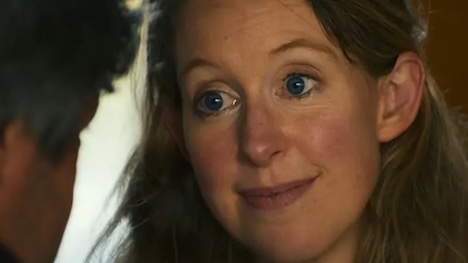
Elizabeth Holmes and her big blue eyes. They don’t blink. They don’t stare. Not quite robotic. Not quite human. Not full of pathos. Just there. A blank imprint, by design. Waiting for you to ascribe whatever it is that you will ascribe. It’s not possible to come to one judgement or another. In fact you may come to multiple judgements simultaneously.
When studying documentary film theory, especially if you are a student of Bill Nichols, one of the first things you learn about is genre. Is it a Cinéma Vérité piece? Perhaps Voice of God? Or maybe self-reflexive? In terms of self-reflexive documentary, where the filmmakers want you to see how the sausage is made, if you will, You Can See Everything is a double entendre. Elizabeth Holmes tells our wavering documentarian Nathan Fielder, “You can see everything about me.” Meanwhile, we the audience are shown everything about how this documentary is being constructed.
Back to the eyes. There are some fantastic stare down scenes with Fielder. At one point he asks Holmes, “When you met your current partner, Billy Evans, how did you flirt with him?” You guessed it, she just looked at him with those big eyes. And guess what, according to Evans, right then and there, he knew he was in love. Which reminded me of the Netflix doc, Inside the Mind of a Dog. This Voice of God doc explains that puppy dog eyes and yes, a human baby’s big eyes are designed by nature to help us feel sympathy for this poor thing that needs our assistance.
Speaking of babies, one thing to know about Holmes is that she had her first child right before her criminal trial for wire fraud and conspiracy began in July 2021. The second after she was found guilty in January 2022. Her co-conspirator and first partner, Ramesh “Sunny” Balwani received a sentence of 12 years. And Holmes will effectively be behind bars for 7 years. Fielder asks Elizabeth’s father if she has a track record of being involved with manipulative men. Evans jumps in and tries to change the conversation and end the interview. He does this again during an interview when a would-be business partner is telling Fielder that CEOs promise a lot of things that aren’t realistic.
What’s fascinating to me is the attempted manipulation and setup of Fielder. For example, the already iconic scrambled eggs scene. Or the let’s make a deal with A24 scene. Taking a step back, you’d have to be gullible not to believe Holmes and Evans are in lock step, portraying Evans as manipulative, when in reality they are in cahoots. Was Sunny really the manipulator in their business and personal relationship? Look into Elizabeth’s eyes for the truth.
ACT III makes You Can See Everything an instant classic. It takes the self-reflexive genre and turns it on its head. In a film-within-a-film way, Amanda Seyfried, the actress who played Holmes on the Hulu miniseries, The Dropout, about the rise and fall of her company, Theranos, is enlisted to do a few re-creations. And in one scene, Seyfried confronts Billy Evans directly. Evans wants Seyfried to know that Holmes never said the things she is portrayed as saying on The Dropout. Seyfried replies that the intention and results are what matters, not the exact words. It’s fiction. Not like this documentary, where the exact words are all that matters.
Though even exact words can have multiple meanings. The most elucidating scene involves Fielder screening a classic comedy routine for Elizabeth Holmes to break down. Abbot and Costello’s “Who’s on First?” Earlier in the film Holmes reconstructs her infamous blood testing machine, the one that never worked and bilked investors of millions. She claims, “This machine can run any test.” But she doesn’t say that, “Someday this machine will be able to run any test.” She implies that it can right now. Which it can’t. …But someday it could. Who’s on first? I don’t know. Third base.

