
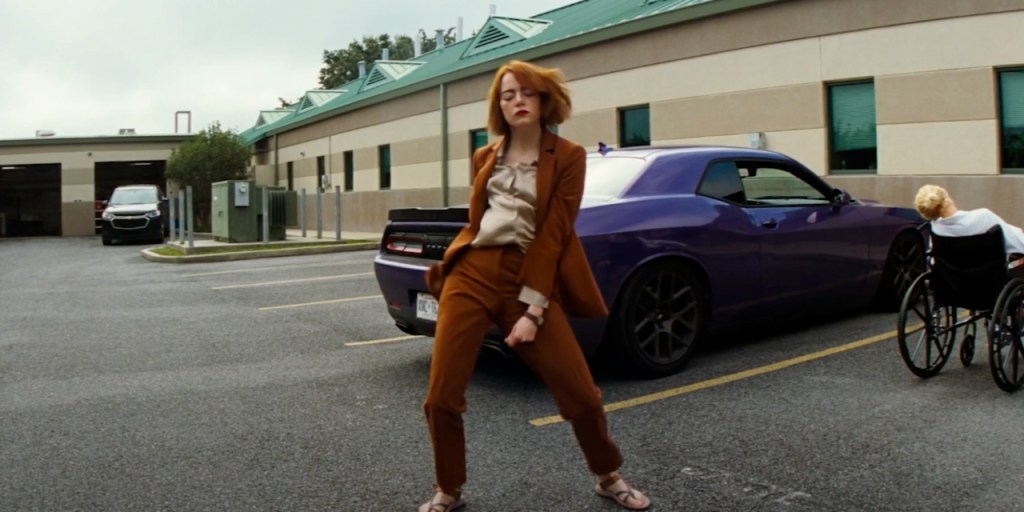
Director Yorgos Lanthimos must have the strangest dreams. At times during the triptych of shorts that is Kinds of Kindness I inadvertently said, “What the Fuck” out loud. D leaned over with a, “Yeah, we could have left after the first one.” But I wasn’t thinking we should duck into Inside Out 2 or Despicable Me 4. I was thinking, these shots are so inspired. Where is he getting these from? The way Yorgos uses the wide shot, it’s like Bob Ross dipped his patented Number 2 Landscape Blender Brush into liquid LSD.
There are flashes of Wes Anderson in these films: The reeling off of items in a hand written note, the robotic gait of an actor, the traditional literary narrative structure of the stories, and their titles, working like chapters of the same book — the use of Willem Dafoe!

However, Yorgos does have a specific visual language and thematic preoccupations of his own. And they’re often revolting in a riveting, I know I’m going to feel nauseous/possibly hurl/maybe be too amped and have to write about this film at 1:00AM, but I can’t look away, kind of way.
The great Senegalese Director, Djibril Diop Mambete (check out Touki Bouki or Hyènes immediately), once said that he was against the Hollywood system because it asked you to believe that the actor you saw in a movie last week was now a different person in a movie you are currently seeing. But Yorgos proves that an audience can indeed suspend disbelief in this regard. In these back to back movies, it’s easy to buy into the imagined world with these great actors in complex stories. It reminds me of the sleight of hand I saw Piff the Magic Dragon perform at the Flamingo in Vegas. Before everyone’s eyes he changed one playing card into another by rubbing his finger over it. The trick was being transmitted live on screens in the auditorium, as a close up. So how did he do it? The term movie magic typically refers to cheap tricks in special effects or editing. But I would posit that there is a much deeper level where we can talk about movie magic as the transformation of these talented actors, like chameleons, changing colors right before our eyes.
The stories are all absurd parables, that harken to the literature of Kafka, Dostoevsky and Marquez. Stories that draw a murky line between no one to root for and everyone to root against. But to say they are dark would be simplifying unfairly. Yorgos does have his own signature. Yes, it’s written in the blood of the nearest available animal or human internal organ —but it’s nevertheless his. And I believe what redeems his films are that he is coming at these motifs with a critique of how we treat one another. He looks unflinchingly at the deformity of the human soul as it leverages wealth to debase even genuine miracles themselves. He makes us ask honestly, is anything sacred?
Yorgos loves to reveal human avarice and unspool it to its logical final conclusion. If you don’t mind being disturbed in a similar way that Poor Things disturbed you, I highly recommend Kinds of Kindness. For your efforts you will be rewarded by witnessing a tennis racket, whose head John McEnroe destroyed in a rage in 1984, preserved under glass, illuminated by a spotlight.
 L&D Report