Notice to Quit

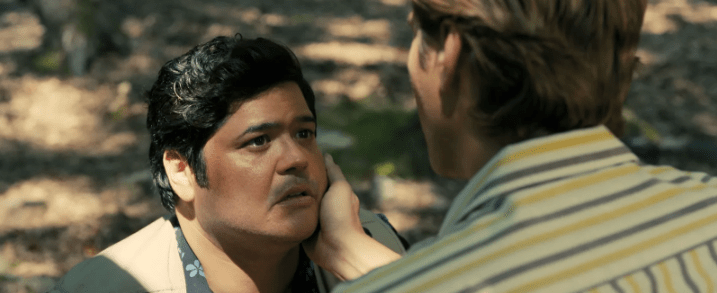
Once you know that Director Simon Hacker was an apprentice to the Safdie brothers, a lot of the style of Notice to Quit becomes apparent. Like their Uncut Gems, the New York that’s depicted on screen is a blistering, suffocating and crushing one. If you’ve ever been in that particular mother of all concrete jungles in the middle of Summer, you’ll have a visceral reaction to the heat in Notice to Quit. And also to its almost mythological level of adoration of the otherwise ubiquitous air conditioner. The protagonist, Andy Singer (Michael Zegen) in fact carries an air conditioner around, like Sisyphus pushing a boulder, for what feels like the entirety of the movie. 

However, unlike Uncut Gems, there is room to breathe in Notice to Quit. This is wholly due to the presence of Andy’s daughter, Anna (Kasey Bella Suarez) a 10-year-old who needs her Dad to step up and save her from a life-altering move to Florida. But Andy, he can’t even take care of himself. He’s four months behind on his rent, a scam to skim appliances has backfired big time and he can’t seem to walk a straight line without having a coffee cup face plant itself on his dress shirt. Forget about the apartments he’s supposed to be renting as a broker. His listings include a place with a toilet in the living room. 

The film is easily stolen with the appearance of Andy’s dad, played brilliantly by Robert Klein. When Klein’s roommate Marvin (Rao Rampilla) quotes Death of a Salesman in a sleeveless T-shirt, “A man is not a piece of fruit.” Andy says he doesn’t understand how this applies to his father not being willing to look after Anna. To which Klein says definitively, “It applies.”

Notice to Quit is an homage to independent films like the Wim Wenders classic, Alice in the Cities. It’s also shot on 35mm film, which lends itself to the throwback feel. It’s a character driven film that works within the constraints of a single day and the end of a chapter in the relationship of this father and daughter. There are plenty of real moments, of fun and games and most of all a lot of heartfelt emotions. 

One last thing. Not only the Writer and Director, Simon Hacker is the Producer and Distributor. He got tired of waiting for other distributors to get his movie on screens so he, in indie style, figured out how to do it himself. I’m glad I caught Notice to Quit on the big screen and I look forward to Simon Hacker’s next Directorial effort. 

Just a Bit Outside

Just a Bit Outside is ostensibly about the Milwaukee Brewers 1982 World Series run but it’s really about how a city can fall in love with a team. In this case, a team of misfits who could simultaneously claim four future Hall of Famers. 

The city of Milwaukee had a World Champion in 1957 when the Braves beat the Yankees. But the team broke the city’s heart when it skulked off in 1965, like so many manufacturing jobs, to the South to become the team from Atlanta. However, in 1970, the Brew Crew né Seattle Pilots arrived to bring baseball back to Milwaukee. …Too soon. The fans, once bitten, twice shy, weren’t in the mood. By 1982, the economic mood was dire. All of the breweries had closed down and the schlemiel schlimazel salad days were a thing of the past. 

Interestingly, the start of the ’82 season was anything but auspicious. And the club was just about in the cellar. In the midst of this disappointment, a new manager was hired, Harvey Kuenn. Coach Kuenn was former player, a leauge batting champ no less. Maybe more importantly, he and his wife Audrey owned a tavern, Cesar’s Inn, a few blocks from the stadium. Both Harvey and Audrey tended bar. They lived in the back! And they had the players over for dinner and drinks at the tavern after every game. — I can’t even conceive of this situation in our day of multi-million dollar salaries for players and coaches. Coach Kuenn hated meetings. In his first meeting as new manager he said, “I have two things to say. Number one, I hate meetings. Number two, this meeting is over.” In his wisdom, he let the players play. He unleashed them and they produced victory after victory. A great lesson in getting out of your own way. How’s that for Zen coaching, Phil Jackson? 

The real stars of Just a Bit Outside are the rabid Brewer fans. A lot of the b roll footage is from the many rockin’ taverns of the time. And the fact that the boys don’t ultimately win all the marbles doesn’t stop the fans from loving them anyway. The film makes you ask, “Is it possible that they even love them more?” When I was growing up in New Jersey, in the late 1980s, the Devils were a fun new hockey team. In fact, Wayne Gretzky infamously said they were a Mickey Mouse franchise. So they played with a chip on their shoulder. For the fans of course, being from Jersey meant already having a chip on your shoulder. It was a match made in heaven. When the Devils lost in the playoffs, we the fans went to the airport to greet them when their plane landed. We had bonded with the players, win, lose or draw. Just a Bit Outside captures that dynamic precisely, with great humor and emotion. 

When I asked my friend F if he wanted to join me to see this film about the Milwaukee Brewers, he said in his typical to the point manner, “I am a Yankees fan!”. But after watching this movie about a specific team and year, I realized that this film could be enjoyed by any fan, anywhere. Personally, as kid, I started off rooting for the Yanks myself. Then when I moved West, the SF Giants. Followed by the LA Dodgers for my years in Tinseltown. I just did what the song said to do, “Root, root, root / For the home team”. But will I now, as resident of Wisconsin, become a Brewers fan? These words of wisdom were carried on the wind from generation to generation, from the bleachers of old Milwaukee County Stadium to the ears of one of the all-time Brewers greats, Bob Uecker, “Down in front!”. The Brewers 1982 season proves that nothing is impossible. 

Kinds of Kindness


Director Yorgos Lanthimos must have the strangest dreams. At times during the triptych of shorts that is Kinds of Kindness I inadvertently said, “What the Fuck” out loud. D leaned over with a, “Yeah, we could have left after the first one.” But I wasn’t thinking we should duck into Inside Out 2 or Despicable Me 4. I was thinking, these shots are so inspired. Where is he getting these from? The way Yorgos uses the wide shot, it’s like Bob Ross dipped his patented Number 2 Landscape Blender Brush into liquid LSD.

There are flashes of Wes Anderson in these films: The reeling off of items in a hand written note, the robotic gait of an actor, the traditional literary narrative structure of the stories, and their titles, working like chapters of the same book — the use of Willem Dafoe!

However, Yorgos does have a specific visual language and thematic preoccupations of his own. And they’re often revolting in a riveting, I know I’m going to feel nauseous/possibly hurl/maybe be too amped and have to write about this film at 1:00AM, but I can’t look away, kind of way.

The great Senegalese Director, Djibril Diop Mambete (check out Touki Bouki or Hyènes immediately), once said that he was against the Hollywood system because it asked you to believe that the actor you saw in a movie last week was now a different person in a movie you are currently seeing. But Yorgos proves that an audience can indeed suspend disbelief in this regard. In these back to back movies, it’s easy to buy into the imagined world with these great actors in complex stories. It reminds me of the sleight of hand I saw Piff the Magic Dragon perform at the Flamingo in Vegas. Before everyone’s eyes he changed one playing card into another by rubbing his finger over it. The trick was being transmitted live on screens in the auditorium, as a close up. So how did he do it? The term movie magic typically refers to cheap tricks in special effects or editing. But I would posit that there is a much deeper level where we can talk about movie magic as the transformation of these talented actors, like chameleons, changing colors right before our eyes.

The stories are all absurd parables, that harken to the literature of Kafka, Dostoevsky and Marquez. Stories that draw a murky line between no one to root for and everyone to root against. But to say they are dark would be simplifying unfairly. Yorgos does have his own signature. Yes, it’s written in the blood of the nearest available animal or human internal organ —but it’s nevertheless his. And I believe what redeems his films are that he is coming at these motifs with a critique of how we treat one another. He looks unflinchingly at the deformity of the human soul as it leverages wealth to debase even genuine miracles themselves. He makes us ask honestly, is anything sacred?

Yorgos loves to reveal human avarice and unspool it to its logical final conclusion. If you don’t mind being disturbed in a similar way that Poor Things disturbed you, I highly recommend Kinds of Kindness. For your efforts you will be rewarded by witnessing a tennis racket, whose head John McEnroe destroyed in a rage in 1984, preserved under glass, illuminated by a spotlight.


Shogun

A guest review by music writer and performer Mr. Ian Moore, who by his own admission is, “prolly banned”.

A powerful woman bows before a home shrine, the mood reverent and gentle.  A samurai enters and meticulously prepares his estranged wife a small matcha tea, which she drinks and ceremonially compliments his performance before refusing his offer of reconciliation.  Such are the illustrative vignettes created in “Shogun,” the Sengoku period Japanese epic now streaming on Hulu. Meditative, rainy landscapes, rituals, and trials form the main action of the plot; but not to worry, plenty of heads get chopped off and the occasional ship race, battle, or wreck erupts in high-budget glory, courtesy of the James Clavell novel that “Shogun” is based on. 

The two main characters are struggling against the Osaka council’s takeover when a mysterious British naval pilot is captured attempting to open up trade with Japan, now monopolized by the Portuguese.  Lady Mariko and Toranaga are trying to save Japan from tyranny and are constantly on the run back to Edo, a smaller fishing village, keeping them in sight of the British ship and the warlord who graphically boiled alive one of the British crew, though now he’s ready to enjoy some of the good saké while plotting to make Toranaga the Shogun, the military leader of Japan. The marooned Blackthorne has an uncertain mission but quickly makes himself indispensable to Toranaga as leverage against the council while developing a relationship with Mariko, who interprets for him having been taught Portuguese by the scheming Catholic priests.  The depiction of women in “Shogun” reflects a deeply repressive society with a rigid role-based hierarchy but subverts this system occasionally with female power moves and notably when a madame eloquently uses a bartered moment with the leader to request that he set aside a large district in his capital city for retired courtesans.  More unexpected business filled some episodes: a conniving small town warlord is shown to be pretty kinky and the plot often revolves around not violence, but Toranaga or Mariko gaming the complex political world to outwit the council in unpredictable ways.

Throughout the ten hour series, the mise en scene is almost another character, we’re forever coming upon the samurai staring out into the rain like moody teens – it’s heavy when the fate of the empire is on your gorgeously robed shoulders. Each character wore iridescent fabrics with geometric, jacquard knots – even in the remote village where dry cleaning must be outrageous! If someone happens upon a noble warrior in such a moment, then it’s time for impromptu Haiku. Characters would go back and forth composing a poem together until one is overcome by the elegance of the others’ imagery and submits. Or, as another friend said, “that show is boring,” but I like a good poetry slam and the soundtrack is just perfect – composed by half of the Grammy-winning duo that scored ‘The Social Network.’ I just loved how complicated the characters were, often double-crossing each other and employing tricks of etiquette to wrongfoot their opponents. It’s a war movie, so that might not be your thing, cannon blasts and swordplay are maybe 1/5 of the film. Also: tons of subtitled talk of keeping your third heart hidden and building an eightfold fence in your mind; but the sex was really sexy and the blood spurty, so there’s something for the whole family!

On The Diving Bell and the Butterfly Director’s Commentary — Essay

Some DVDs will supply you with the bonus of a Director’s Commentary. Something that every cinephile looks forward to. Most of these tracks are disappointing. Either the Director would rather be somewhere else for whatever reason or there is a whole gaggle of people along for the commentary ride. This only serves to muddle the narrative. 

My favorite Director’s commentaries include those of Wim Wenders. He really knows how to tell a story. He seems so pleased you are listening and sort of invites you in. He’ll explain through personal anecdotes about his own life (I grew up in this valley) and funny ones (the Cinematographer fell asleep with one eye on the viewfinder in this scene), or critical aspects of the movie (we waited a day for this one-way mirror to be installed and it became the most iconic scene in the film). As opposed to a lecture or spoiler about how things were made, it’s much more a sharing and a conversation, in a sense. Since you never see the Directors, they seem quite at ease. For example, in the Director’s commentary for The Thing, you can hear the ice clinking in John Carpenter’s whiskey glass. 

Schnabel will tell you that he couldn’t make any of his films by himself. However, there is no doubt about his stamp, his signature. He is a physical Director, in the style of Werner Herzog. This makes his Director’s commentary compelling. One scene in The Diving Bell and the Butterfly finds an actress submerged, going deeper and deeper under water, holding on to the person in the diving bell. Schnabel says, “They wanted me to put weights in her jacket, so she could stay down there. I wouldn’t allow it. I was down there with them.” Of course he was! As I have been researching my  7th annual Winter Film Series, for which I selected four Schnabel films, what comes across to me is how he is someone who weaves himself physically into the film. As much as an oil paint becomes inextricable to a canvas. In behind the scenes you see Schnabel diving off a pier to prove to Javier Bardim in Before Night Falls,  that it’s safe to jump into this part of the sea—you also witness an injured Schnabel being wheeled around in a make-shift hand cart. In the commentary he will throw away facts like, “That’s my shirt.” or “That’s my hat.” But without the commentary, you would not have the insight that 0n-set, Schnabel gives everything. 

During one of the soliloquies in Diving Bell, Schnabel opines in the commentary, “It would be a crime to speak over this.” This is the greatest form of Director’s commentary. Actually experiencing the film along with the audience. At another point in the film, during a gut-wrenching phone call by Jean Dominique Bauby’s father (Max von Sydow) Schnable is moved. He lets you know he watched the scene just like the audience. He says of the father, “Who talks like that?” 

If you’ve never watched The Diving Bell and the Butterfly, or read the book, I highly recommend both. It’s on the surface, an incredible story of a person who is paralyzed but can still communicate through blinking. But what it is truly about is the power of the human imagination and the dignity of creating an active and healthy inner-voice for oneself. Another one of Schnabel’s themes seems to be the artist’s ability to transmute mortality, to live on, through their work. The final shot of The Diving Bell and the Butterfly is actually during the credits. Schnabel says that the entire film was inspired by this shot of massive glaciers  violently crashing into water. Except that in a surreal but soothing twist, the footage is moving in reverse. The glaciers, healing, repairing and transforming back into their once glorious states. Schnabel won’t say but for me it’s a hopeful message that no matter how seemingly broken someone is, with imagination we can envision them anew and with promise.   

The Winter Film Series is held annually, December through March, at the 602 Club in Appleton, Wisconsin. https://the602club.wordpress.com

The Iron Claw

I initially stayed away from The Iron Claw because it seemed to be a sports satire à la Will Farrell in Semi-Pro. But as the other $6 Tuesday offerings at Marcus Cinema got dimmer and dimmer, the spotlight on The Iron Claw intensified. A strong nudge came from my friend Bob, a former Incredibly Strange Wrestler in San Francisco and host of the insightful and hilarious podcast, “Old Movies for Young Stoners”. After this, I read that the film was based on a true story, also intriguing. The Metacritic score, for whatever that’s worth, was off the charts. I was finally ready to give The Iron Claw a chance. 

As a child of the 80s I was as geeked up as any kid about pro wrestling, using living room furniture to springboard on an already subdued opponent and land a victorious pin. However, I had never heard or at least not remembered the Von Erich family. Their story had an eerie familiarity but was still obscure to me. Some words I’d use to describe The Iron Claw are unsettling and disturbing. It at times elicited in me feelings of a horror movie like Final Destination or Midsommar. The drama suffocating, every early scene recognizable as foreshadowing, all the fun and games leading to inevitable disappointment if not demise. However, the film never goes full Aronofsky, who I’ve said, should really clean up his shock directing schtick. The Iron Claw never feels like it’s putting the audience through an emotional grinder just because it can. It always feels like it’s telling you an improbable yet simultaneously plausible story.

The questions provoked by the film included, how do you define bad luck vs ill fate? Free will vs determinism? Self-sabotage vs destiny? People have been debating these questions since before the Greek stoics codified them thousands of years ago. And leaving aside the theological conundrum that if the creator knows all, including what you will do with your so-called free will, do you even have it? Determinism could simply be related as, if you engage in high-risk activities then chances are greater that you will have poor outcomes. You could blame it on bad luck or fate. Or you could stop wrestling, as friend of LnD, B, who sat next to us, kept yelling at the screen. All to say, this film fulfills one of the criteria I have for a good film, that it’s thought provoking. 

Another movie that The Iron Claw reminds me of is the great, I Tonya. A story about a struggling family, graced with immense athletic talent, that’s pulled by dark forces around them. The difference here is that the dark force emanates from within and spreads like a low speed lava flow, slowing destroying everything in its path. Holt McCallany is rightly cast as the patriarch who leads his flock into a metaphysical desert. And I found Zac Efron’s performance compelling as he traversed love and tragedy. I was at times as frustrated by the choices of his character, Kevin Von Erich, as B was. However, I could understand his case of Stockholm syndrome and feel sympathy for these brothers who were convinced they were on a righteous path. A notable performance was turned in by Aaron Dean Eisenberg who was totally convincing as an unhinged yet sympathetic “Nature Boy” Ric Flair. He steals every scene he is in. 

I should add, there is plenty of fun in this film, scream at the screen and laugh out loud moments to go with the intense drama. Watching someone’s head get dragged along the top rope will produce some reaction from you, one way or the other. Both D and I found the scene that brothers David (Harris Dickinson) and Kevin (the aforementioned Zac Efron) share with a toilet bowl mesmerizing and funny at the same time. 

If you’re interested in a well-crafted film, with strong performances, that will take you down memory lane while instigating self-reflection on a few of the Big questions, I highly recommend The Iron Claw to you. 

It will drop kick you in the solar plexus in the best way possible. 

Ferrari vs American Fiction

Although Ferrari and American Fiction are ostensibly each about difficult families, these two films couldn’t be further apart. After hearing an interview with Adam Driver, who plays Mr. Ferrari, I broke my own rule and went into that movie with high expectations. Driver described how director Michael Mann was so into detail that he would put nine microphones on a car to get the exact sound. That may be true, but great engine revving sounds don’t excuse the many sins of this forgettable, formulaic film.

My first issue is with authenticity. Why did all of the actors have to speak in English with bad Italian accents? The only person who really pulled this off in any way was Mr. Driver. A combination perhaps of his undeniable talent and the fact that he doesn’t speak so much. When Shailene Woodley tried this trick, I had the visceral reaction of hearing nails on a chalkboard. Instead of making me think that this was an Italian story, I just kept thinking, “Why are all these actors speaking English so poorly?”

It didn’t even seem that Penélope Cruz tried, instead relying on her natural Spanish accent. That didn’t work for me either. I heard Sean Penn praising her performance recently and had to wonder if he had seen the movie at all. Cruz does play her part admirably but the entire time I was thinking, “Isn’t Penélope Cruz a great actress?” She cried and screamed and shot a gun in this flattened melodramatic one note of a character, trapped in two dimensions.

After an illustrious career, it may be time for Michael Mann to hang up the directing megaphone. Especially if he is going to be phoning them in. Even the racing scenes, which had their moments, didn’t expand on the cinematic style we saw in Ron Howard’s 2013 film Rush, starring Chris Hemsworth. Meanwhile, one of Mann’s contemporaries, Ridley Scott, convincingly pulled off Napoleon this year. I enjoyed that film. But we were given a heads up by our friend F to read Napoleon as a comedy. And it was funny. Including plenty of slapstick. Maybe Mann was just taking everything too seriously? 

Unlike Mann’s portrayal of the Ferrari famiglia, the characterization of the Ellison family of American Fiction is far more nuanced. The film, based on a Percival Everett novel, explores the loyalties, alliances, jealousies, secrets and not-so-secrets amongst the parents and children, who have a difficult time simply communicating, showing vulnerability.

Although the children are each ‘doctors’ (a GP, a plastic surgeon, and a professor), professional achievement doesn’t necessarily translate into familial harmony. Indeed, according to the youngest son, Cliff (Sterling K. Brown), “This family will break your heart.” Cliff delivers the line as he makes his way to a taxi in the rain, having had his own heart just broken in at least two different ways. And the line and sentiment just hangs in the theater, sending a chill down your spine.

The drama unfolds with a focus on the precarious trajectory of Cliff’s brother, Thelonious “Monk” Ellison (Jeffrey Wright). Monk is a professor and a writer, who takes a leave of absence in Boston to work through some professional and personal issues. A dominant issue for Monk and for the film is trying to navigate the increasingly opaque state of American race relations as a Black American.

Remarkably, this all adds up to being an at times fun movie. The laughs are inspired from a wide spectrum of humor including awkward situations and biting social commentary.  

D brought up one of my favorite movies in relation to American Fiction, Robert Townsend’s classic Hollywood Shuffle. I remember working as a camera assistant on a TV series called South of Nowhere. The directors for the series changed for each episode, and one week the great Robert Townsend took the helm. I remember that he was always whistling or singing. He seemed happy, like a man with a song in his heart. In Hollywood Shuffle, Townsend used humor to capture the pain of black people who are not taken seriously as actors in stories other than those solely depicting stereotypical, impoverished, ghetto scenarios.   

I thoroughly enjoyed American Fiction. Like the novel, it plays in a realm of metanarrative, it deals with current social issues with humor, care and poignancy. But like any great movie, the characters become alive, the characters become real. The alchemy of the written word synthesizing with inspired performances is magic to behold. I hope you can get to the theater and check it out.

Poor Things

There are two things L&D want you to know about Yorgos Lanthimos’ Poor Things, out in theaters just in time to disrupt your holiday season.  

First off, it is a masterpiece.

Second, it is not for everybody.

In fact, it might not be for most people.  It is full of sordid characters, blasphemy, torture, maiming, dismemberment, houses of ill repute, objectionable animal husbandry, live-action surgery, graphic sex, and a lot of things that could be dealbreakers for you that possibly didn’t even register for me.  And in many cases what is implied in the script is even worse than what we actually see on the screen.  I admit to some squirming throughout and covering my eyes and wincing at least twice.  It is probably not a great holiday movie choice for you and the kids.

On the other hand, the production values are extraordinary, at least three movie stars are at their best (or better), and the story is cerebral in more ways than you can count on one hand. 

The movie begins with an in-color shot of Emma Stone taking a nosedive off a bridge and into the drink.  What follows is not a flashback, but does initially revert to black-and-white with Stone awkwardly walking, playing, eating, urinating, etc… in a cognitively primitive state.  She is within the confines of the home of a heroically patient yet grotesquely disfigured Dr. Godwin Baxter, played by Appletonian Willem Dafoe (!).  “God”, as his inner circle immodestly addresses him, is a pure empiricist — a surgeon or a man-of-science of some sort.  

L&D were huge fans of Emma Stone’s performance in The Favourite, another Lanthimos film, so we were expecting good things. But five minutes into this one I was pretty confused as to what was going on, and thought to myself that there is no way Stone’s character can carry this movie. Boy was I way off in that initial assessment. I was also not expecting Mark Ruffalo to show up and attempt to steal the show with a bravado performance. But a bravado performance it is, with his portrayal of the the rakish Duncan Wedderburn.   

And then there is Dafoe. For a horribly disfigured guy who is on the front-end of surgical innovation, it is a pretty understated performance. But as we were leaving the theater, we were debating whether this was the best performance of his career.  Although the movie does not reveal the backstory on the heavy scars covering his face, we have enough clues to put together the likely source.  It becomes more and more heartbreaking as the movie goes along.  

So to sum up, a crazy feminist science fiction steampunk storyline, an abundance of edgy content, several great performances, a number of big laughs, and a visually challenging yet gorgeous backdrop.  

In short, a masterpiece.  

L&D were duped into paying full price for this one, but it was still way over the bar. I wouldn’t be surprised if we catch this one again before it leaves the theaters.  

The Holdovers

When I was at UCLA Film School we always talked about Alexander Payne with such reverence. One of us. Who broke out to make real films. Films that mattered and dealt with human emotion. And that could make you laugh out loud. But we never felt he had a sense of grandeur. Alexander Payne would come back to his alma mater. Talk to the students. Give them editing notes on their films. His legacy was also that he cared. In The Holdovers, Payne taps Paul Giamatti for the second time and they, like in Sideways, cover ground that is esoteric, of the elite, yet somehow completely relatable to anyone. 

I grew up in a large East coast city in the United States, with a huge immigrant population, to which my family was one. When I chose a liberal arts college in Western Massachusetts, I don’t even think that odd was the first word out of peoples’ mouths. And at this small school I met a certain type of person I had never met before. The sons and daughters of business magnates who had shipped their kids off to boarding schools. I’m not here to judge because I know that at least some of those kids are proud of their schools and have made lifelong friends. Even go back to visit! But for some of the others, anyone could tell that it was also a slow motion wound, the pain of forced separation from home and family. What I really learned firsthand was that in life, just coming from money isn’t everything. What I love about The Holdovers is that it reveals how: rich people are people too, the workers at the school are people too, nerds are people too, jocks are people too, exchange students are people too, teachers are people too and even parents, yes parents, are people too. Who’s not a person? The headmaster. That would be bridge too far. As the song goes, “Belligerent ghouls / Run Manchester schools / Spineless swines / Cemented minds.” And there is a very great zinger towards the end of the film that I won’t ruin for you. 

The Holdovers seems like a film I may have worked on in my own Hollywood career. Or even a very well done UCLA film. And I mean that as a high compliment. It’s a natural and raw film. Of course, there are things in the film that happen that would never happen in a totally low budget film. Again, it’s not about the whiz-bang or dazzling you with spandex outfits while zooming towards the cosmic horizon of outer space. It’s a 1970s period piece shot in a 1970s style, right down to the zoom lens. It leaps off the foundation of films like Truffaut’s The 400 Blows, (which if you have never seen, please go watch immediately) and more particularly, One Flew Over the Cuckoo’s Nest and Harold and Maude. There is also a cameo by The Newlywed Game. 

The Holdovers is a holiday film, with all the baggage that implies. It takes on difficult topics, in ways that seem familiar but are actually original. It dives deep into the lives of its characters but at its core, it’s a buddy movie. And it’s about how change is not just scary and inevitable but also necessary for growth. If you’d like to see a film that has some teeth, with great performances, that’s not above a fart joke and that if you’ve read this far I’m sure you’ll enjoy, check out The Holdovers

Stop Making Sense

Our guest reviewer, Sharad Shanbhag, plays keyboard & guitar for the rock band The Beams.

I was 13 years old in December of 1983 when Stop Making Sense was filmed. I knew the Talking Heads existed, since “Once in a Lifetime”, “Psycho Killer”, “Life During Wartime” and “Burning Down the House” were in rotation on FM rock stations in the NY metro area where I grew up but wouldn’t say I was a fan in those days.  So, I have no real memory of the film’s initial release in 1984.

Fast forward to 1989. By this time, I am a fan of the Talking Heads. Remain in Light remains a fixture on my turntable in my dorm room for weeks. I’m discovering the African influences on their music. And I finally watch Stop Making Sense on a rented VHS tape and, if memory serves me correctly, it gets screened at my college at some point. Looking back, I recall the film being absolutely entrancing while also wishing that I’d had the chance to see the band live.

The recent release of a new digital transfer of the film for its 40th anniversary allowed me to both go back in time as well as marvel at just how well the director, Jonathan Demme, captured a band in its prime. And what I hadn’t realized when I was younger was the sheer joy the band displayed in creating music. The core of the band – Byrne, Harrison, Frantz and Weymouth – are clearly immersed in their performance. And you see just how much fun they are having with their interactions with the musicians brought on their 1983 tour – percussionist Steve Scales, guitarist Alex Weir, vocalists Ednah Holt and Lynn Mabry, keyboard player Bernie Worrell. The group, having rehearsed and toured with the material for the better part of the year, is in top form.

You don’t see the audience that much, apart from some shots at the start and end of the film. The effect is that you, the viewer of the film, feel as though you are the audience (with a much better view of the onstage action than if you were in the venue in 1983). Perhaps it is a bit of the pandemic hangover, but I found myself experiencing the same regret at not having seen the band in person during their heyday. It highlighted the communal aspect of creating and experiencing a musical performance that cannot be underestimated. Stop Making Sense is as close as you’re going to get to seeing the Talking Heads live, and it is not much of a compromise. Go see it in a theater if you can. You might find yourself dancing in the aisles with other fans as you are caught up in the fun “onstage”.