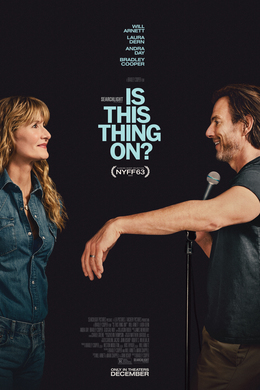
This will be a particularly subjective review of Is This Thing On? starring Will Arnett because I’m a Smartless devotee. That is the podcast that features Arnett, Sean Hayes and Jason Bateman. It’s my go to pod for snow shoveling. And also was my go to for flying before I was turned on to The Rest is History (The Abraham Lincoln two parter. So good. You. Have. Got. To. Be. Kidding. Me.) If you have never listened to Smartless, start with the interview of José Andrés, the celebrity chef and humanitarian. It’s inspiring and enlightening.
The strange thing is that since I listen to Arnett often, I almost didn’t want to watch this movie. If I’m into a podcast and don’t know what the hosts look like, I enjoy my imaginary idea of how they look. Do you do that? And so I thought, well this may be weird to see this person on the screen with the voice of Will Arnett. But I’m here to report that no such phenomenon happened. I was able to watch and enjoy this film without thinking about the podcast. Will Arnett did a great job creating the character of Alex Novak, a guy who’s down on his luck and finds salvation in stand-up.
That said, there were times when the real Will Arnett poked through. The football (Liverpool) chant in the restroom, for example. This would be a non sequitur if you didn’t know Arnett’s fandom. Though later, he wears a Liverpool T-shirt as he emerges from his bed. In these cases, the nod to Liverpool took me out of the story. Not because I dated a girl who was a Liverpool fan, I did, but because there is no reason given, no indication why Alex Novak would be a fan. Also, where does Alex Novak work? He is in finance we are told. That’s convenient but does he work from home? These ideas are tied because there is no backstory, if you will, no history for Alex, or life for him outside his pain and drama. Does this guy have a job? Is he a real person? Is he simply self-inflicting wounds and self-centered? For the audience, it’s tough because his marital separation is just as murky. The whys threaten to creep in and overwhelm the story. And if they did, the film would die in its tracks. Because we the audience would feel that at any point, Alex Novak, the trust fund kid and Liverpool fan, could simply fly himself to Saint Martin, or Sint Maarten for that matter, when things start to fall apart.
But these filmmakers are too savvy for that. Perhaps starting and ending with Director, Actor and Co-Producer Bradley Cooper. He knows how to keep an audience interested in a story and empathetic to the main character. Even one who gets on stage at the comedy club, sets his drink down on a table in the front row and says, “Don’t roofie me. …No actually roofie me. I would love to be roofied.” Frankly, I thought the depth of darkness in that line was genuinely funny. It gives profound insight into the loneliness of the character. And yet, someone who is reaching out to others. And it’s a reason I enjoy stand-up. A sphere where everyone agrees ahead of time, we’re all grown ups here. We are gonna vent and laugh, be vulnerable together in a way that may be acceptable in few other places outside of this club.
Laura Dern also drops in a heartfelt performance, filled with nuance. She and Arnett have a strong chemistry together that’s sometimes even stronger when they are at odds.
As a fan of stand-up, I enjoyed Is This Thing On? It felt like a great balance between the art of telling a story and the art of learning a craft like making strangers laugh.
One of my favorite directors, with Bugonia, Yorgos Lanthimos has done it again. However, D noticed that there are quite a few beheadings in this latest venture. Not surprising when you notice Mr. Midsommar himself, Ari Aster, produced. Aster probably gave the most input on how to fake blood realistically, the aforementioned headlessness and the customary face smashing with a blunt instrument. Why normalize Ari Aster? That said, Aster’s darkness counterpoints well with Yorgos’ typically deep exploration of human psychology, existential angst, stupidity, pathos — and the absolute tragi-comic essence of it all. That’s a lot to contain in a movie and I’m so glad that Yorgos goes for it.
Not to put too fine a point on the beheadings but D and I thought we would get a lot of those in 2016’s Ben-Hur, starring Morgan Freeman. It’s a gladiator movie after all. But no, they are all here in Bugonia instead.
Speaking of Bugonia, Teddy (the great Jesse Plemons — who could forget his recent turn in Civil War) has got a lot on his mind. His mother has a terminal disease and is in a coma, his neurodivergent cousin is thinking about starting a family, his co-workers are bending the knee, afraid to make waves. All the while he has cracked the code on identifying the Andromedans who have infiltrated our planet. But Teddy has a plan. He is going to fix all of this and save our species. He simply needs to have a sit down with the alien chief aboard their spacecraft.
As with anyone who has ever picked up a paintbrush, a pen or a camera — the artist has a reason. Even if the reason is not to decry violence or war but simply to make art for arts sake. Or perhaps just as simply to make a buck. There is a reason. What Yorgos is saying in Bugonia is really worth thinking about. Maybe a re-read of Andy Grove’s seminal business text, “Only the Paranoid Survive” is in order here.
Bugonia is intense, all the way through. It grabs you and holds you. You want to look away but you know you can’t. It’s partly a suffocating horror film (thanks, Ari!) with an epic score that lends to the gravitas. But it is equally a meditation on our shared humanity; on where we ultimately put our faith.
Editors note (L): We had been talking about scrapping the actual writing of this blog and simply video recording our post-movie debrief —which occurs on our ride home. But I’ve been balking since I have enough video editing projects in my life. And I like writing the blog, even though it means, ultimately, that less of the movies we see will get reviewed. On this trip, we had help from GB who suggested that we audio record our rant. I took it a step further, wondering what if we put our 4 minute rant into Google Notebook LM (Language Model aka AI). It turned around a 9 minute podcast with hosts Jean and Raj in about 2 minutes…maybe less! Weirdly, or maybe not so weirdly or maybe just scarily, it understood the context of these comments without any explanation from us. It understood it was a car ride rant right after a movie and went off from there. D did a great job editing this down for time and readability. So enjoy our first ever L&D Report AI generated guest blog entry. Guest contributors always get an L&D Report t-shirt. What size do you think Jean and Raj wear?
Editors note (D): …. starring Rami Malek, Laurence Fishburne, and probably some other people.
Jean: OK, so let’s talk about this idea. Like, how many times can a movie ask you to just ignore logic before you just throw your hands up and say, nope, I’m out?
Raj: Yeah, that’s a great question. And it seems like that’s exactly what happened with the listeners we’re focusing on today.
Jean: Right. We’ve got this really interesting source. It’s basically an informal audio recording. Some folks talking right after seeing a movie called Revenge of the Nerd (L&D had just screened The Amateur)
Raj: And just to be clear, not the 1984 comedy. This is apparently a very different film.
Jean: Oh, definitely. And our whole mission here is to kind of unpack their reactions, figure out why this specific movie just, well, failed to connect with them so badly.
Raj: It’s fascinating because it’s so raw, you know?
Jean: Yeah.
Raj: You’re getting their immediate thoughts unfiltered. It’s a really unique window into that audience experience.
Jean: Absolutely. And one of the first things that jumped out at me from their chat was this idea of a suspension of disbelief budget.
Raj: A budget, huh? Okay.
Jean: Yeah. You only grant a film so many moments where you have to consciously decide to ignore something unbelievable. And for them, with this movie, they felt that budget was just blown completely.
Raj: That makes a lot of sense. We all go into a movie willing to accept certain things, right? Fictional worlds have rules, but there’s a limit.
Jean: Exactly.
Raj: Too many breaks in that believability, too many wait, what, moments, and you just get fatigued. It pulls you right out.
Jean: Yeah, you stop being immersed. They even brought up what they called the Indiana Jones exception.
Raj: Oh, yeah.
Jean: The idea that some movies just seem to get a pass, you know? They can get away with way more unbelievable stuff. Why do you think that is?
Raj: Well, I think with something like Indiana Jones, the film signals its reality level right from the start. It’s heightened. It’s adventure with a capital A.
Jean: OK, so there’s an understanding up front.
Raj: Exactly. An unspoken agreement. Maybe Revenge of the Nerd, this one, either didn’t set its rules clearly or maybe it violated the internal logic it did try to set up. So the unbelievable moments felt jarring, not fun.
Jean: That tracks. Now, another big thing for them was predictability. They felt the plot was just completely obvious. Someone said, you already knew it was going to happen just from the revenge angle.
Raj: Hmm. Predictability. That can definitely be a drag on the experience, can’t it?
Jean: You think so. How much does that lack of surprise really matter?
Raj: Well, a lot of the fun of watching a movie is discovery, right? Finding out what happens next, if you feel like you’re always five steps ahead.
Jean: Yeah, it takes the wind out of its sails.
Raj: Right. You lose those potential aha moments they mentioned wanting. You become more of an observer than like an active participant in the story. It’s a real challenge, especially in genre films, to use familiar ideas but still make them feel fresh.
Jean: Keep you guessing somehow.
Raj: Exactly. You need that balance.
Jean: And speaking of not being invested, they really hammered the pacing, especially Act One. Act One took so long, someone said. Oof.
Raj: A slow start is tough. Yeah.
Jean: They even joked about getting confused, thinking maybe they were watching The Accountant instead at first. Which, I mean, that tells you how little it grabbed them early on.
Raj: Yeah, that first act is so crucial. It’s where the film’s supposed to, you know, set the tone, introduce who matters, what the stakes are, basically give you a reason to care.
Jean: To stick around.
Raj: Precisely. If it drags, you start checking your watch, you get restless, you lose that initial buy-in, even if things pick up later. It needs to build momentum, make a promise that the journey’s worth it.
Jean: And it sounds like, for these viewers, that promise felt pretty empty. They actually pointed to a specific moment where they felt it all just went downhill.
Raj: Oh, really? What was that?
Jean: It was when the main character, after blackmailing someone, apparently just decides, OK, now I’m going to go kill them myself.
Raj: Oh, OK. That’s a shift.
Jean: Yeah, their reaction was basically, that’s totally unbelievable. It’s amazing how one plot point can just shatter everything for a viewer.
Raj: It really speaks to character motivation, doesn’t it? And, like, logical progression. Even in a wild story, you expect characters to act in ways that make some kind of sense for them.
Jean: Right, based on who they are, what’s happening.
Raj: Yeah. And that sudden jump from blackmail to personal execution, it sounds like it felt completely unearned or illogical to them. And boom, there goes that fragile connection to the story’s reality.
Jean: Snapped just like that. They also seem to go in expecting something… Different, like maybe more of an action movie.
Raj: Ah, genre expectations.
Jean: Yeah, they felt this wasn’t really it. And the comparison they used was pretty brutal. A poor man’s Enemy of the State.
Raj: Ouch. OK, that’s telling. Enemy of the State suggests they were geared up for a certain kind of thriller, you know, tech, conspiracy, maybe some slick action.
Jean: Right.
Raj: And calling this a poor man’s version implies it just didn’t deliver on that level. Quality, pacing, maybe the thrills just weren’t there compared to what they expected. It really shows how important it is for a film’s marketing or even just its basic premise to line up with the actual movie.
Jean: Manage expectations, basically.
Raj: At least meet the expectations you set up.
Jean: Then there was, well, the ghost of the wife show, as they put it.
Raj: The what now?
Jean: Yeah. Apparently, a subplot involving the protagonist’s dead wife appearing. Their reaction was just universally negative. Pointless. Nobody bought it.
Raj: Oh dear. That sounds like a subplot that did not land.
Jean: Not even close, it seems. What happens when something like that, intended maybe for emotion, just falls flat?
Raj: It could be really detrimental. If a subplot feels forced or unbelievable or just unnecessary, it distracts from the main plot. Instead of adding depth, it just muddies the water.
Jean: Makes it feel cluttered.
Raj: Exactly. Or worse, unintentionally funny or just awkward. Sounds like this ghost wave thing felt like a total misstep that pulled them further out of the story.
Jean: Despite tearing it down pretty hard, they actually had ideas for how it could have been better.
Raj: Oh, like what?
Jean: Well, shorter runtime for one, maybe even cut most of Act One, a simpler plot, fewer bad guys maybe, and a more believable escape for the villains.
Raj: Okay, streamlining it.
Jean: Yeah, they specifically called out a very public kidnapping scene as being so unbelievable it sounds like they just wanted something tighter, more focused.
Raj: That makes sense. Taken together, their suggestions point towards wanting a story that was just more plausible within its own context. Faster pace, clearer conflict, and events that didn’t constantly strain credulity. That kidnapping scene sounds like a real breaking point for them.
Jean: A bridge too far. And maybe the biggest issue, which came up near the end of their chat, was the protagonist himself.
Raj: What about him?
Jean: They just couldn’t connect. Someone said flat out, you have to sympathize or empathize with the protagonist. And here, there was nothing really redeeming about him at all.
Raj: Wow. That’s tough for a film to overcome.
Jean: Isn’t it? How crucial is that connection, really? Do you have to like the main character?
Raj: I mean, not always.
Jean: Yeah.
Raj: But you need something to hold on to. Empathy, understanding, fascination, even. If you find the central character completely off-putting or unrelatable…
Jean: Why should you care what happens?
Raj: Exactly. It creates this huge emotional distance. It’s hard to get invested in the journey if you have no connection to the person taking it. I bet a lot of you listening have felt that, where you just can’t find anything to latch on to with the main character.
Jean: And it wasn’t just him. They pointed out they knew almost nothing about the wife he was supposedly avenging.
Raj: The ghost wife.
Jean: Well, the wife before she was a ghost, presumably. The only detail they could recall was that she goes to conferences for work.
Raj: Goes to conferences. That’s it.
Jean: Apparently, it just highlights how underdeveloped things felt. If even the core motivation, the wife’s significance, feels vague or underdeveloped.
Raj: It makes the stakes feel really low, doesn’t it? Why is he going through all this? If her character is just a cipher defined by professional conference attendance?
Jean: Yeah, it feels almost absurd.
Raj: It makes it hard to buy into the emotional core of the story. Those little details, or lack thereof, they add up.
Jean: So summing it all up, their final take was pretty scathing. Worst movie since Mother, one person said. Another thought it was definitely one of the worst of all time.
Raj: Pretty definitive judgments there.
Jean: Yeah. It really brings us back to where we started, doesn’t it? The whole deep dive was about why it failed, and it seems it was a failure on multiple levels for these viewers. Believability, pacing, plot logic, character connection.
Raj: And connecting this back for everyone listening, thinking about valuable insights, this conversation really highlights how vital that narrative contract is.
Jean: The unspoken agreement.
Raj: Exactly. Audiences need consistency. They need believable motivations, even in fiction. You push that too far, ask for too many leaps, make characters act nonsensically, you risk losing people completely, like these viewers were.
Raj: It’s a fragile thing, that suspension of disbelief.
Jean: Very fragile.
Raj: So maybe a final thought for you to chew on. What’s the movie that tested your limits the most? Was there one specific moment, one plot point, one character choice that just made you mentally check out and say, nope, not buying it?
Raj: And thinking about that, what does it tell us about that unspoken relationship, that delicate dance between the storyteller and the audience?
Just a Bit Outside is ostensibly about the Milwaukee Brewers 1982 World Series run but it’s really about how a city can fall in love with a team. In this case, a team of misfits who could simultaneously claim four future Hall of Famers.
The city of Milwaukee had a World Champion in 1957 when the Braves beat the Yankees. But the team broke the city’s heart when it skulked off in 1965, like so many manufacturing jobs, to the South to become the team from Atlanta. However, in 1970, the Brew Crew né Seattle Pilots arrived to bring baseball back to Milwaukee. …Too soon. The fans, once bitten, twice shy, weren’t in the mood. By 1982, the economic mood was dire. All of the breweries had closed down and the schlemiel schlimazel salad days were a thing of the past.
Interestingly, the start of the ’82 season was anything but auspicious. And the club was just about in the cellar. In the midst of this disappointment, a new manager was hired, Harvey Kuenn. Coach Kuenn was former player, a leauge batting champ no less. Maybe more importantly, he and his wife Audrey owned a tavern, Cesar’s Inn, a few blocks from the stadium. Both Harvey and Audrey tended bar. They lived in the back! And they had the players over for dinner and drinks at the tavern after every game. — I can’t even conceive of this situation in our day of multi-million dollar salaries for players and coaches. Coach Kuenn hated meetings. In his first meeting as new manager he said, “I have two things to say. Number one, I hate meetings. Number two, this meeting is over.” In his wisdom, he let the players play. He unleashed them and they produced victory after victory. A great lesson in getting out of your own way. How’s that for Zen coaching, Phil Jackson?
The real stars of Just a Bit Outside are the rabid Brewer fans. A lot of the b roll footage is from the many rockin’ taverns of the time. And the fact that the boys don’t ultimately win all the marbles doesn’t stop the fans from loving them anyway. The film makes you ask, “Is it possible that they even love them more?” When I was growing up in New Jersey, in the late 1980s, the Devils were a fun new hockey team. In fact, Wayne Gretzky infamously said they were a Mickey Mouse franchise. So they played with a chip on their shoulder. For the fans of course, being from Jersey meant already having a chip on your shoulder. It was a match made in heaven. When the Devils lost in the playoffs, we the fans went to the airport to greet them when their plane landed. We had bonded with the players, win, lose or draw. Just a Bit Outside captures that dynamic precisely, with great humor and emotion.
When I asked my friend F if he wanted to join me to see this film about the Milwaukee Brewers, he said in his typical to the point manner, “I am a Yankees fan!”. But after watching this movie about a specific team and year, I realized that this film could be enjoyed by any fan, anywhere. Personally, as kid, I started off rooting for the Yanks myself. Then when I moved West, the SF Giants. Followed by the LA Dodgers for my years in Tinseltown. I just did what the song said to do, “Root, root, root / For the home team”. But will I now, as resident of Wisconsin, become a Brewers fan? These words of wisdom were carried on the wind from generation to generation, from the bleachers of old Milwaukee County Stadium to the ears of one of the all-time Brewers greats, Bob Uecker, “Down in front!”. The Brewers 1982 season proves that nothing is impossible.
A Man Called Otto is an old school After School Special for adults. Handily Directed by Marc Foster of Quantum of Solace, Monster’s Ball and Finding Neverland fame, the film never feels like it’s breaking new ground, yet each vignette carries the story along. I found myself entertained from moment to moment and before I knew it, the ride of Otto was over. Interestingly, some of the imagery and situations that were depicted have stayed with me, even several days after watching the movie. There was a lot to process though at the time everything seemed innocent enough.
The inclusivity aspects of the story at times feel forced and stretch to the point the story enters, “suspend your disbelief” territory. And so we are simultaneously and ironically once again looking at the white savior narrative trope. Yet overall, the film works. It’s because the audience wants it to work. A lot of this has to do with Tom Hanks. In this film, thankfully, he doesn’t start out good, continue to be good and end good. Don’t remind me about Sully. The Otto character has a great narrative arc. When the classic curmudgeon says, “I’m not unfriendly”, it’s a laugh out loud moment in the theater. This film delivers several of those. And the supporting stories: the immigrant family, the insidious real estate speculators, the stricken and neglected neighbors, even an abandoned cat! They all work in shoring up the main narrative; how Otto got to be this way and what can be done about it.
The more I think about it, the more I really enjoyed this film. It sort of develops this fantastic world but there is a lot of truth in it and in what it’s ultimately trying to say. Your life isn’t over unless you think it is. And in life, empathy can take you much further than bitterness. I hope you all get to catch this one.
I had always heard of the films of WKW but his oeuvre lived in a blind spot in my viewing. Recently the Criterion Collection released a box set of his films on Blu-ray. The visual style of the films are lush. The dark colors are heavy, crushed. As a viewer you are completely sucked in. Not dissimilar to an experience I had sitting in front of a Rothko for 25 minutes in the Seagram Murals room or what I call the Red Room of the Tate Britain in London. It’s mesmerizing, transcendent and a little scary. You need to re-calibrate to reality afterwards — but it’s never quite the same. In the case of WKW, now you know how beautiful a film can actually be.
The collaboration of WKW and Cinematographer Christopher Doyle is now legendary. Doyle, an Aussie who lived in Hong Kong and spoke fluent Cantonese worked hand in glove with WKW. He is featured prominently in behind the scenes documentaries in the Criterion set. However, years ago I had seen a BBC doc in which he walked the audience through Hong Kong. Describing how, for example, certain streets or lights from buildings inspired his style. It’s not surprising that in both directing and cinematography the craft of these films is derived from the surrounding world. Consider that the inspiration for one film, Happy Together, came from a lamp that long time WKW Art Director and Editor William Chang found at a local shop in Buenos Aires.
Which leads us to WKW’s directing style. As Western filmmakers, at my grad school, UCLA and in my own role as a teacher, I have always followed the rule, been told and taught that the script is the Bible. And on large productions this holds true. All the department heads look to the script to help find clues to or straight up answer questions. No stranger to this method, WKW had 50 TV & Film screenwriter credits before he directed his first film. But his own directing method is antithetical to this. He works 100 percent from improvisation. It takes many months to complete his films. The actors have time to sink into their roles, costumes, movements — their world. Curious about this method, also shared to an extent by Wenders and Fellini, I tried it myself on my last film. The way to pull it off is to be working with smart actors who have great ability to pivot depending on what’s happening. Actors with great intuition and ability to go with the flow. Sure, there are adjustments from the Director, notes. But setting the scene, creating the environment, is the main job of the Director when working this way. WKW was certainly one of the most successful —and intense— Directors to achieve results with this method. Combined with the visual style, he tapped into raw human emotion and created a parallel reality in front of the camera.
— If you’d like to experience this reality firsthand, then head over to The 602 Club in Appleton, Wisconsin. I’ll be screening In the Mood for Love on Blu-ray on Friday, January 13th.
I watched most of CODA (Children of Deaf Adults) with a lump in my throat. It’s such a moving and emotional work and such a genuinely funny one at that.
I could tell the people next to me where crying (No, not D and Dr. B…the people to my other side) and that was totally understandable.
Even though there is an obvious ending it’s really not about the destination at all. The journey there is so profound and harrowing for Ruby Rossi (Emilia Jones) that you get lost with her at every twist and turn.
The role of Ruby’s dad, Frank, is played so utterly humanly by Troy Kotsur it also garnered him an Oscar, along with this film for Best Picture. Again, I’d emphasize the humor in this film. It’s not above a good fart joke. Or Tinder joke for that matter. As much as you’re rooting for, hoping and getting caught up in the raucousness of this family, you are laughing along with them the whole way.
Eugenio Derbez gives a multi-layered turn as Choir Master Bernardo Villalobos. Oscar winner Marlee Matlin also stars with a strong performance as the mom, Jackie.
It’s one of those films that makes you think about life, how you got where you are and how great a privilege it is to struggle. It transcends the screen and I highly recommend it.
Nightmare Alley brings the star power: Bradley Cooper, Cate Blanchett, Rooney Mara, Toni Collette, Ron Perlman, David Strathairn, Willem Dafoe…I could go on. And in Act I, it does a great job creating dramatic tension, with an intensely cinematic take on a Midwest carnival in 1941. A circus where side shows are the main event and the animals are human. This part of the film wonderfully weaves directing, acting, screenwriting, art direction, cinematography, hair, makeup, wardrobe, special effects — the whole shebang —into an intriguing portrait. The homages fly: Days of Heaven, Strangers on a Train, La Strada, Wings of Desire…and yet it also seems all its own.
But then ACT II happens, and the waves of tension and intrigue flatline.
By ACT III the film is a mockery of itself and a bathroom break is in order.
This is the 5th year of the LnD Report and if you look through the archive you’ll find many circumstances where the sum of its impressive parts didn’t achieve the total of a great film. What went sideways in Nightmare Alley? As D pointed out, the foil is not strong enough, particularly in terms of motivation. Also, by the time of the denouement, there are no characters for the audience to care about. The most interesting characters are left far behind. As one example, Willem Dafoe has more of an opportunity to show his dramatic range in Spider-Man: No Way Home, than he has playing Clem Hoatley, the carnival boss and geek wrangler in Nightmare Alley.
According to our friend F, the 1946 novel is much better. So that would be worth checking out. I was also reminded of a great title I read in a previous life, Katherine Dunn’s Geek Love. Or simply pop in a DVD, Blu-ray or stream Tod Browning’s 1932 masterpiece, Freaks, if you are jonesing for an emotional carnival drama.
— Cutie and the Boxer, a documentary now on Netflix.
In a New York City studio, an 80 year old artist does his work.Ushio Shinohara puts on swimming goggles and boxing gloves adorned with sponges and produces another “action painting,” dipping the sponges in a bucket of black paint and boxing at a giant canvas while his wife, Noriko, more than 20 years his younger, takes pictures.
She helps him weave cardboard and attach it to a giant sculpture he is trying to finish and hoping to soon sell.“You can tell, she doesn’t really want to help,” Ushio says.“She is just an assistant.The average one has to support the genius.”
But when we finally see Noriko, quiet and alone, bent over a drawing, we learn a different story through the character of Cutie with her twin braids identical to Noriko’s.“I’m always naked,” says Cutie, “because I am poor.”She comes to New York as an eager and ambitious young art student.Cutie meets Bullie at a gallery and is awed by his unusual art.He gives her studio space for her own work.Six months later she is pregnant with their son.
Filmmaker Zachary Heinzerling creates an intimate portrait of this complex marriage, both supportive and competitive, through close-up shots of the artists’ daily lives intermixed with animations of Noriko’s drawings. “Love is ROARRR!” Cutie says, attacking Bullie.
When the gallery owner who is going to host Ushio’s show comes to the studio to see his work, Noriko is prepared and quietly asks if he would like to see her drawings.He is impressed and invites her to be a part of the show.When Ushio sees the show catalog, he can’t believe it, that it opens talking about famous artist couples.“What the hell?” he says laughing.“That’s crazy!”
When Ushio is gone, Noriko feels calm and quiet.But when he comes home, she runs to greet him.She has compromised her art for him.And yet, she knows it is her struggles with him from which her art has grown.
Set to a beautiful soundscape by Yasuaki Shimizu, this delightfully contemplative film shows us the difficulties of love and ambition and asks us to take a closer look at the compromises we all inevitably make.
The Rhythm Section really caught my eye with some nice Steadicam moves and jaw dropping landscape shots thanks to the handy cinematography work of Sean Bobbitt. This film has great scope as we travel along Stephanie’s trail of violence throughout the world, including a unique car chase in Tangier. I also enjoyed the shot selection and style of director Reed Morano. And though The Rhythm Section hit many clichés it was still a mostly enjoyable ride due to the serious talent of one Blake Lively. For a genre crime film this is a powerful performance. It starts out intense and it ends that way — and don’t you forget it.
The film has many merits. Jude Law convincingly plays a former British spy forced to turn into trainer of lethal force. Aside Warning — Why is it the training scenes in films are always more compelling then the following events?…Full Metal Jacket, Rocky, etc. — Regardless, the drama is carried deftly by Lively and Morano. This film was extremely human for one with several car bombs. That’s a nod to novelist Mark Burnell, who created a compelling character that has to learn difficult lessons about vengeance. The Rhythm Section doesn’t have the sustained visceral energy of some other kick-ass woman films like Besson’s Anna or Lucy but it still carries you along on other stylistic and emotional levels. It certainly easily passed the Tuesday 5 dollar bar at our local cinema.









 L&D Report
