Shogun

A guest review by music writer and performer Mr. Ian Moore, who by his own admission is, “prolly banned”.

A powerful woman bows before a home shrine, the mood reverent and gentle.  A samurai enters and meticulously prepares his estranged wife a small matcha tea, which she drinks and ceremonially compliments his performance before refusing his offer of reconciliation.  Such are the illustrative vignettes created in “Shogun,” the Sengoku period Japanese epic now streaming on Hulu. Meditative, rainy landscapes, rituals, and trials form the main action of the plot; but not to worry, plenty of heads get chopped off and the occasional ship race, battle, or wreck erupts in high-budget glory, courtesy of the James Clavell novel that “Shogun” is based on. 

The two main characters are struggling against the Osaka council’s takeover when a mysterious British naval pilot is captured attempting to open up trade with Japan, now monopolized by the Portuguese.  Lady Mariko and Toranaga are trying to save Japan from tyranny and are constantly on the run back to Edo, a smaller fishing village, keeping them in sight of the British ship and the warlord who graphically boiled alive one of the British crew, though now he’s ready to enjoy some of the good saké while plotting to make Toranaga the Shogun, the military leader of Japan. The marooned Blackthorne has an uncertain mission but quickly makes himself indispensable to Toranaga as leverage against the council while developing a relationship with Mariko, who interprets for him having been taught Portuguese by the scheming Catholic priests.  The depiction of women in “Shogun” reflects a deeply repressive society with a rigid role-based hierarchy but subverts this system occasionally with female power moves and notably when a madame eloquently uses a bartered moment with the leader to request that he set aside a large district in his capital city for retired courtesans.  More unexpected business filled some episodes: a conniving small town warlord is shown to be pretty kinky and the plot often revolves around not violence, but Toranaga or Mariko gaming the complex political world to outwit the council in unpredictable ways.

Throughout the ten hour series, the mise en scene is almost another character, we’re forever coming upon the samurai staring out into the rain like moody teens – it’s heavy when the fate of the empire is on your gorgeously robed shoulders. Each character wore iridescent fabrics with geometric, jacquard knots – even in the remote village where dry cleaning must be outrageous! If someone happens upon a noble warrior in such a moment, then it’s time for impromptu Haiku. Characters would go back and forth composing a poem together until one is overcome by the elegance of the others’ imagery and submits. Or, as another friend said, “that show is boring,” but I like a good poetry slam and the soundtrack is just perfect – composed by half of the Grammy-winning duo that scored ‘The Social Network.’ I just loved how complicated the characters were, often double-crossing each other and employing tricks of etiquette to wrongfoot their opponents. It’s a war movie, so that might not be your thing, cannon blasts and swordplay are maybe 1/5 of the film. Also: tons of subtitled talk of keeping your third heart hidden and building an eightfold fence in your mind; but the sex was really sexy and the blood spurty, so there’s something for the whole family!
Stop Making Sense

Our guest reviewer, Sharad Shanbhag, plays keyboard & guitar for the rock band The Beams.

I was 13 years old in December of 1983 when Stop Making Sense was filmed. I knew the Talking Heads existed, since “Once in a Lifetime”, “Psycho Killer”, “Life During Wartime” and “Burning Down the House” were in rotation on FM rock stations in the NY metro area where I grew up but wouldn’t say I was a fan in those days.  So, I have no real memory of the film’s initial release in 1984.

Fast forward to 1989. By this time, I am a fan of the Talking Heads. Remain in Light remains a fixture on my turntable in my dorm room for weeks. I’m discovering the African influences on their music. And I finally watch Stop Making Sense on a rented VHS tape and, if memory serves me correctly, it gets screened at my college at some point. Looking back, I recall the film being absolutely entrancing while also wishing that I’d had the chance to see the band live.

The recent release of a new digital transfer of the film for its 40th anniversary allowed me to both go back in time as well as marvel at just how well the director, Jonathan Demme, captured a band in its prime. And what I hadn’t realized when I was younger was the sheer joy the band displayed in creating music. The core of the band – Byrne, Harrison, Frantz and Weymouth – are clearly immersed in their performance. And you see just how much fun they are having with their interactions with the musicians brought on their 1983 tour – percussionist Steve Scales, guitarist Alex Weir, vocalists Ednah Holt and Lynn Mabry, keyboard player Bernie Worrell. The group, having rehearsed and toured with the material for the better part of the year, is in top form.

You don’t see the audience that much, apart from some shots at the start and end of the film. The effect is that you, the viewer of the film, feel as though you are the audience (with a much better view of the onstage action than if you were in the venue in 1983). Perhaps it is a bit of the pandemic hangover, but I found myself experiencing the same regret at not having seen the band in person during their heyday. It highlighted the communal aspect of creating and experiencing a musical performance that cannot be underestimated. Stop Making Sense is as close as you’re going to get to seeing the Talking Heads live, and it is not much of a compromise. Go see it in a theater if you can. You might find yourself dancing in the aisles with other fans as you are caught up in the fun “onstage”.

The Whale

Too scared to venture out on our own, L&D turns to a guest reviewer from our friend and Reuben expert, Tommy Bergler, soon to be proud owner of the coveted L&D tee!

In these days of escapism, the Marvel Cinematic Universe, Baz Luhrmann, and the insane CGI of Avatar, whichever version we are on, Darren Aronofsky brings a different view.

The first film I saw of Aronofsky’s is Pi, and just let’s leave it at his is a special oeuvre, to be savored at the right time and with the right people, and with a certain expectation. His work is not light. It is not flighty. It is not a cream puff of a film, to be swallowed and for the sugar rush to give you a pleasant warm hug all over. Aronofsky flays you. He turns you upside down. He isn’t afraid to dig in.

To truly see how challenging he can be with your vulerabilties, and make you uncomfortable. I noted that when the lights came up on The Whale, the audience I was with, all middle-aged white Brooklynites from Park Slope, Ft Greene, and Dumbo, got up and left and there were a smattering of what I distinctly heard were really uncomfortable laughs.

To say that this was Brendan Fraser’s greatest cinematic performance is an understatement. I remember watching Fraser opposite Pauly Shore back in the 90’s as an unfrozen Cro Magnon specimen in modern day Encino (Encino Man was the title of this great film), and this film shattered all opinions I previously had of Fraser.

The Whale is set in Idaho in the late fall of 2016, when Fraser, who portrays a brilliant though mortally emotionally damaged, kind, and sensitive man named Charlie, who realizes he is quickly dying, and seeks to reconcile with his estranged daughter Ellie, played by Sadie Sink (Stranger Things). Along the way, this ensemble piece, originally written as a play, shows us the relationships Charlie has with his friend Liz (Hon Chau), who is also a nurse, and who is his closest friend, as well as Thomas (Ty Simpkins), a complex young man with some familial estrangement issues.

Look, there are moments in this film when I was desperately uncomfortable and even disgusted. Aronofsky has a talent for challenging the audience. But I was prepared for what I was going to see, and I enjoyed it. My wife, however, was not amused nor entertained. So let me just offer that it’s not necessarily a “date night” movie. The play — yes, it’s a film, but really, it’s a play — takes you on a psychological journey through the valley of despair but rest assured that Aronofsky doesn’t leave you there in that chasm, there is redemption “at the end.” So go see it if you’re interested in taking that journey and see a tour de force performance by the actor previously known for playing Tarzan the Ape Man.

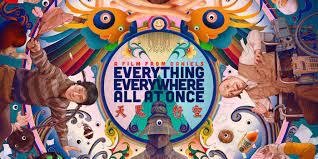
Everything Everywhere All at Once

Another awesome guest review from artist & friend of the L&D Report, the ever-esteemed, Joanna K. Dane.

What a delight to see at the theater, a movie as odd and daring as Everything, Everywhere, All at Once

First, there’s Evelyn, played by Michelle Yeoh, a woman caught in a mid-life rut of hard work, high expectations, and daily proof that her husband is silly and useless; her daughter, endlessly difficult.  How did she turn out to be such an ordinary woman, washing other people’s clothes, after so many big dreams?  A failure, just like her father says.

Here she is at the dining room table, worrying over stacks of receipts. Not only is their struggling laundromat being audited by the IRS, but Evelyn’s father is visiting from China, and her daughter has just arrived home from college with her new girlfriend. 

Evelyn needs to focus, but she has a spitting headache and keeps getting distracted by very odd visions.

Haha!  It’s Jamie Lee Curtis playing the evil tax auditor who wears orange polyester suits that highlight her belly fat.    

Evelyn’s husband, Waymond, played by Ke Huy Quan is mousy and silly and sweet.  In this universe.  But in another, the universe where they didn’t get married, but went their separate ways, he is suave and rich and charming.  

But Evelyn’s journey is so much more than a marriage story.  There’s the universe where she is a chef with a chef who wears a raccoon under his hat.  There’s a universe where she is a kung fu master.  A universe where she is traffic cop.  A universe where she is a maid for a sleaze bag who’s into S&M, a universe where people have giant hotdogs for fingers and Evelyn and the tax auditor are lovers.  And her favorite universe, where she is a world famous singer.

It’s a mother/daughter story and a father/daughter story, and a story that blurs the line between dream and reality, between failure and success.  It is a kung fu story and a story about the nature of our minds.  It’s a movie that breathes and dances and pulses with life.  A dazzling feat of editing and sound.

And there’s the realization that Nothing Matters.  And the black hole that’s shaped like an everything bagel.  And the fanny pack kung fu scene in the IRS office.  And the dazzling costumes worn by Stephanie Hsu playing Evelyn and Waymond’s daughter Joy, who, it turns out, is also the villain of the multiverse. 

And the line, “I would have loved to have spent a life with you doing laundry and taxes.”

And there’s the long silent scene where mother and daughter are rocks in a lifeless universe.  

A scene so long, you start to wonder, is it going to end like this?

The Green Knight

What follows is a guest post from the Good Doctor himself. For a Stoopid American, he sure knows a lot about English literature!

Dark: And so Sir Gawain sets off, traversing forests and mountains to find The Green Knight, where he meets a talking fox who warns him: 'You will find no mercy, no happy end'

The Gawain doctor is in—and like most doctors, he’s running a little behind.

I should probably start with the patient’s question, which was about how faithful Sir Gawain and the Green Knight is to the 14th-Century poem of the same name. It’s not particularly faithful, but since we’re not 14th-Century readers, that’s not necessarily a bad thing. It is deeply engaged with the original poem in ways that are probably more interesting than would be the case in a more direct adaptation. Knowing the poem will give you a framework and additional material to think about, but it won’t “explain” the film or leave you with nothing to do but listen to some English professor carping about what the director misunderstood or didn’t get right.

The original poem explores the themes of courtesy and mirth, reflecting on how a society genuinely inspired by the medieval Christian understanding of those virtues might operate (and on how the actual medieval world falls short). David Lowery’s movie has almost no mirth, and courtesy always turns out to be a deceptive mask (as it sometimes is in the original as well). It feels more like the world of Beowulf or Game of Thrones than the refined and civilized world of the movie’s source material.

Fittingly, Lowery’s Sir Gawain is a flawed everyman rather than an innocent embodiment of courtesy. He has a hooker-with-a-heart-of-gold girlfriend, and his drunken excess is always set in a brothel or a tavern to distinguish it from the equally-inebriated, Christian-sanctioned mirth of the original poem. I think this revision is probably designed to make Gawain a relatable character, allowing modern film-goers to identify with his trials and tribulations over the course of the film, in much the way that medieval readers were invited to identify with the courteous but inexperienced Gawain of the poem.

At the same time, Lowery nicely captures the sense in the original poem that things are rarely as simple as they seem, and that forces at the edge of our understanding—if not entirely beyond it—are at work shaping the course of events and giving them meaning. His approach is more in the form of a fever dream than the subtle and teasing allegorical undertone of the original poem, but it feels properly medieval in its rejection of naturalist or realistic plot in favor of symbolic or allegorical meaning.

There are definitely easter eggs for readers of the original poem. There is a brief mention of the five virtues, an important set piece from the original poem in which Sir Gawain’s shield is allegorized for its “endless knot” pentangle front and painting of Mary inside. When that shield is cracked and destroyed in the opening episode of his journey, it confirms what you had probably already guessed about how far those medieval virtues would get you in the movie’s world.

The film also follows the basic structure of the original poem: the Green Knight’s visit to Arthur’s court, fast-forwarding to Gawain’s departure a year later, a Christmas over-nighter at a mysterious castle, and a final conclusion of Sir Gawain’s “game” with the Green Knight. Readers familiar with the poem will find significant resonances with the critically important castle episode immediately prior to that final encounter, and may be particularly interested in the decision to cast the same actress as the hooker-with-the-heart-of-gold and the lady of the house.

The final confrontation with the Green Knight is as confusing and counter-intuitive as in the original, but works to a different end. My own reading is that, where the original invites the recognition of our fallen nature in even the most virtuous of Christian heroes, Lowery is more interested in revealing the systemic injustice of patriarchy. Ironically, Lowery’s Gawain must pass his test if he is to succeed, whereas the 14th-Century Gawain can become a hero despite his all-too-human failings. But there is plenty of material (friendly robbers, lady ghosts, talking foxes, earth giants) to fuel other interpretations, which is one of the things that makes this movie so rewarding.

If you can figure out what those creepy giants are up to, you’re a smarter reader than I am. Len tells me that they’re Czechoslovakian anime, and who am I to disagree?

The Forty-Year-Old Version

A special guest review to the LnD Report by Joana Kosowsky Dane

After reading half a sentence about the film “40-Year-Old Version,” I knew I needed to see it.  

Radha Blank plays herself, missing her dead mother, unable to return her brother’s phone calls. She is chronically late to the after-school theatre class she teaches where one of the girls, frustrated with Miss B’s indifference to her heartfelt spoken word, calls her washed up, a fake. It stings more than the girl knows.  Radha had higher expectations for her art, no doubt.  Her name is on the 30 Under 30 Playwright’s Award that sits among the clutter on her dresser.  But now she’s 40, with that all-too-familiar reality facing aging artists: What do I have to show for this life I’ve lived?

Filmed in black and white, we follow Radha on a journey through New York – Harlem and the Bronx and a brief foray on Broadway – the camera in close, capturing all the details of her pain and her comedy.  She glances at the camera and we know exactly how she’s feeling about D, the guy who lays down beats for anyone willing to bring him a bag of weed; or about J. Whitman, a famous producer who is willing to give Radha a big break but only if she compromises the integrity of her play by turning the characters into racial stereotypes.  

What’s an aging artist to do?  

Interspersed are color photographs explaining years of back story in a single flash (like the one of Radha and her gay agent, dancing together at her high school prom); and postcard sized snippets of interviews with characters from the neighborhood giving blunt and hilarious commentary on Radha’s middle-aged life.  

She’s down, but not so far down that she can’t grasp inspiration when it strikes, rapping one afternoon about all the ailments that come with being 40.  “Why my ass always horny? Why I always gotta pee? Why a young boy on the bus offer his seat to me? Why my skin so dry? Why am I yawning right now?  Why them AARP niggers sending shit to my house?” She catches the ear of the elusive D who invites her to perform her piece Poverty Porn at his next showcase.  She fails hard.  But we see what the past 10 years have taught her, a resilience that comes when an artist keeps creating despite being crushed and ignored.  

D takes her on a long drive, to a Queen of the Ring competition where 4 women battle with their rhymes in a stark boxing ring.  Radha is awed by their raw power and their courage.  They show her how it’s done, and in turn, she shows us.  Keep doing, stay brave. 

Radha goes to see her brother.  Trying to figure out what to do with one of their mom’s numerous paintings that neither have room for, her brother says it will just have to go into storage.  “Wow. You come here with a dream, and your work ends up in storage,” says Radha, a pitiful conclusion to an artist’s life.  Her brother sees it differently.  “She did what she wanted. She was a teacher, a curator.  She chanted, she traveled, she did some art.  She lived a life.”  Her children, their mother always said, were her greatest creation.

Radha realizes the reward is not in the big production, but in the much smaller daily task of staying true to her art.  And when she does, she wins the admiration of her theatre students, though she won the viewers’ admiration long before that.  

Lady Bird

LadyBirdPoster

A special guest review to the L & D Report by Joanna K. Dane of                           A Terminal Case of Whimsy.

****************************

A few things about Lady Bird.

It passes the Bechdel Test in the opening scene: A middle aged mother and an 18 year old daughter weep to the closing lines of John Steinbeck’s Grapes of Wrath.  They have a moment. Then the daughter turns on the radio and the mother turns it off asking can’t we just have some silence?  Do we always have to be entertaining ourselves?

A sketch that immediately illuminates their relationship.

The daughter insists her mother call her Lady Bird and dreams of moving to New York.

The mother berates that she’ll never get into Columbia, that she has a terrible work ethic, scolding her for leaving her clothes lying on the floor, for being insensitive that her dad just got fired, and that everything they do they do for her.

The father is empathetic and flawed, complexities even in the minor characters.

Lady Bird hams up the audition for the school musical and then is shocked she only gets chorus.

She falls in love with the leading man, a rich kid who breaks her heart, and then loses her virginity to a jaded boy in a rock band who reads Noam Chomsky and Howard Zinn.

There’s the touching scene when the beloved theater teacher cries.  And a hilarious one when the captain of the football team takes over as director.

And in the end, we feel the most empathy for the character who is the most difficult to empathize with.

That’s some great screenwriting.

And it’s an ode to Sacramento.