The Iron Claw

I initially stayed away from The Iron Claw because it seemed to be a sports satire à la Will Farrell in Semi-Pro. But as the other $6 Tuesday offerings at Marcus Cinema got dimmer and dimmer, the spotlight on The Iron Claw intensified. A strong nudge came from my friend Bob, a former Incredibly Strange Wrestler in San Francisco and host of the insightful and hilarious podcast, “Old Movies for Young Stoners”. After this, I read that the film was based on a true story, also intriguing. The Metacritic score, for whatever that’s worth, was off the charts. I was finally ready to give The Iron Claw a chance. 

As a child of the 80s I was as geeked up as any kid about pro wrestling, using living room furniture to springboard on an already subdued opponent and land a victorious pin. However, I had never heard or at least not remembered the Von Erich family. Their story had an eerie familiarity but was still obscure to me. Some words I’d use to describe The Iron Claw are unsettling and disturbing. It at times elicited in me feelings of a horror movie like Final Destination or Midsommar. The drama suffocating, every early scene recognizable as foreshadowing, all the fun and games leading to inevitable disappointment if not demise. However, the film never goes full Aronofsky, who I’ve said, should really clean up his shock directing schtick. The Iron Claw never feels like it’s putting the audience through an emotional grinder just because it can. It always feels like it’s telling you an improbable yet simultaneously plausible story.

The questions provoked by the film included, how do you define bad luck vs ill fate? Free will vs determinism? Self-sabotage vs destiny? People have been debating these questions since before the Greek stoics codified them thousands of years ago. And leaving aside the theological conundrum that if the creator knows all, including what you will do with your so-called free will, do you even have it? Determinism could simply be related as, if you engage in high-risk activities then chances are greater that you will have poor outcomes. You could blame it on bad luck or fate. Or you could stop wrestling, as friend of LnD, B, who sat next to us, kept yelling at the screen. All to say, this film fulfills one of the criteria I have for a good film, that it’s thought provoking. 

Another movie that The Iron Claw reminds me of is the great, I Tonya. A story about a struggling family, graced with immense athletic talent, that’s pulled by dark forces around them. The difference here is that the dark force emanates from within and spreads like a low speed lava flow, slowing destroying everything in its path. Holt McCallany is rightly cast as the patriarch who leads his flock into a metaphysical desert. And I found Zac Efron’s performance compelling as he traversed love and tragedy. I was at times as frustrated by the choices of his character, Kevin Von Erich, as B was. However, I could understand his case of Stockholm syndrome and feel sympathy for these brothers who were convinced they were on a righteous path. A notable performance was turned in by Aaron Dean Eisenberg who was totally convincing as an unhinged yet sympathetic “Nature Boy” Ric Flair. He steals every scene he is in. 

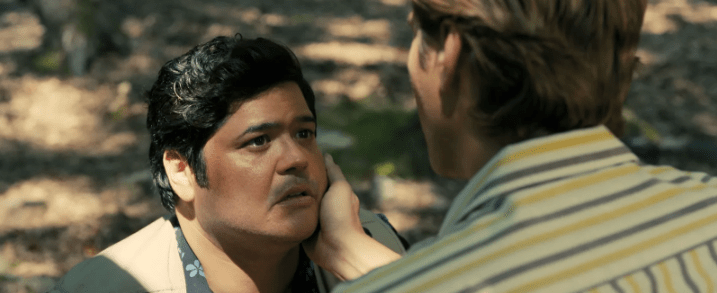
I should add, there is plenty of fun in this film, scream at the screen and laugh out loud moments to go with the intense drama. Watching someone’s head get dragged along the top rope will produce some reaction from you, one way or the other. Both D and I found the scene that brothers David (Harris Dickinson) and Kevin (the aforementioned Zac Efron) share with a toilet bowl mesmerizing and funny at the same time. 

If you’re interested in a well-crafted film, with strong performances, that will take you down memory lane while instigating self-reflection on a few of the Big questions, I highly recommend The Iron Claw to you. 

It will drop kick you in the solar plexus in the best way possible. 

Ferrari vs American Fiction

Although Ferrari and American Fiction are ostensibly each about difficult families, these two films couldn’t be further apart. After hearing an interview with Adam Driver, who plays Mr. Ferrari, I broke my own rule and went into that movie with high expectations. Driver described how director Michael Mann was so into detail that he would put nine microphones on a car to get the exact sound. That may be true, but great engine revving sounds don’t excuse the many sins of this forgettable, formulaic film.

My first issue is with authenticity. Why did all of the actors have to speak in English with bad Italian accents? The only person who really pulled this off in any way was Mr. Driver. A combination perhaps of his undeniable talent and the fact that he doesn’t speak so much. When Shailene Woodley tried this trick, I had the visceral reaction of hearing nails on a chalkboard. Instead of making me think that this was an Italian story, I just kept thinking, “Why are all these actors speaking English so poorly?”

It didn’t even seem that Penélope Cruz tried, instead relying on her natural Spanish accent. That didn’t work for me either. I heard Sean Penn praising her performance recently and had to wonder if he had seen the movie at all. Cruz does play her part admirably but the entire time I was thinking, “Isn’t Penélope Cruz a great actress?” She cried and screamed and shot a gun in this flattened melodramatic one note of a character, trapped in two dimensions.

After an illustrious career, it may be time for Michael Mann to hang up the directing megaphone. Especially if he is going to be phoning them in. Even the racing scenes, which had their moments, didn’t expand on the cinematic style we saw in Ron Howard’s 2013 film Rush, starring Chris Hemsworth. Meanwhile, one of Mann’s contemporaries, Ridley Scott, convincingly pulled off Napoleon this year. I enjoyed that film. But we were given a heads up by our friend F to read Napoleon as a comedy. And it was funny. Including plenty of slapstick. Maybe Mann was just taking everything too seriously? 

Unlike Mann’s portrayal of the Ferrari famiglia, the characterization of the Ellison family of American Fiction is far more nuanced. The film, based on a Percival Everett novel, explores the loyalties, alliances, jealousies, secrets and not-so-secrets amongst the parents and children, who have a difficult time simply communicating, showing vulnerability.

Although the children are each ‘doctors’ (a GP, a plastic surgeon, and a professor), professional achievement doesn’t necessarily translate into familial harmony. Indeed, according to the youngest son, Cliff (Sterling K. Brown), “This family will break your heart.” Cliff delivers the line as he makes his way to a taxi in the rain, having had his own heart just broken in at least two different ways. And the line and sentiment just hangs in the theater, sending a chill down your spine.

The drama unfolds with a focus on the precarious trajectory of Cliff’s brother, Thelonious “Monk” Ellison (Jeffrey Wright). Monk is a professor and a writer, who takes a leave of absence in Boston to work through some professional and personal issues. A dominant issue for Monk and for the film is trying to navigate the increasingly opaque state of American race relations as a Black American.

Remarkably, this all adds up to being an at times fun movie. The laughs are inspired from a wide spectrum of humor including awkward situations and biting social commentary.  

D brought up one of my favorite movies in relation to American Fiction, Robert Townsend’s classic Hollywood Shuffle. I remember working as a camera assistant on a TV series called South of Nowhere. The directors for the series changed for each episode, and one week the great Robert Townsend took the helm. I remember that he was always whistling or singing. He seemed happy, like a man with a song in his heart. In Hollywood Shuffle, Townsend used humor to capture the pain of black people who are not taken seriously as actors in stories other than those solely depicting stereotypical, impoverished, ghetto scenarios.   

I thoroughly enjoyed American Fiction. Like the novel, it plays in a realm of metanarrative, it deals with current social issues with humor, care and poignancy. But like any great movie, the characters become alive, the characters become real. The alchemy of the written word synthesizing with inspired performances is magic to behold. I hope you can get to the theater and check it out.

Poor Things

There are two things L&D want you to know about Yorgos Lanthimos’ Poor Things, out in theaters just in time to disrupt your holiday season.  

First off, it is a masterpiece.

Second, it is not for everybody.

In fact, it might not be for most people.  It is full of sordid characters, blasphemy, torture, maiming, dismemberment, houses of ill repute, objectionable animal husbandry, live-action surgery, graphic sex, and a lot of things that could be dealbreakers for you that possibly didn’t even register for me.  And in many cases what is implied in the script is even worse than what we actually see on the screen.  I admit to some squirming throughout and covering my eyes and wincing at least twice.  It is probably not a great holiday movie choice for you and the kids.

On the other hand, the production values are extraordinary, at least three movie stars are at their best (or better), and the story is cerebral in more ways than you can count on one hand. 

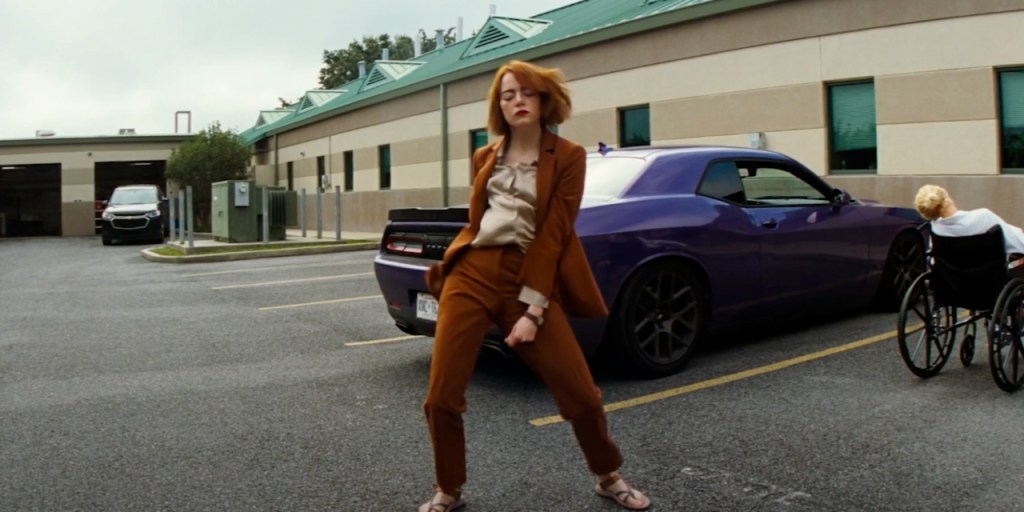
The movie begins with an in-color shot of Emma Stone taking a nosedive off a bridge and into the drink.  What follows is not a flashback, but does initially revert to black-and-white with Stone awkwardly walking, playing, eating, urinating, etc… in a cognitively primitive state.  She is within the confines of the home of a heroically patient yet grotesquely disfigured Dr. Godwin Baxter, played by Appletonian Willem Dafoe (!).  “God”, as his inner circle immodestly addresses him, is a pure empiricist — a surgeon or a man-of-science of some sort.  

L&D were huge fans of Emma Stone’s performance in The Favourite, another Lanthimos film, so we were expecting good things. But five minutes into this one I was pretty confused as to what was going on, and thought to myself that there is no way Stone’s character can carry this movie. Boy was I way off in that initial assessment. I was also not expecting Mark Ruffalo to show up and attempt to steal the show with a bravado performance. But a bravado performance it is, with his portrayal of the the rakish Duncan Wedderburn.   

And then there is Dafoe. For a horribly disfigured guy who is on the front-end of surgical innovation, it is a pretty understated performance. But as we were leaving the theater, we were debating whether this was the best performance of his career.  Although the movie does not reveal the backstory on the heavy scars covering his face, we have enough clues to put together the likely source.  It becomes more and more heartbreaking as the movie goes along.  

So to sum up, a crazy feminist science fiction steampunk storyline, an abundance of edgy content, several great performances, a number of big laughs, and a visually challenging yet gorgeous backdrop.  

In short, a masterpiece.  

L&D were duped into paying full price for this one, but it was still way over the bar. I wouldn’t be surprised if we catch this one again before it leaves the theaters.  

The Holdovers

When I was at UCLA Film School we always talked about Alexander Payne with such reverence. One of us. Who broke out to make real films. Films that mattered and dealt with human emotion. And that could make you laugh out loud. But we never felt he had a sense of grandeur. Alexander Payne would come back to his alma mater. Talk to the students. Give them editing notes on their films. His legacy was also that he cared. In The Holdovers, Payne taps Paul Giamatti for the second time and they, like in Sideways, cover ground that is esoteric, of the elite, yet somehow completely relatable to anyone. 

I grew up in a large East coast city in the United States, with a huge immigrant population, to which my family was one. When I chose a liberal arts college in Western Massachusetts, I don’t even think that odd was the first word out of peoples’ mouths. And at this small school I met a certain type of person I had never met before. The sons and daughters of business magnates who had shipped their kids off to boarding schools. I’m not here to judge because I know that at least some of those kids are proud of their schools and have made lifelong friends. Even go back to visit! But for some of the others, anyone could tell that it was also a slow motion wound, the pain of forced separation from home and family. What I really learned firsthand was that in life, just coming from money isn’t everything. What I love about The Holdovers is that it reveals how: rich people are people too, the workers at the school are people too, nerds are people too, jocks are people too, exchange students are people too, teachers are people too and even parents, yes parents, are people too. Who’s not a person? The headmaster. That would be bridge too far. As the song goes, “Belligerent ghouls / Run Manchester schools / Spineless swines / Cemented minds.” And there is a very great zinger towards the end of the film that I won’t ruin for you. 

The Holdovers seems like a film I may have worked on in my own Hollywood career. Or even a very well done UCLA film. And I mean that as a high compliment. It’s a natural and raw film. Of course, there are things in the film that happen that would never happen in a totally low budget film. Again, it’s not about the whiz-bang or dazzling you with spandex outfits while zooming towards the cosmic horizon of outer space. It’s a 1970s period piece shot in a 1970s style, right down to the zoom lens. It leaps off the foundation of films like Truffaut’s The 400 Blows, (which if you have never seen, please go watch immediately) and more particularly, One Flew Over the Cuckoo’s Nest and Harold and Maude. There is also a cameo by The Newlywed Game. 

The Holdovers is a holiday film, with all the baggage that implies. It takes on difficult topics, in ways that seem familiar but are actually original. It dives deep into the lives of its characters but at its core, it’s a buddy movie. And it’s about how change is not just scary and inevitable but also necessary for growth. If you’d like to see a film that has some teeth, with great performances, that’s not above a fart joke and that if you’ve read this far I’m sure you’ll enjoy, check out The Holdovers

Stop Making Sense

Our guest reviewer, Sharad Shanbhag, plays keyboard & guitar for the rock band The Beams.

I was 13 years old in December of 1983 when Stop Making Sense was filmed. I knew the Talking Heads existed, since “Once in a Lifetime”, “Psycho Killer”, “Life During Wartime” and “Burning Down the House” were in rotation on FM rock stations in the NY metro area where I grew up but wouldn’t say I was a fan in those days.  So, I have no real memory of the film’s initial release in 1984.

Fast forward to 1989. By this time, I am a fan of the Talking Heads. Remain in Light remains a fixture on my turntable in my dorm room for weeks. I’m discovering the African influences on their music. And I finally watch Stop Making Sense on a rented VHS tape and, if memory serves me correctly, it gets screened at my college at some point. Looking back, I recall the film being absolutely entrancing while also wishing that I’d had the chance to see the band live.

The recent release of a new digital transfer of the film for its 40th anniversary allowed me to both go back in time as well as marvel at just how well the director, Jonathan Demme, captured a band in its prime. And what I hadn’t realized when I was younger was the sheer joy the band displayed in creating music. The core of the band – Byrne, Harrison, Frantz and Weymouth – are clearly immersed in their performance. And you see just how much fun they are having with their interactions with the musicians brought on their 1983 tour – percussionist Steve Scales, guitarist Alex Weir, vocalists Ednah Holt and Lynn Mabry, keyboard player Bernie Worrell. The group, having rehearsed and toured with the material for the better part of the year, is in top form.

You don’t see the audience that much, apart from some shots at the start and end of the film. The effect is that you, the viewer of the film, feel as though you are the audience (with a much better view of the onstage action than if you were in the venue in 1983). Perhaps it is a bit of the pandemic hangover, but I found myself experiencing the same regret at not having seen the band in person during their heyday. It highlighted the communal aspect of creating and experiencing a musical performance that cannot be underestimated. Stop Making Sense is as close as you’re going to get to seeing the Talking Heads live, and it is not much of a compromise. Go see it in a theater if you can. You might find yourself dancing in the aisles with other fans as you are caught up in the fun “onstage”.

Bottoms

Bottoms had me laughing pretty much all the way through. However, as D noted, a lot of the laughs were asynchronous. It happens. When two hapless lesbian high schoolers, PJ (Rachel Sennott) and Josie (Ayo Edebiri), try to hook up with cheerleaders by starting a school sanctioned fight club, things go sideways, quickly. First of all, what faculty member in their right mind would sign on to advise such a group? Maybe someone like Mr. G, played convincingly by former NFL star Marshawn Lynch, who’s going through a divorce and phoning it in. In one memorable scene, Mr. G has the class reenact the Treaty of Versailles while he sits back to enjoy the Big Booty Babes edition of Divorced & Happy magazine. 

As the poster says, Bottoms, is produced by Elizabeth Banks, who also Directed Cocaine Bear. (We actually both wrote Cocaine Bear reviews.) And this film certainly has that same zaniness, irreverence, great casting and a touch of gore, but nothing too over the top. Just enough to make you audibly groan and then laugh. The dialogue reminded me of His Girl Friday, with plenty of repartee that kept things moving right along.

I also learned a few things. In a dramatic mic drop moment, one black fight club member says, “This is the Second Wave all over again!”, a reference to the exclusion of women of color in the narratives of Second-wave feminism. This zinger, set up by a Mr. G multiple choice question, possibly in a “History of Murdered Women” class, had people laughing out loud in the theater.

Bottoms creates an absurd yet believable universe. It is certainly silly but the comedy belies a cutting social critique. What better way to heal what ails us, than to serve it up with a smile. Or an uppercut to the jaw. A side kick to the groin. A broadsword through the chest. …Mistimed explosives.

Gran Turismo

According to the National Association of Collegiate Esports there are currently 5,000 esports student-athletes and $16 million in scholarships awarded in the U.S. annually. Stats like these illustrate the blurring of what has traditionally been considered sports. Gran Turismo considers the relationship of gaming in the virtual world with that of a high stakes sport in the physical world. 

Based on the true story of Jann Mardenborough, a young man who lost himself in the simulated world of auto racing in the game Gran Turismo, only to find himself in the real-world GT Academy. A driving school where the winners of a seemingly half-baked marketing idea learn what it takes to race behind the actual wheel.

The film is extremely formulaic in terms of the Joseph Campbell hero’s journey. Right down to a “use the force” moment in ACT III. Not surprisingly, it fails the Bechdel test. Though it had the opportunity to pass when racer Leah Vega (Emelia Hartford) meets love interest Audrey (Maeve Courtier-Lilley) at Le Mans. There were also two women competing at the GT Academy, another missed opportunity.  In fact, the entire Audrey girlfriend storyline is crowbarred into the narrative and is simply an awkward attempt to normalize a character who has an extraordinary talent. I’m sorry but Jann Mardenborough (Archie Madekwe) is anything but typical. He has big dreams that he is unafraid to pursue. And he’s laser focused.

All of the impressive computer generated graphics and all the other actors are completely upstaged by the great David Harbour.  He reprises his role as sage protector from Stranger Things and it totally works. You don’t doubt his sincerity or vulnerability for a moment. There were also other strong performances by Orlando Bloom, Geri Halliwell and Dijon Hounsou. 

Gran Turismo is a fun, globetrottting affair. It celebrates Japanese design and western showmanship. It certainly hits on the well worn tropes of the racing film genre. Yet, the story is told in a such a fast-paced way, with such cool effects and good acting, that the audience is still surprised by the twists. If nothing else, Gran Turismo is effective. 

The greatest strength of Gran Turismo is Director Neill Blomkamp. His first feature was the instant classic and box office smash District 9. A haunting combination of science fiction and social commentary from his homeland, South Africa. He is a master of weaving special effects with live action. A perfect choice to navigate this subject matter, which lives in both places simultaneously. Even though our hero Jann is constantly told by every person in authority that life is not a game, the only way he can feel calm and conquer the so-called real world is, besides blasting Kenny G at unholy levels, reminding himself that, “It’s only a game.”

Unstoppable (Unlimited Fun)

There is always a movie from India playing at the Marcus Hollywood cinema here in Appleton, Wisconsin. They are screened in the Hindi, Telugu or Tamil languages.  Sometimes a film will have various language versions during the same theatrical run.  Out of curiosity, we snuck into one of these films, halfway through, a few years back. It was loud, very loud, but also seemed like something we’d like to try for real down the line. 

This week, we finally made it back to the Indian screening, with all-star LnD contributor, G., for a film called Unstoppable (Unlimited Fun). Going to one of these screenings is a unique experience. Right off the bat, I can’t think of another film that has parenthesis in the title.  …I’ll wait. … No, right? …Then, I forgot to bring earplugs. This is not an exaggeration. Unstoppable (Unlimited Fun) is an all out full throttled assault on your senses and the theaters’ surround sound system. It makes Everything, Everywhere All at Once look like a French alpine picnic, including baguettes and brie. There is a wall of sound & color. You can feel the full energy and power of the Indian sub-continent. By the way, India is now the most populated country on earth with 1.4 billion people and you can think of U(UF) as a blaring public address announcement for you.

To enjoy U(UF) just order a side of suspend your disbelief with your popcorn.  It’s a rollicking whirlwind, an absurd ride, that breaks into elaborate and large song and dance numbers. One dance scene takes place in a Hollywood themed amusement park. The protagonists end up sitting in front of a statue of Laurel and Hardy for a moment. There are also funny but poignant critiques of the way we do things in the West. In particular the obese child of one of the main heels who seemingly would be able to find the floor of a bottomless bucket of KFC — and demand more like a golden ticket winner in the Wonka factory. 

Another note on sound. The film had a comic book sound design that surprised my sensibilities. Akin to the original TV Batman series, the effects accentuated each character, gag and zinger. There was no shame in this. And it made sense in a universe that was so completely over-the-top. As far as the volume, I’m not saying this facetiously, to be cute or racist…bring your damn earplugs. Why are these Indian films so loud? I can’t tell you why. I don’t know if this is the volume that they are normally played at in India and is what people expect or if this is an anomaly. I suppose we could have had the staff turn it down. We were after all the only people in the theater, but that wouldn’t seem right in principle. This must be the way it was intended to be heard. Another thing is that the Indian films which play at Marcus Hollywood are long.  At two and a half hours, U(UF) is a shorty. Most are at least three hours. I asked a friend who immigrated to the US from India about this and without missing a beat he said that, “L., there is no air-conditioning in India.” Maybe so. I know that in most places in the world people use the movies to escape muggy, hot weather. This leads me to wonder if movies are going to get longer due to global warming? I’ll leave this question to box office experts and climate scientists. Ironically, it was kind of stuffy in the Marcus Hollywood Cinema in Appleton. 

The plot of the film, which you can easily understand without reading a word of subtitles, follows two YouTube celebrity film critics, Kohinoor Kalyan (VJ Sunny) and Jilani Ramdas (Saptagiri) as they get into some hot water before a big wedding. Their quest has them come up against a really bad hombre and his henchmen. Our crew is aided by Ramdas’ girlfriend Apple aka Bandar (Aqsa Khan) and also an internet influencer and Kalyan’s love interest named Time Table Tulasi (Nakshatra) who really needs this to end so she can make a reel for her friends. She has a lot of followers! An Uber driver named Tyre (Bithiri Sathi) who is only into “super interesting” stories and experiences basically steals the movie. Overall, as an experience, I enjoyed Unstoppable (Unlimited Fun). I would have enjoyed it more with ear protection but that’s my own damn fault. I judge this film not on the usual standards I would apply to story structure and reality but to how well it brings energy  —and this film really brings it. In the words of Tyre, the cracked out Uber driver, “It’s SUPER INTERESTING, bro!”

Fool’s Paradise

Dr. Ken Jeong screaming over and over “I am somebody! I am somebody!” as he is floating atop a mosh pit of security guards who are about to 86 him from the Downtown LA Standard Hotel is a highlight in Fool’s Paradise. Sadly, the highlights are few and far between. There were other stand out moments, like the scenes with Adrian Brody, especially drunk driving at night and shooting out the La La Land streetlight from his supped up Mustang on Mulholland Drive. And every time he said, “I’m coming for you!” right before a scene in the movie within a movie, Billy the Kid, was about to start. And there were a few fun moments with the inimitable Drew Droege who I had the good fortune of working with when I was the Cinematographer on the Ringo Le’s feature, Big Gay Love. Drew lit up the screen in Fool’s Paradise. He’s a natural in front of the camera. 

To look at Fool’s Paradise on paper, from the talent-side alone, you’d think there is no way this will miss. But you’d think wrong. At the heart of the film is a parable in the vein of Charlie Chaplin. The protagonist doesn’t speak, wears a bowler, walks and runs with the same gait as the master. However, a cursory glance at the works of Chaplin like Modern Times, The Great Dictator, City Lights and The Kid reveal a character who was active in the world. He wanted things. He wanted to be gainfully employed. He wanted to be in love …and would fall in love. Even watching the last scene of City Lights simply puts Fool’s Paradise to shame. There is so much power in movie making that this film never explores and has left on the table. It only somewhat hints at the magic of cinema once. A shot where a lamp in Echo Park, a movie location since 1910, starts to flutter. Instead we have a protagonist who is blank slate. A mirror to the insanity around him. But he’s helpless. What he wants most is to sleep on a park bench. And we want him to. We don’t want him to succeed in Hollywood. We just want him to be left alone. 

It was disconcerting to me how bad this film unraveled. It doesn’t help to overanalyze it. As D said, the jokes were flat. 

It’s a comedy that wasn’t funny. 

Big George Foreman

I’d like to start this review by pointing to the great craftsmanship in this film. Sometimes it even feels slightly overproduced. For example, a street sign in a part of town that is supposed to be downtrodden looks like it was just created and polished in the prop shop. But in general the film is well made and impressive from a technical point of view. It’s a big movie for a big guy. 

However, it’s not a great movie. There is just so much about George Foreman. His will and his achievements are almost incomprehensible. How could you focus on just one aspect, one moment? To the detriment of the story, the filmmakers didn’t even try. Alternately, let’s look at the 2018 Ruth Bader Ginsburg film, On the Basis of Sex (I break down how the film works in the penultimate paragraph of this essay, Power). It didn’t focus on her illustrious career. It honed in on her very first case. It was so effective in that telling, that we could understand her thought process and extrapolate from there. If given this situation, RBG is going to handle it like this. This is what she’s like. 

In Big George, we come to similar epiphanies but go on an epic roller coaster ride. During the end credits we are told that the George Forman® Grill rights were sold by George for 137 million dollars. The grill was only mentioned once, in passing, during the entire movie. That story alone could have taken an hour and a half to tell. Maybe it’ll be the sequel? To be fair, there were a lot of interesting things I didn’t know. How Forman won the Olympic Gold Medal in ’68. How Foreman became world champ not once, but twice…20 years apart!  And a lot about his deep faith and how he came to it. Over the course of his life, George Foreman’s spirituality and intellect rose to match his raw power and athletic talent. 

This is an epic film. It’s a long film and it feels that way…but I still enjoyed it. As D pointed out, it plays more like a filmed graphic novel. I rejoined that if it were a Bob Ross painting, it would be painted using only his famously wide two inch brush. To quote the most prolific painter the world has ever known,  “There are no mistakes. Just happy accidents.” Big George Foreman does have a lot of heart and gives you plenty to think about. It’s a good movie that’s worth watching.