All the Money in the World

all-the-money-in-the-world-plummer-poster.jpgpaty.jpg

All the Money in the World is a fine example of what can go wrong if you don’t actually have a story to start with. Considering this, it is shocking that Ridley Scott Produced and Directed this film. It’s almost like he got carried away by the chance to shoot in remarkable locations, with an A-list cast and tell a story that in parts could inspire real horror and empathy. Yet there is no core to All the Money in the World. No one to sympathize with. No stakes to get raised. Furthermore, to the detriment of the narrative, the film continues to refer back to J. Paul Getty’s (played convincingly by Christopher Plummer) immense and constantly growing wealth. This serves to deflate the thin tension that exists in the story in the first place. Meanwhile, as contemptible as they are, you almost feel bad for the goofball peasants who kidnapped grandson Paul III. They just want to eat their pasta, play their music and expand their good quality knock-off Gucci bags empire. (Who doesn’t appreciate a good knock-off Gucci?) This is another slap in face to basic storytelling. Make your bad folks really bad. So the villains, though criminal, ultimately aren’t that villainous and the heroes, if you can call them that, aren’t that heroic. It seems like they are all just having a bad case of the Mondays that goes on for a few months.

You know that sooner or later the Getty’s will get back to those antiquities, paintings and villas. There is no psychological drama, no Stockholm syndrome, no real connection among anyone in the film. I started making up obstacles like, “Will Paul III fall in love with that home made gravy from the one lady cook who all these kidnappers seem to always have around?” Or how about the relationship between Mark Wahlberg and Michelle Williams? This would have been a perfect place to invoke artistic license and build up a strong fictional yet meaningful relationship. But the relationship here remains about as superficial as the flesh would Williams delivers to Wahlberg with the handset of a faded mustard yellow telephone. The telephone in the film becomes a main character, another storytelling faux pas breaking the show don’t tell rule. Yet the actors did do an admirable job in spite of having so little to work with story-wise.

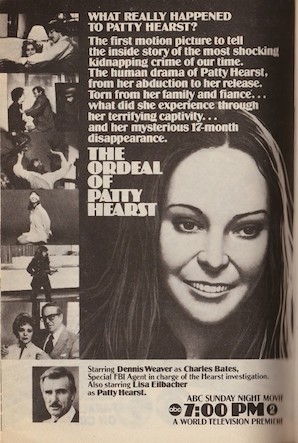
Is the movie based on a true story? Yes. Loosely based. Instead of human relationships though, the film decides to fictionalize a Keystone Cops style chase in ACT III. It’s almost impossible to suspend disbelief in this case. The only thing this film does make me want to do is watch a survey of Patty Hearst movies like the 1979 made for TV classic, “The Ordeal of Patty Hearst.” Or any other kidnap movies for that matter. Taken comes to mind. Maybe Die Hard, since it is Christmas. Or since it’s minus 5 degrees out and more of a heist than kidnap movie, some egg nog and Dog Day Afternoon, you know, just to warm up a little. Like the lives depicted, All the Money in the World certainly left me cold.

The Shape of Water (L)

shapeofwater

When I lived in Hollywood I’d occasionally stop in at a cafe that was frequented by Guillermo del Toro. There were always tales of Guillermo sightings before he would go back to his office across the street. Everyone knew that the great Spanish Director of Pan’s Labyrinth was cooking up something good and The Shape of Water was well worth the suspense.

This morning I was listening to NYC news on internet radio and during the entertainment report just about every other new release for this week was mentioned: Perfect Pitch 3, The Greatest Showman, Jumanji 2 but not The Shape of Water. I think this is mostly because its premise is so absurd on its face that it’s not considered mainstream. Yet the film is inspired by the 1954 classic, Creature from the Black Lagoon. That said, The Shape of Water takes an original spin and is unafraid to deal with aspects of sexuality that society in general feels uncomfortable seeing portrayed on-screen. Not only that, as a period piece from 1961, it calls out segregation and fear of the other — of anyone or even in this case anything that is different.  It’s ironic that The Greatest Showman is about the circus itself and yet The Shape of Water has more in common with Tod Brownings edgy 1932 big top classic Freaks than Jackman’s sanitized vehicle.

With some incredible special effects The Shape if Water is unfettered in its ability to go deep into fantasy, early on paying homage to Dorothy’s ruby slippers and later a full blown black and white Golden Age of Cinema musical number. And like Dorothy, the amphibious creature will do a song and dance here and now but knows that ultimately there is no place like home.

Octavia Spencer, as Zelda D. Fuller, here easily slings the best laugh out loud zingers of 2017. However, as D. noted after the film, her character disappears for a large chunk and then sputters out at the end. Though I will say that the main characters all do have multidimensional lives and concerns. We follow the mute protagonist Elisa’s (an Oscar nomination worthy performance by Sally Hawkins) only friend, Giles (the masterful Richard Jenkins who was incredible in the vampire thriller Let Me In) get rejected from a big illustration gig and then also, in humiliating fashion, from a possible romance. We also follow Dr. Robert Hoffstetler (Michael Stuhlbarg, star of the Coen Bros. A Serious Man), his intrigue with Moscow lackeys and his personal conflict in putting science over politics. Then there is government contractor Strickland, who captured and hates the creature. He wants to eviscerate amphibious man before the scientists even get a chance to fully examine him. Strickland is played by Micheal Shannon in what has to be one of his greatest performances. It. Is. Creepy. Shannon made me squirm and alternately made my stomach turn in every other depraved scene he is in. He makes the audience ask, “Who is the real monster here?” Ironically Strickland wants to kill the one thing that could save him.

Thematically, the film resembles E.T. as a misunderstood being with unimaginable powers is tossed around a lab like a frog in Freshman Bio. Aesthetically, the film draws from Amélie and City of Lost Children with its stylized camera set-ups and movements, oxidized color palette and steampunk sensibility.

The general openness of this film will play much better worldwide than here in the States, where it can’t even make the entertainment section on the radio. However, I think it will become a cult classic and be appreciated when all the other more commercial titles from this week are long gone and forgotten. The Shape of Water gave me chills and may even have opened my mind…just a little.

Star Wars: The Last Jedi (L)

swtlj

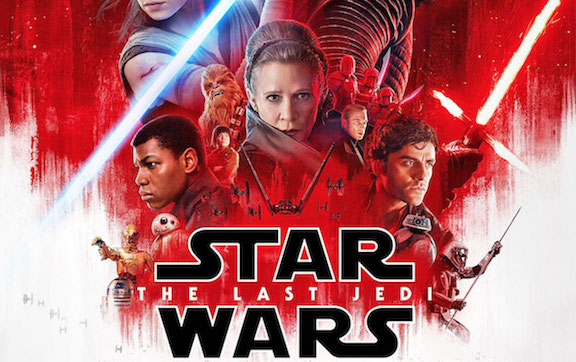
Here at the L & D we put our top picks for 2017 on hold, eagerly awaiting the release of Star Wars: The Last Jedi.  We needn’t have. Last Jedi is a film that is very much in love with itself. And honestly, how can you blame the producers, director or editor. Each shot, a technical marvel. Each set-up, costing the GDP of various small island nations. However, it’s exactly the job of the editor, the director and the producers to make the tough choices that keep a story moving along. If this 2 hour and 33 minute behemoth had been more tightly spun and less concerned with literally looking at itself in the mirror, it would have been a lot stronger. However, with no one there to stop John Williams, the band played on…and on. At one point Mark Hamill (Luke Skywalker) says to Carrie Fisher (Princess Leia) that nothing really dies. The irony escaped no one that she actually was (RIP Carrie). Unless you are a totally enlightened monk, many things can die, including the attention span of the audience. Like so many action films, this one went on at least 20 minutes too long. You could feel it lumbering along, trying to establish relationships for the next episode and getting away from the filmmakers with every drawn-out, self-important gaze.

The biggest stars of the film are these Gremlins type creatures found on Luke’s island. It’s no coincidence Kathleen Kennedy also produced that film is 1984. And like Gremlins, a lot of the action, music and shot selection in Last Jedi feels like it’s directly out of the Spielberg playbook. Spielberg, another Gremlins producer. I almost expected space ships to fly in silhouette across a moon (or several moons since it is Star Wars) with ET perched on a bicycle basket.

All that said, the acting was great, including star Daisy Ridley, John Boyega, Adam Driver and Kelly Marie Tran, with a solid turn by Benicio del Toro. Though as D mentioned, Laura Dern picked the short stick when it came to cool Star Wars characters. The plot itself was strong and original taking some well deserved cracks at arms dealers and also at those who sit on the fence. The Cinematography and special effects were outstanding and I realized I could watch a feature length film of simply Star Wars landscape shots. If you are a fan of this franchise (and by the size of the audience this opening night, who isn’t) this is a must see installment. For everyone else, firing up the original aka A New Hope or The Empire Strikes Back will give you the same thrills and chills.

Women on the Verge of a Nervous Breakdown — Essay

WOTVOANB

Thanks to you film fans, including D!, who came out to the Almodóvar Series opener Women on the Verge of a Nervous Breakdown at the 602 Club here in Appleton, Wisconsin. It was a cool evening paired with another 6 oh 2 event, Noche de Español. We ate well to say the least and even the “despacito” sign wasn’t enough to stop the sangria from spilling. Oh well.

The version of Women on the Verge that I screened was a pristine Criterion Collection copy, a remastered version with wonderful liner notes from Elvira Lindo which I picked up at the equally wonderful Appleton Public Library. They do have a top notch collection that I find difficult to stump, which is saying something. And the APL is also great at digging up more obscure titles for me. Doing research for my little pre-screening spiel I discovered that a lot of early Almodóvar came about from something called La Movida Madrileña. A time after the death of ironclad dictator Francisco Franco’s 40 year rule of dogmatic, machiavellian inspired Roman Catholicism. Franco himself died only in 1975. It shocked me to realize that the rapid societal attitude changes toward individual freedom that have happened in Spain occurred during my lifetime. It made me consider how I take a lot of the freedoms we have here in the West for granted. So what happened in Spain? As I mentioned in my little film intro, people went ballistic with this new found freedom in a kind of non-gendered “Ding-Dong! The Witch is Dead” kind of way. Maybe it’s a similar feeling a first year college student has in the dorms after deciding they are not fit for religious vows of chastity after all—“Sorry mom and dad!…and hey! Stop bogarting the bong!” And it was within this zeitgeist of personal freedom, art, music, fashion and yes filmmaking, La Movida, that the person — the film auteur— we know as Almodóvar was truly born.

We shouldn’t take our freedoms lightly. I don’t necessarily think we do but I think that there is nothing like a threat to shake us from our complacency. One thing I love about film is its ability to illuminate history like this and light us along in our path to being fully human, warts and all and respecting one another. Now if you can do this with bright primary colors, amazingly painted on fake eyelashes and totally barbiturate spiked gazpacho, as in the world of Almodóvar and Women on the Verge of a Nervous Breakdown, better still.

— The next installment in The 602 Club Almodóvar Series is Saturday January 6th, 2017 at 9:PM, when I’ll screen, All About My Mother. Preceded by a Noche de Español event. Save the date and leave room for tapas.

Lady Bird

LadyBirdPoster

A special guest review to the L & D Report by Joanna K. Dane of                           A Terminal Case of Whimsy.

****************************

A few things about Lady Bird.

It passes the Bechdel Test in the opening scene: A middle aged mother and an 18 year old daughter weep to the closing lines of John Steinbeck’s Grapes of Wrath.  They have a moment. Then the daughter turns on the radio and the mother turns it off asking can’t we just have some silence?  Do we always have to be entertaining ourselves?

A sketch that immediately illuminates their relationship.

The daughter insists her mother call her Lady Bird and dreams of moving to New York.

The mother berates that she’ll never get into Columbia, that she has a terrible work ethic, scolding her for leaving her clothes lying on the floor, for being insensitive that her dad just got fired, and that everything they do they do for her.

The father is empathetic and flawed, complexities even in the minor characters.

Lady Bird hams up the audition for the school musical and then is shocked she only gets chorus.

She falls in love with the leading man, a rich kid who breaks her heart, and then loses her virginity to a jaded boy in a rock band who reads Noam Chomsky and Howard Zinn.

There’s the touching scene when the beloved theater teacher cries.  And a hilarious one when the captain of the football team takes over as director.

And in the end, we feel the most empathy for the character who is the most difficult to empathize with.

That’s some great screenwriting.

And it’s an ode to Sacramento.

Murder on the Orient Express

murder on the orient express

For all the reasons I thought Murder on the Orient Express was great you might hate it or at least feel lukewarm about it. This is a tour de force for the star, Producer and Director, Kenneth Branagh. Stellar. But if you hate Kenneth Branagh, or feel lukewarm about him, I would suggest you steer clear. As D pointed out, the other star of the film (he would say the main star) is the train itself.  The Orient Express is brought to life with incredible CGI vistas of Istanbul and the Alps. The cinematography by Haris Zambarloukos leaves nothing to be desired and is as complex as the intricate place settings in the dining car. Ultimately, Branagh and Producer Ridley Scott understand cinematic storytelling and use the adventurous scope of this widescreen epic to their advantage.

The film does not lack in zingers or in unearthing human truths, foibles and frailties. Humanity has a lot to be ashamed of and these traits are most visible when stories of people living in extreme situations are depicted. It’s safe to say that it doesn’t get more bougie than the first class car of the Orient Express in the 1930s.

Strong performances are turned in by Johnny Deep, Michelle Pfeiffer and Daisy Ridley of Star Wars: The Force Awakens fame. The acting here by the entire cast feels alive and organic.

There might well be another reason you might not like this film. Perhaps you feel that the previous versions, for example cinematic genius Director Sidney Lumet’s 1974 version, which was nominated for 6 Oscars, including a win for Best Supporting Actress for Ingrid Bergman, was good enough for you. And that’s valid too. That said, if you’d like to see these particular performers do their thing within the realm of the greatest production value our current cinema has to offer, then I would say go for it, you will enjoy the ride.

Thor: Ragnarock

thor.ragnarock.jpeg

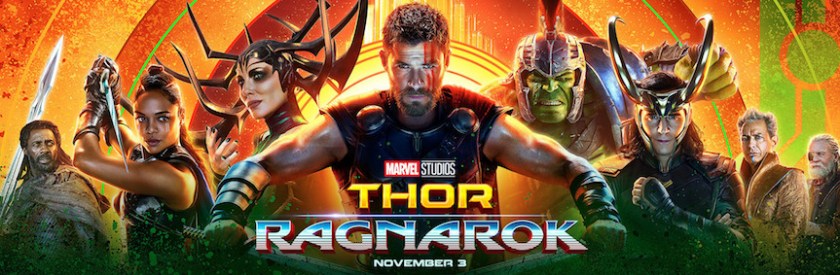
Thor: Ragnarok was a surprisingly enjoyable movie. To its great credit Marvel Studios has enough self-awareness, self-deprecation, humor and zaniness going on for everyone in the audience to let their hair down and have fun. Even though the theme of the film is a heroic one, stating essentially that it’s important to not hide but rather face your problems head on, it doesn’t hurt when part of your problem is a giant digital hieroglyph of psychedelic Gradmaster, Jeff Goldblum.

Also, it’s a Thor movie where Thor loses his anvil permanently in Act I and Stan Lee himself cuts off Thor’s hair. From a storytelling standpoint, it takes courage to knock out two of the main elements that your protagonist is known for and that fans have come to expect.  I could go on but there are enough surprises and bends in the road to keep you laughing and into the story the entire way through. Not only that, when done well like this, a superhero action movie can provoke thoughts of both current events and also antiquity — even in the same scene.

In terms of special effects, it’s mostly nothing you have never seen before (the fire demon Surtor had an uncanny resemblance to Te Kā, the volcanic demon in Moana) but they do serve the story well and never feel gratuitous or overbearing.  A small army of animators and digital artists cooked this film up fantastically.

The stellar cast lives up to its billing, led admirably by Chris Hemsworth and Cate Blanchett with strong performances by Idris Elba, Tessa Thompson, Tom Hiddleston, Mark Ruffalo and Anthony Hopkins among others.

L & D caught this feature in 3D and it worked well for the scope of this epic, with wide shots of colorful cosmic waste dumps and massive water falls. I would just ask that the filmmakers spare us of unnecessarily fast focus pulls unless the joke is you’re into millions of cross-eyed Thor fans vomiting a little in their mouths. But mostly it was cool in 3D, not Blade Runner 2049 cool but cool nevertheless.

There were several times I laughed out loud, often at the expense of the Caligula’s yacht inspired leisure starship of the Grandmaster. It’s hijacked by Thor who finds that its only line of defense is whatever is left from the previous orgy and fireworks.

In the words of The Collector on The Simpsons, “This was definitely one of my favorite super hero genre movies, ever.”

The Foreigner

theforeigner

The most revelatory thing I learned while watching The Foreigner is that Pierce Brosnan can actually act. He really turns in a stellar performance here. In a film whose characters all play the same note, he adds great variation to his. Arguably Brosnan’s character, a presumably reformed IRA chief, Liam Hennessy, is the central figure of this story. In the end it is he who comes to shame and epiphany. Only his character has shifting ideas of right and wrong.

Of course, Executive Producer and star Jackie Chan is why we came. I’m not sure how many times I leaned over to D to mention that he does his own stunts. “See how he lit that photo with the lighter? He actually did that.” I guess I am just a huge Jackie Chan fan. And Jackie, who to me is timeless, does kick some royal, well actually rogue IRA ass.

It took me a while to warm up to the story and to who the bad guys are. Which is good because it does keep you off balance about the antagonists for awhile. There are obvious homages to Taken, Taken 2, Taken 3 and even more to Rambo, in the best way possible. One reason to catch The Foreigner in the theatre as opposed to watching it on TNT next year is that it is shot in widescreen (2.39:1 aspect ratio) and it does take you on a ride with strong aerial footage and intense exterior situations.

There is also a certain gravitas to the film. I made D sit through the credits, as he has made me do during Marvel movies. Jackie Chan movies often have a whole series of the bloopers and goofed up stunts he did in the film on a split screen with the credits. But The Foreigner had no such outtakes. I think that Jackie Chan wanted to measure up to Pierce Brosnan and say, “Hey, I can act too. I can be serious too.”  He did do a fine job in his portrayal of Quan Ngoc Minh, whose heartbreak and capacity for vengeance is boundless.

Battle of the Sexes

battle of the sexes

Battle of the Sexes is a political commentary wrapped in a history lesson holding at its core an entertaining and spellbinding narrative. I figured that Billy Jean King had defeated Bobby Riggs, or why make the movie but I really wasn’t absolutely sure about what happened. Their 1973 match and its buildup are as legendary as Cosell and Ali interviews. Emma Stone as BJK and Steve Carell as Riggs pull off the tennis stars’ volatile on-screen chemistry flawlessly.

The true nemesis in the film turns out not to be the marketing genius and buffoon Bobby Riggs, who by all accounts was a dedicated gambler above all. But rather Margaret Court, who as one of the greatest tennis players ever, was beaten in straight sets by Riggs before BJK stomped him. Court went on to be a Pentecostal Christian minister in her home country of Australia and staunch enemy of the gay, lesbian, bisexual and transgender community.  The film has no qualms grinding that axe and would fit in easily as the Opening or Closing Night film at Outfest or Framline. Speaking of history lessons, Outfest and Framline are two of the premiere LGBT film festivals in the U.S. and have been around for 35 and 40 years respectively.

Battle of the Sexes itself is sensual and fun, well-crafted with great period touches like coin-op TVs in airport lounges and excellent wardrobe and costumes like BJK and Riggs’ glasses and fancy kicks.  The film is helmed deftly by Jonathan Dayton and Valerie Faris (the team that delivered with the classic Little Miss Sunshine). They know how to handle tension and drama. They keep perfect continuity with the period without falling into sappy nostalgia.  The Directors also keep the various storylines with BJKs personal and professional life and Riggs’ own drama with his gambling addiction, problems with his wife — played expertly by the great Elisabeth Shue — and the pressure of his resurgent career as a self-proclaimed male chauvinist pig.  Every time Steve Carell appeared, I laughed out loud. I haven’t appreciated him as much since his brilliant performance in The 40 Year Old Virgin. I thought the casting was spot on except for Fred Armisen who really should be starring in his own films by now. As Riggs’ restrained pill-pushing dealer Fred is unable to unleash his true comic genius. Or perhaps the role would have been more in tune with someone more intense like John Goodman. However, a wonderful turn was made by the great Scottish-American Alan Cumming as Cuthbert ‘Ted’ Tinling, the flamboyant, big hearted and empathetic stylist to the women on the Virginia Slims tour.  One of the best lines is in the last act, right after her victory, Ted turns to BJK and says “Times change. You should know, because you changed them.”

Blade Runner 2049 (L)

blade runner 2049

JUST FYI – POSSIBLE SPOILERS so go see it first if you are worried about SPOILERS.

L & D watched Blade Runner 2049 in 3D. I thought that the epicness (wiktionary: The quality or state of being epic.) of the film merited the 3D treatment and it was handled extremely well. Even what you might normally call a cool shot like a birds eye view from a tree limb was brought to life with the effect. Speaking of epic, the storyline of this film seemed directly out of the Bible, particularly the Old Testament story of Moses, a child who is hidden, adopted by the oppressor and would become the leader of a revolution.

I did enjoy Blade Runner 2049 but if you are not a fan of the original film or are unfamiliar with it, I highly suggest watching that one first. Only a Blade Runner fan, or I suppose anyone with a serious thing for Ryan Gosling (which yeah, is a lot of people but still) could sit happily through so much silent acting. I am certain that if one was to cut out all of the seemingly endless stares and deep thoughts moments at least an hour of this 2 hour and 43 minute behemoth could be cut back. I was disappointed by the lack of action but not as much as in another Gosling snoozer, so-called Drive. To say the pace is plodding would be an insult to turtles everywhere. Worst of all, the philosophical implications of androids and AI have been covered much better in films like Alien: Covenant (not accidentally directed by original Blade Runner Director Ridley Scott), Her and Ex Machina. Even visually, director Villeneuve went into his bag of tricks as the final scene with Harrison Ford putting his hand on a glass wall was an exact copy of the scene in his 2016 sci-fi gem Arrival, when Amy Adams makes contact with the alien heptapods Abbott and Costello. For me, and this was an L & D split decision, Arrival was intellectually stimulating and original. As for 2049, one could argue that as a sequel originality is not the foremost concern but rather being respectful to the first film. I would agree to a point but at the same time, homage and originality should go hand in hand. To ironically steal a line from the political drama NO, Blade Runner 2049 feels like, “A copy of a copy of a copy of a copy of a copy.”

Still, I love this aesthetic so much and my nostalgia for how mind blowing it was in the 80s kept me rapt as I watched 2049. Even over the audible yawns and snores of the few people in the audience.

Yes, I would watch it again. I’m still not convinced, or maybe I don’t want to believe that Deckard is a replicant.